


The new South Clyde Energy Centre due west of the QEUH to get the very most of the pollution into the wards. No comparable hospital in the World faces such threat.

With this massive incinerator, approved by the Labour-run council in 2012, the QEUH will be exposed to even greater threat than it already faces.
By Joe Murray
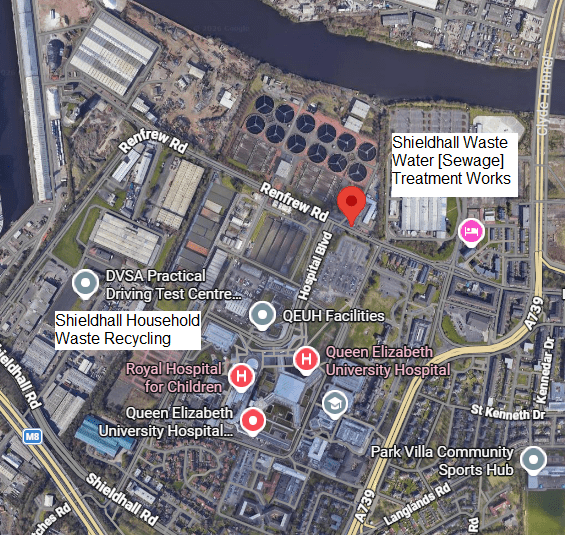
The South Clyde Energy Centre (SCWC) an Energy from Waste (EfW) Incinerator being built at North Cardonald in Glasgow is sited around 500 metres and directly upwind of the Queen Elizabeth University and Sick Children’s Hospitals (or the Southern General as locals stubbornly refer to it still). The QEUH is one of the largest hospital campuses in Europe.
According to the Planning Application for the EfW facility, it will generate electricity from 350,000 tonnes of non-hazardous domestic and commercial waste (municipal waste) left over from the recycling process. It is planned to generate up to 45 MWe gross of lower carbon electricity. This is enough to power the equivalent of around 70,000 homes[1] – minus operation limitations and transmission losses.
I received many of the application documents for this project. However, these documents did not include the Environmental Impact Assessment (EIA) report or the Environmental Impact Statement (EIS). All waste disposal facilities require an EIA. Developers make all sort of claims for their projects; an EIA is a study that puts them to the test. So, for public Health, Safety and Welfare, these are among the most important documents as the study must be carried out to strict rules and regulations
Town and Country Planners are foremost protectors of public Health, Safety and Welfare; that is their job, and yes, economics are a factor here too. Therefore, their decisions must be fair and balanced without endangering public and environmental health in the human, natural and the built environments. Being a Town and Country Planner carries heavy a burden of necessary professionalism and personal responsibility.
It must be said here that the technologies associated with modern incinerators are hugely better than even thirty years ago. Emissions can be very low, but seldom, if ever, are they non-existent. So, the decision to the site this incinerator in Bogmoor Road in North Cardonald is concerning.
Before I go any further, I need to say that I am not anti-incinerator; they have a place in society and can be necessary in meeting important environmental targets (if planned properly). I conducted a Pilot Project for a Materials Recycling Facility (MRF) for GCC over twenty years ago.
Preventing approximately 350,000 tonnes of residual waste going to landfill or being exported outside of the UK each year is, in fact, a good thing and incinerators are, in some cases, a reasonable tool. But, and it’s a big But, where best to site them? 500 metres from one of the largest hospitals in Europe comes out top of the “not a good place to put one” list. Therefore, real questions have to be asked over the decision-making process of the South Clyde Energy Centre and Glasgow City planning Department. The first question might be: did ‘Meaningful Consultation’ take place?
According to the documents I have, only residents of Bogmoor Road adjacent to the proposed site were given a letter in 2012 – the local area is mainly industrial. I live nearby in a highly residential area less than 700 metres from this site and me nor anyone else in the area I have spoken to on this had ever heard anything about it until this huge structure began to appear, 14 years after the initial planning application. There appears to have been no public meetings on this. However, among the documents I was given, was a clip of the Evening Times from 2023 in the planning proposals section. Appearing halfway down the column among around thirty proposals was a reference the South Clyde Energy Centre. It was very benign with no reference to incineration. Personally, I do not read newspapers. If you do, you would need to have read it very carefully and understand the process to realise incineration was a part of the proposed process. I can find no reference as to whether the Board at the QEUH were ever consulted, but as they had already showed a preference for the hospital to be built between two sewage facilities it is not very likely they would have objected. This is my own opinion of course, based on a view that opposition from the hospital board would most likely have halted it. The Project went ahead. So, there appears to have been no public consultation, meaningful or otherwise. If there was, someone who lived close by with my credentials and qualifications would certainly have got involved in the discussions.
It is worth noting that while the documentation reveals that the SCWC is “being built with state-of-the-art technology”, so too, apparently, were Three Mile Island, Chernobyl and Fukushima nuclear plants. Incinerators the world over for decades were “state of the art” facilities, yet they continually poisoned local communities. State of the Art means only “Yesterday”.
SCWC will generate power by using non-recyclable waste as fuel. The combustion process and flue gas cleaning technology is designed to remove harmful emissions to the highest internationally accepted standards.[2] I believe they may be correct, but with no EIA or EIS I cannot say for sure. As for International Standards, people of a certain age will remember when emissions of Sulphur and Nitrogen Oxides from UK power stations were killing off lakes, forests, fish and sea mammals in Scandinavia while Margaret Thatcher waved her papers and thumped her tub, crying: “we were within the agreed guidelines!” Those guidelines did not help the Scandinavians (out of sight, out of mind?). The problem with SCWC is that for any failure in the “Failsafes”; if current International Standards again turn out to be not good enough, then there is a large building full of sick and vulnerable people who are very much in sight and only a few hundred metres away directly downwind of the Plant. The Scottish Environment Protection Agency (SEPA) will monitor emissions. I think they have may committed themselves to some very heavy lifting.
I know I am writing this without sight of the EIS; if SCWC was built on a more open and less populated site, I would have less concerns about the facility. But even without these impact documents there as so many concerns about the siting of it in close proximity to one of the largest hospitals in Europe that planners decisions must be called into question. As I have said previously, planners are usually very professional, they understand the burden they carry of ensuring the health, safety and wellbeing of everyone in the natural and the built environments. So, was there any undue pressure from politicians? Did some planners not understand the severity of possible impacts of such a facility and were simply box ticking? I do not know. What I do know is that any ecologist or environmental engineer worth their salt, regardless of how great the technology is (there are never any guarantees of 100% safety), would have highlighted serious concerns over the siting of the project in North Cardonald. Until I can see these impact studies I can only go with my own knowledge and experience and think that concerns were ignored by Planners and by SEPA, or they were not highlighted at all.
Further to health concerns: these facilities need to be profitable and 350,000 tonnes of municipal waste is a lot. It is more than twice the municipal waste disposal rate of Glasgow as a whole, and it is unlikely to be all nice clean cardboard. It will consist of contaminated paper and board; there is also the likelihood of plastics slipping through; some of these may contain inks, paints and other chemicals and heavy metals; garden wastes that cannot go to landfill or composting can you guarantee any soil residues are not contaminated? The scrubbers will catch most of these, but not all. There will be some most likely invisible and unpleasant emissions. The QEUH and the Children’s hospitals sit right within this facility’s emissions Plume – surely there was Atmospheric Dispersion Modelling done? I must consider here that there was. What did it show? I am pretty sure I know what it would have shown.
Here is an unlikely (but not impossible) scenario. The QEUH in Govan sits close to the river, along the lowest parts of Glasgow. Some years down the line, when the State-of-the-Art technology is wearing thin and emissions, though still on the acceptable side, are increasing from this 24/7 stack. Late January/early February and a thermal inversion descends on Glasgow; centred around the West End and Govan. At 1 o’clock on day one, emissions from our EfW plant are still quite low, but are now held within the trapped air column beneath the inversion. 2 o’clock some more low emissions become trapped, then 3 o’clock, then 4 o’clock and so on. All these low emissions are now accumulating. Thermal inversions can sit for days, and a large building campus with low-lying streets within it become like canyons trapping this increasingly contaminated air. A few yards away over a thousand vulnerable folk are now breathing it in. There are many models for this, but as I said, it is an unlikely, but not impossible scenario. However, it is one that must be considered and someone has to take responsibility for making the decision to dismiss it. I would not have dismissed it. I value people over profit every time. On its own, the SCWC is potentially a good facility, but some folk appear to have chosen a very wrong site for it.
NOTE TO EDITOR: I am not sure I have the figures correct here, I might have missed something. I can’t see ScotGov and SEPA getting their sums wrong. So you can bin the bit that follows if you think I am wrong. While Household and municipal wastes are slightly different, municipal waste is largely made up of household waste with some commercial/retail wastes added. These are usually of the same types of materials. Likely for that reason some use the terms interchangeably, but shouldn’t. Look up municipal waste online and the data thrown up on official sites are very often just termed household waste. I suppose, while I think I’m correct, this is why I am not as confident in my opinion on this waste data. That, plus twenty years away from it all.
Health and welfare problems aside, there are other concerns over such a facility.
Most new incinerators market themselves as ‘energy-from-waste’ (EfW) plants meaning that they can make electricity or produce heat. They are known as Community Heat and Power (CHP) facilities. However, EfW plants are NOT renewable energy power generators. While burning materials from the waste stream produces less carbon than landfilling, 350,000 tonnes of mixed waste, mainly cardboard and paper will produce around 130,000 tonnes of CO2 into the atmosphere, not quite, but similar to, burning other non-renewables.[3]
Friends of the Earth’s ‘Independent Review on the Role of Incineration in the Waste Hierarchy’ found “a risk of long-term overcapacity beginning from 2026 or 2027, if all or most of the incineration capacity in the pipeline is built” and that “given the risks of overcapacity, the Scottish Government should limit the amount of national capacity that is developed [this has since been capped at 2.3 million tonnes and that is the ‘total’ municipal waste in Scotland. We must now ask: are we planning to incinerate ALL municipal waste in Scotland? Is all recycling and landfill to end? JM].
“Overcapacity could mean councils paying incinerator operators for capacity
they do not use. Recycling rates would suffer as useful resources were burnt – in 2023, a Zero Waste Scotland study found that 52% of household waste thrown away could have been recycled [in 2024 SEPA have it at 44%. Is the increased incineration capacity already using recyclables as feedstock? If so, this will substantially increase CO2 emissions JM].
“People across Scotland would be exposed to harmful pollution. There is even the possibility that waste from England could be sent to Scotland to be burned.”[4]
I wonder who will have monitored the content of those loads?
As Friends of the Earth also remind us: “focusing on these EfW plants diverts opportunities away from real renewable energy solutions. By their nature, EfW plants are required burn waste which creates a continuous demand for waste as the feedstock – they simply create ‘more’ waste.”

SEPA: Waste Data for Scotland
Let us look at EfW Capacity in Scotland. SCWC’s 350,000 tonnes of household/municipal waste on top of the almost two million tonnes capacity already logged becomes a difficult amount of feedstock to access in order to run these facilities on a 24/7 basis. A quick look at those EfWs already on-stream shows that many, through restrictions on access to types of waste, already run well under capacity. If you build capacity to burn 350,000 tonnes, you don’t want to be losing money burning 150,000 tonnes.
Through past experience, I already know approximately how much Municipal waste is produced in Scotland, so the ‘capacity’ figures stood out for me. Being away from this stuff for a long time, I did not know how many other EfWs were onstream in Scotland. When I found out, alarm bells got louder. In Zero Waste Scotland’s Technical Report[5], it is shown that by 2025, 1.7 million tonnes of municipal waste should be taken out of landfill, and these figures do not include the capacity of SCWC, we need to look at the figures for this. Because SEPA’s figures[6] show that there are only 2.3 million tonnes in total of municipal waste in the whole of Scotland. Over 1 million tonnes of it is recycled; another million tonnes is removed by various means, including EfW and that only 0.25 million tonnes of this total is landfilled. I feel as if I am missing something here as the figures do not seem to add up. Why is a 2.3 million tonne capacity required to remove the current quarter of a million tonnes from landfill? According to Zero Waste[7], in 2018 the eight operational EfWs had a capacity of 983 tonnes but incinerated only 305,280, equal to 31% of capacity, but is more than going to landfill at present.
As it is, by creating a cap at 2.3 million tonnes that cap matches the ‘total’ municipal waste in Scotland. That being the case, there simply is not enough waste to feed these plants even if we stop all recycling and use that as feedstock. We must now ask: are we planning to incinerate ALL municipal waste in Scotland using ‘recyclable waste’ and waste from other disposal methods as fuel? That does not appear in any Application. Are all recycling and landfill to end? If it does, it would add another half a million tonnes of CO2 to the atmosphere. Where does the consequential increase in CO2 leave Scotland’s Net Zero?
Maybe I have missed something but that’s what the figures say: 2.3 million tonnes total household/municipal waste generated; 2.3 million tonnes capacity required for EfW. What happened to taking only non-hazardous domestic and commercial waste from landfill?
It is over twenty years since I have dealt with or read about these things, so this article has been written by using my experience and what I know. I am happy for any fact to correct any conclusion I may have got wrong or data I missed. However, I would say, even a layperson can see that Bogmoor Road was/is the wrong place to site this EfW facility. A short and swift bit of research also shows the SCWC to be a completely unnecessary piece of technology; one that apparently cannot fulfil its promise. Or maybe SEPA and Zero Waste Scotland’s data is wrong? Or maybe I have missed something?
[1] The South Clyde Energy Centre Application for Planning to GCC
[2] Ibid
[3] Open Environmental Resources, Carbon Footprint Calculator [1. Waste Incineration] https://oer.enviraj.com/online-tools/waste-carbon-footprint-calculator/ (Accessed 13-8-2026)
[4] Briefing Paper on Incineration (2024) https://foe.scot/wp-content/uploads/2024/09/Briefing-on-incineration-Aug-2024.pdf
[5] Technical Report The climate change impacts of burning municipal waste in Scotland, Pratt K; Lenaghan M, Zero Waste Scotland (2021) https://cdn.zerowastescotland.org.uk/managed-downloads/mf-a-fhszvb-1678196543d
[6] SEPA, Waste Data for Scotland, https://informatics.sepa.org.uk/HouseholdWaste/
[7] Loc cit
Discover more from Talking-up Scotland
Subscribe to get the latest posts sent to your email.


The map in this article may confuse some. The new facility is on the other side of the motorway, still close to the hospital. I have queried the wisdom or lack of regarding this. Thank you once more for your accurate information.
Gordon Bickerton
LikeLike
Many thanks for your kind words, Gordon.
Are you sure about the new facility being on the other side. I recently drove past it, not knowing what it was, heading SE and it was to my right.
John
LikeLike
Thank you for providing this information. It’s a lot to digest! but gives insight into the issues surrounding waste disposal. It confirms that some very dodgy decisions are made in siting these facilities. The Aberdeen incinerator was dumped in Torry to add to the fumes breathed in by the council tenants, or those who bought their properties, near what was once green parkland bordering St Fittick’s Bay. Now the bay has disappeared under huge bings to provide a cruise ship terminal and the tall chimney of the incinerator looms over what’s left of the park. Criminal vandalism IMO.
The council has been a Labour/Tory coalition for years to block out the largest group of councillors, the SNP.
LikeLike
Is the Torry incinerator near a large hospital?
LikeLiked by 1 person
No. Luckily, Aberdeen Royal Infirmary is high uphill above the main city surrounded by nice residential areas.
Torry is a traditional fishing area down at the harbour. There are many council tenants and workshops connected with fish curing and timber export, overwhelmed by the oil industry now.
St Fittick’s park and bay was the one expanse of green the locals could use. That’s where the incinerator is sited. It seems to break down frequently. The bay is now buried beneath the cruiser port.
LikeLike
I was involved in the campaign against the Loganswell incinerator in the early 2010s, not least because several schools were in the path of the prevailing winds. I do not have my data from that time to hand but the main protagonist research tactic that I remember was to distinguish between domestic/municipal waste incineration and industrial waste incineration with (again from memory) clear evidence of harm to humans in the path of an industrial waste incinerator, but more nuanced outcomes from purely household/municipal waste incineration. And quoting carefully and selectively thereafter. I would defer to Joe Murray (and his excellent recent contributions) regarding the reality of the true combustion mix and simply point out this recent Australian systematic review of waste incineration: https://www.sciencedirect.com/science/article/pii/S132602002300732X which concluded: “A range of adverse health effects were identified, including significant associations with some neoplasia, congenital anomalies, infant death and miscarriage, but not for other diseases.” And, again if I remember correctly, the planning application for this incinerator was based on a long preceding planning application which had lain dormant (again defer to Joe Murray). Finally, again without facts to hand, I recollect the matter of a shortfall in available municipal waste for the proposed Loganswell incinerator being supplemented by potentially more overtly hazardous incineration material being left rather vague. It is instructive to ‘skiptrace’ the proponents of these incinerators purely to determine if their families are subject to similar encumbrances. And yes, you know the answer!
LikeLiked by 2 people