

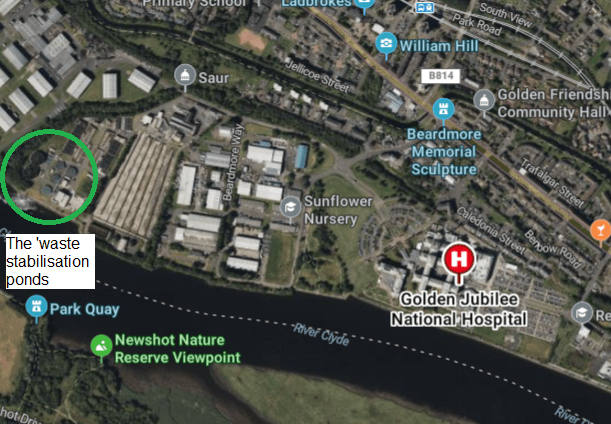
Thanks to derekscott1953 for alerting us to this:
As Joe Murray pointed out on an earlier version of this topic, the NHS Golden Jubilee University National Hospital in Clydebank was built in 1994 as a private facility by US firm, Health Care International, for £180 million. Located on the north bank of the River Clyde in the Dalmuir area, it sits along the waterfront near local industrial and utility infrastructure, including the regional wastewater treatment works for West Dunbartonshire and North West Glasgow.
At the time, the Labour leaders either as thick as the stuff in the ‘waste stabilisation ponds’ or caring little for their locals, were Tony Worthington (Labour MP for Clydebank and Milngavie) and Provost Patrick (Pat) O’Neill (Clydebank District Council leader/civic head).
Was there debate, any mention even in media, of the nearby upwind sewage treatment plant?
No evidence of any debate or media mention of the nearby Dalmuir Wastewater Treatment Works (WWTW) in connection with the planning, construction, or opening of the HCI/Golden Jubilee hospital in the late 1980s–1990s could be found online.
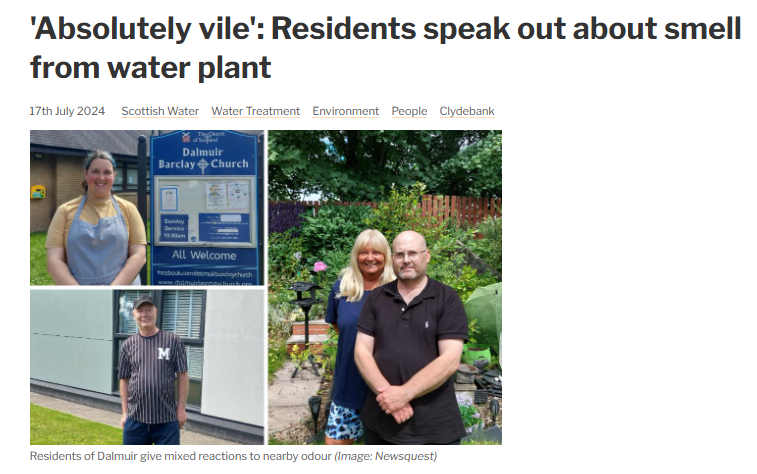
Odour complaints about the Dalmuir plant (“Dalmuir smell”) are well documented in later decades (especially after the major secondary-treatment and capacity upgrades around 2001–2003 and subsequent investments), with local residents, council involvement, and media coverage in the 2000s–2020s. These post-date the HCI hospital’s planning and opening and are not linked back to it in available sources.
Just how downwind of the raw sewage treatment is the hospital?
See this:

Less than 800m away, further than QEUH is from sewage, but ‘getting it‘ almost every day.
Getting what?
A substantial body of research documents that wastewater treatment plants (WWTPs / sewage works) emit bioaerosols containing bacteria, fungi, viruses, endotoxins, and opportunistic pathogens, and that these can pose health risks—especially via inhalation. Opportunistic pathogens (e.g., certain Aspergillus species that can cause invasive fungal disease, or antibiotic-resistant bacteria associated with healthcare infections) pose greater threats to immunocompromised individuals, those with chronic lung disease, or other high-risk groups. Fungal particles of respirable size are noted as capable of reaching the lower airways and causing infection in susceptible hosts. https://pmc.ncbi.nlm.nih.gov/articles/PMC11934199/
This is the second Scottish hospital built next to and downwind of, a sewage treatment plant, reported here.
Are there any other similar cases, in the UK? No. In Europe? No. The World? No. It seems to be a uniquely Scottish Labour council thing. God knows why. If you do too, meet me and hand me it in a plain brown envelope.
Footnote - Yes I see the sunflower nursery. I'm not taking the p here but it seems that human 'waste' - urine and the other - is regularly used to fertilise sunflowers - https://www.sciencedirect.com/science/article/abs/pii/S0929139322001913
Discover more from Talking-up Scotland
Subscribe to get the latest posts sent to your email.


You wouldn’t want to spend too much time at the Nature Reserve Viewpoint either.
Something smells “fishy” about this pure coincidence of Labour Council decisions. Keep digging!
LikeLiked by 1 person
BBC very quick to apologize to English viewers but not us when we complain.
The BBC has decided to apologise after English viewers complained they couldn’t understand Scottish weather presenter Judith Ralston
LikeLike
You can find some (only some!) of the story on Wikipedia. https://en.wikipedia.org/wiki/Golden_Jubilee_University_National_Hospital Remember that the entire scenario was a twice failed private venture, both hospital and hotel being for wealthy overseas private clients (not NHS plebs) on the former site of a major shipyard turned ROF Dalmuir. The NHS ultimately purchased the hospital and, I think, the hotel (haven’t double checked) but at a huge discount to the original cost (a true rarity for the NHS or government!). The sewage works are 0.75km west of the hospital (i.e. not sharing a boundary as with QEUH) and their story is even more mysterious. The plant dates from 1904 originally and in recent decades has been run by a company called Saur Ltd (still labelled as such in the above photo) under some kind of PFI arrangement involving other companies such as ‘Scotia Water’ and ‘Equitix’ with Scottish Water having oversight prior to the entire works returning to them recently presumably because the PFI contract has ended. Much more work to be done here to ascertain what Scottish Water has been up to over the years with its ‘private-public’ partnerships. As a lead orthopaedic surgeon (NHS – maybe now retired) at the former ‘National Waiting Times Centre’ by the name of Mr Picard might say: “Make it so”!
LikeLiked by 2 people
I think the hotel and hospital are all one complex. I stayed in the hotel part when my husband was in hospital for an operation. It was very nice and all paid for by SNHS. Much easier for those of us living in other parts of Scotland while the health service was developing “centres of excellence” which means travel. Saved on ambulance journeys too if a relative can transport patients.
I had no idea there was a water treatment works nearby.
LikeLiked by 1 person
The site was badly contaminated with asbestos, and a lot of public money was spent in “decontaminating” it. Cannot remember the exact cost, but I’m sure it was in the millions.
LikeLike
Talking of Labour, or rather the now reinstated Labour MP Joani Reid.
Well I saw this online via an account called ‘Hands around Scotland’ and I had to laugh:
“Joanie Reid can think herself lucky it was a Nuclear Submarine Captain she was allegedly frolicking with and not the Captain of a CalMac Ferry. Then it would have been all over the F****** news 24/7“.
Indeed it would have been.
Though we still await the conclusion of the investigation into her spouse on his alleged spying activities where she stated:
“I have never seen anything to make me suspect my husband has broken any law”.
Meanwhile people in Joani’s Labour party think that Nicola Sturgeon “should have seen something to make her suspect her husband had broken the law” .
Rules for Labour and then distinctly far different rules for the SNP politicians. (apparently, according to Labour politicians).
Joanie Reid (whose husband’s surname is Taylor) wrote this about Nicola Sturgeon in the Daily Record in 2025:
“Her legacy will be one of grand rhetoric, little delivery and the promotion of a crank gender ideology.”
“promotion of a crank gender ideology.” ?
Same promotion of “gender ideology” voted for by Labour MSP’s in the Holyrood parliament and indeed some within Labour HQ also support this “ideology”. So what’s her point other than deflection and also her tiresome , repetitive and obsessive #SNPBAD rhetoric.
“little delivery” ?
What has Reid delivered since becoming an MP other than talking down Scotland , being seen and heard to support and vote for many of Labour HQ’s cruel and bad UK policies as a new (Blue) UK government and also her being named in an alleged nautical scandal and allegedly found to be in a state that some people claimed saw her allegedly the worse for wear i.e. allegedly intoxicated.
“grand rhetoric”
As opposed to Joani Reid’s ‘nasty and spiteful rhetoric’ , I mean as a politician wee Joani (who I suspect tactically chose to use her popular grandfather’s surname) is not in the same league as NS. I mean Reid was only elected as an MP in 2024 and already she has been linked to two alleged scandals.
This moral high horse that many within Labour assume that they can constantly sit upon , as they cast their judgement and condemnation upon others, while they themselves are hardly those immune from Labour party scandals, fiascos and controversies are they.
So many Labour politicians really are so sickeningly self righteous and way way too smug to the point of then coming across as being extremely duplicitous and so then totally untrustworthy. (the forked tongues party).
Allegedly all the (not so nice) girls love a Sailor (that is the senior Sailors and not the lower ranks , aye aye Captain).
Liz S
LikeLiked by 2 people
Re: ROF Dalmuir being contaminated with asbestos: Yep, probably a bigger risk than the sewage works! Same at former ROF Bishopton. Now the huge Dargavel housing estate. Where Renfrewshire Council can’t even calculate how many school places will be required. Where the site is ‘decontaminated’ in batches so the new house buyers of each batch could potentially be exposed to the ‘decontamination’ of the next batch. And there is still a weapons testing facility there, even if BAE Systems call it an ‘environmental test facility’ FFS. From the days when The Herald did decent reporting: https://www.heraldscotland.com/news/12693353.150000-fine-follows-workers-death-at-royal-ordnance-factory/ & https://www.heraldscotland.com/news/12009805.labour-at-one-with-tories-and-snp/ & https://www.heraldscotland.com/news/12006771.bishopton-what-the-experts-did-not-see-pictures-reveal-toxic-lagoons-away-from-prying-eyes/ & https://www.heraldscotland.com/news/12009854.costs-of-closure-at-bishopton/ & https://www.28dayslater.co.uk/threads/royal-ordnance-factory-bishopton-near-glasgow-early-2009.40287/ & https://www.baesystems.com/en/product/bishopton-environmental-test-facility
We are all, wealthy and poor alike, being mocked and degraded and the powers-that-be (whoever they are) simply don’t give a monkey’s
LikeLike