

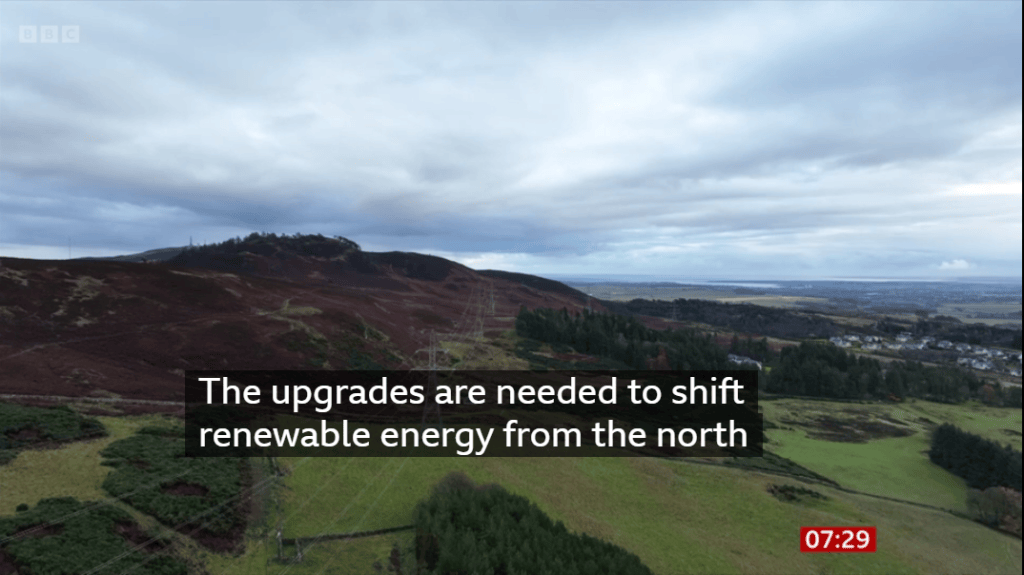
to where it is consumed, mainly Central Scotland and England.
BBC Scotland’s insert into BBC Breakfast makes the above explicit claim that new pylons and infrastructure are needed to ‘shift’ energy from the north to central Scotland.
Notably the full BBC Scotland report online does not make the above claim. Another Reporting Scotland special? https://www.bbc.co.uk/news/articles/c8rn42jp7d6o
Is the claim, additional to their full online report, true? No. Why? In Scotland:
Electricity consumption has declined substantially over the past two decades. Total consumption in Scotland was 21.7 TWh in 2024 — down 26.6% from the 2005–2007 baseline average of 29.3 TWh. Domestic use fell about 29% and non-domestic about 25% over that period. There was a further small drop (0.5%) from 2023 to 2024, driven mainly by the non-domestic sector (domestic rose slightly year-on-year). https://www.gov.scot/publications/energy-statistics-for-scotland-q3-2025/pages/electricity-consumption/
Energy efficiency improvements in the housing stock have contributed. Newer homes are more efficient on average, insulation and other measures reduce heat loss, and overall energy intensity (kWh per household) has fallen. Scottish House Condition Survey data shows gradual improvement in average Energy Efficiency Ratings and a higher share of homes reaching better EPC bands. New-build standards continue to tighten this further. https://www.gov.scot/publications/scottish-house-condition-survey-2024-key-findings/pages/2-energy-efficiency/
These factors support the observation that, all else equal, better housing and efficiency should put downward pressure on demand.
Is the new infrastructure in Scotland not primarily required to transmit electricity across the border and into England?
Yes. The new and upgraded high-voltage transmission infrastructure in Scotland (new pylons, higher-capacity overhead lines, substations, and related works) is primarily required to transmit surplus electricity across the border into England and the wider Great Britain system.
Why this is the main driver:
- Scotland generates far more electricity than it consumes and is a consistent net exporter (net exports of 20.8 TWh in 2025 alone). Generation capacity—especially from onshore and offshore wind—is projected to grow much faster than local demand. https://www.gov.scot/publications/energy-statistics-for-scotland-q4-2025/
- Official assessments (NESO Electricity Ten Year Statement and boundary analysis) state that generation capacity in Scotland heavily exceeds demand, so the country is expected to export power into England most of the time. Rapid growth in Scottish renewables (particularly offshore wind) creates “far greater power transfer requirements across the Scottish boundaries.” https://neso.energy/publications/electricity-ten-year-statement-etys/electricity-transmission-network-requirements/scottish-boundaries
- The critical bottleneck is the Scotland–England boundary (B6) and related internal Scottish boundaries that feed into it. Projected north-to-south flows significantly exceed existing capacity under all Future Energy Scenarios. Reinforcements are explicitly sized to increase this transfer capability, reduce constraint costs (paying Scottish wind farms to switch off while gas plant runs further south), and move power to higher-demand areas in England. https://www.neso.energy/publications/electricity-ten-year-statement-etys/electricity-transmission-network-requirements/scottish-boundaries
Major projects—such as Eastern Green Links (subsea HVDC from northern Scotland to England), onshore 400 kV reinforcements, Cross Border Connection works, and capacity upgrades through central/southern Scotland—are repeatedly described by operators (SSEN Transmission, SP Energy Networks) and NESO as enabling the bulk transfer of Scottish renewable generation southwards. https://www.heraldscotland.com/news/25062599.great-scots-green-energy-upgrade-carve-up/
Discover more from Talking-up Scotland
Subscribe to get the latest posts sent to your email.
 Talking-up Scotland
Also – with our much higher energy costs we are paying for the privilege of giving away our energy as Westminster blocks our capacity to build our own turbines in Ardersier because of China, and Grangemouth is closed losing its diesel and jet fuel refining that is now soaring in price on the world market because of the war in the Middle East in which Westminster colludes and sanctioning of Russian oil and gas – ditto. What strategic geniuses we have ruling over us.
LikeLiked by 2 people
The “benefits” of being a colony.
We pay to produce, then pay to transmit, electricity to the country which controls Scotland. A situation we cannot democratically escape.
We have no media which highlights this iniquity. Indeed we are directly lied to over this issue.
We have no politicians which fight for energy justice for Scots.
I know the answer, but cannot say it.
gavinochiltree
LikeLiked by 2 people
“The new and upgraded high-voltage transmission infrastructure in Scotland (new pylons, higher-capacity overhead lines, substations, and related works) is primarily required to transmit surplus electricity across the border into England and the wider Great Britain system”
Yes indeed, but it’s not just electricity as the BBC website has this article, dated 11 August 2026, on their website on the Scottish Politics page:
“What is happening with the Rosebank and Jackdaw oil and gas fields”?
Included within this BBC article are the below statements of how, once again , the UK/Britain are again reliant on assets/resources sourced from Scotland , that are , as assets/resources , not just for Scotland’s benefit but yet again are for the ‘whole’ of the UK/Britain’s benefit.(‘whole’ as in allegedly).
“Industry bodies argue that starting production at the sites will provide jobs and improve the UK’s energy security as overseas conflicts threaten supply”.
“Jackdaw, which is about 150 miles east of Aberdeen, is a gas field which its operators say could be connected to the UK network within months”
“Rosebank, about 80 miles north-west of Shetland, is Britain’s largest untapped oil field, which would also produce some gas”.
The BBC article then has the audacity to mention “cheaper energy bills for people in the UK” (while knowing that Scots, via another energy source, as in electricity, have standing charges that are among the highest in Britain).
“If approved, Rosebank is expected to fill up to 500m barrels of oil over its 25-year lifetime. But that increased supply does not necessarily guarantee cheaper energy bills for people in the UK“.
To then add further salt onto the wound the BBC article then states:
“Most of the oil produced from Rosebank would be sent to the Netherlands because the UK’s remaining refineries are not equipped to process the heavier type of crude oil extracted from the North Sea“.
What no Oil refinery in Scotland , as in no jobs for ‘North’ Brits ?
Ah no , as Grangemouth Oil refinery is no more. (via yet another broken Labour promise and betrayal).
Of course as yet UK PM Burnham and his UK government have not yet confirmed their final decision upon whether to agree to these two new fields , however Labour had previously “promised not to issue new oil and gas licences while honouring existing ones”.
(Yes I do know that a Labour “promise” means absolutely nothing , as they are now infamous for their succession of U Turns and betrayals).
Also if they do give the go ahead – as in give the (not so) Green light for these two fields to proceed, then that will be yet another nail in the coffin for the fake Labour GB Energy project, that so far , has failed to generate the ‘promised’ amount of jobs and also failed to be a direct ‘energy producer’ that Labour had initially promised us that it would be.
I read this online that:
“Great British Energy (GB Energy) has so far fallen short of functioning as a major standalone commercial energy producer or immediately lowering household utility bills. Critics and analysts note that its initial £8.3 billion funding allocation is far lower than early promises, and it does not operate as a full hands-on energy company employing large-scale local engineering workforces”.
The Guardian , in July 2026 , asked:
“What’s holding back Britain’s Green revolution” ?
My answer – Could it be the Labour party ?
Especially now if we do see the new UK PM Burnham and his UK Labour government approving Rosebank & Jackdaw, then that might go a long way to holding back the supposed ‘Green’ revolution even further (a “Green revolution” as promised by Labour in their 2024 GE campaign).
Now we hear dubious sources cry out “Drill baby drill” and also about “getting every last drop” ( of Oil) .
These statements were most certainly not what was being said to Scotland in 2014 – as instead Scotland was told that there was not that much more (oil) to “drill” and also that we were very near the “last drops” of oil , as apparently oil was running out . (for Scotland if it became independent).
(The BBC even posted a comment on Twitter that stated that an “expert said Oil would run out in five years” as in from 2014 – so run out in 2019).
So during the campaign for Independence in 2014 there was apparently no financial nor economic benefits from Oil for an independent Scotland.
However post the 2014 Independence referendum it seems that has now all changed , so now oil , as a resource, is to be regarded as an ongoing asset “for decades” but only for the UK State .
Where apparently now there is still an abundance of oil that would boost UK national energy security, provide jobs in the UK and also avoid the UK State from relying upon foreign imports.
Since 2014 I wonder how much the UK Exchequer has received via a cumulative total of net fiscal revenues from North Sea oil and gas production ?
As in- #NotYouScotland (again).
Of course our increased capacity and potential in renewable energy within Scotland is being ducked up by a succession of various UK governments, that is until such a time when it is needed by their UK State, then that will be yet another Scottish resource that they, UK governments, will try to exploit for the benefit of the whole UK.
(Though I think I know which nation within the UK will be given priority and preference to – clue not Scotland, Wales nor NI).
Of Course the BBC are now producing articles like the above noted article on these two new fields for Oil and Gas , with absolutely no shame that they, as a British news corporation , were very much at the forefront of promoting fake news on behalf of the No side in 2014, especially about Oil in the North sea for a potential future independent Scotland.
That’s why their audience here in Scotland (and elsewhere within the UK) has diminished so much , as they are regarded as being Masters at promoting and so communicating propaganda and fake news.
Liz S
LikeLiked by 3 people