

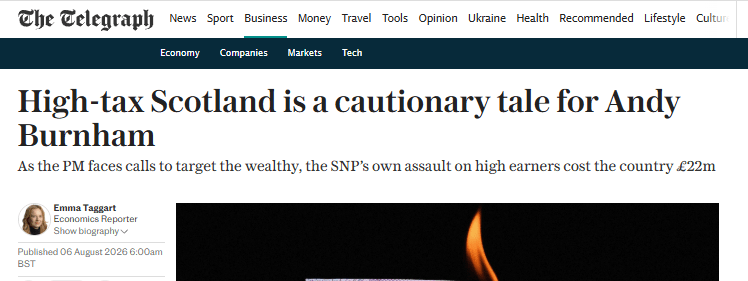
The Telegraph today repeating the already discredited claim above from ‘tax expert’ Dan Neidle.
I’ll leave you to read the detailed, complex for me, but very persuasive, rebuttal by Laurie Macfarlane at: https://www.futureeconomy.scot/posts/587-has-scotland-s-48-tax-rate-really-reduced-public-revenue or watch his excellent explanation at: https://www.youtube.com/shorts/GfSEQfKPNsA
There’s a simpler, easier to get, point made here by rptscott – the £22m is just a ’rounding error.‘
In practical terms, a £22 million figure is effectively a rounding error relative to the scale of Scotland’s public finances.
Here is the context that makes this clear:
- Scotland’s total income tax receipts in 2024-25 were approximately £18.6 billion.
- The overall Scottish Budget is in the region of £50–60 billion.
- £22 million represents roughly 0.12% of income-tax revenue and well under 0.05% of the total Budget.
Even the Scottish Fiscal Commission’s original static estimate for the 1p top-rate rise (£53 million) and its behaviour-adjusted figure (£8 million) were already described by analysts and commentators as trivial or “rounding-error” territory. Dan Neidle himself (the source of the £22m estimate) repeatedly notes that the sums involved are tiny against the overall tax take. Critics of his analysis make the same point.
Also, there’s something far more important because it’s monstrous and so not a rounding error. This:
From How Andy Burnham could raise £15bn – without a tax rise, published 1 July 2026:
It’s the UK’s biggest and least discussed tax problem. There’s between £30bn and £48bn missing from each year’s small business tax bills. It’s been getting worse – and nobody knows why.
There’s no other issue where so much money is at stake but so little time is spent discussing it. It’s almost never mentioned by politicians, and HMRC devotes very limited resources to it. HMRC’s random audit programme checks only 330 small companies each year.
HMRC made spectacular progress on the large business corporation tax gap in the 2000s. If they made the same progress on the small business corporation tax gap, it would raise around £15bn. That revenue could be used to reduce the main rate of corporation tax down to 21%, benefiting all businesses. Or it could cover, for example, a major expansion in defence spending. And corporation tax is only part of the small business tax gap.
Full text at: https://taxpolicy.org.uk/2026/07/01/andy-burnham-tax-gap-15bn/
For a short video explaining it, try this: https://talkingupscotlandtwo.com/2026/07/30/the-supposed-22m-snp-tax-blunder-is-not-true-but-labours-48-billion-tax-avoidance-scandal-is/
Discover more from Talking-up Scotland
Subscribe to get the latest posts sent to your email.


Yet again another lying English HACK
TWISTING THE TRUTH TO SUIT HIS POLITICAL BENEFIT
LikeLike