

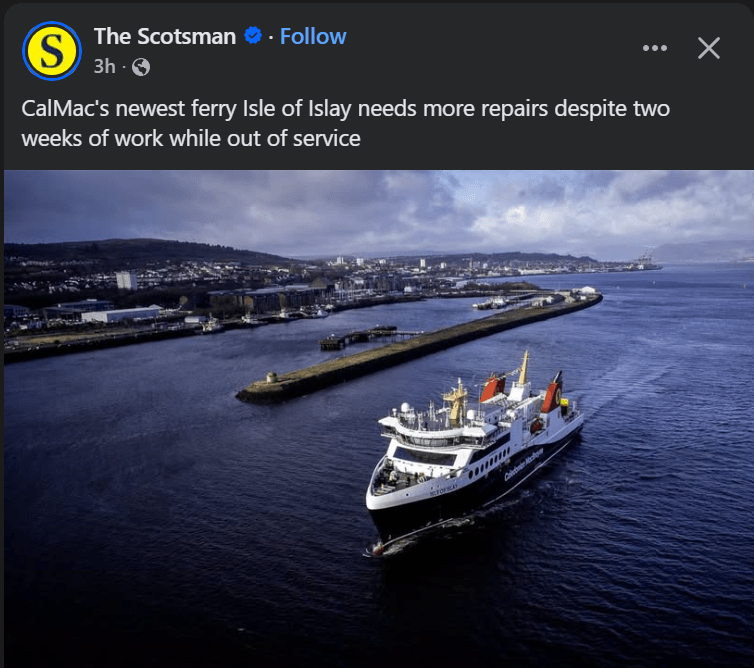
Perhaps thinking that any bad news on CalMac ferries serves the same purpose, to damage the reputation of the SNP Government, the Scotsman serves ours well – to make a case for the Cyde.
From BBC Scotland 1 July 2026:
CalMac’s newest ship – the Turkish-built MV Isle of Islay – is to be withdrawn from service for repairs later this month, just 15 weeks after carrying its first passengers.
The roll-on roll-off ferry entered service on 31 March, but six weeks later a hinge problem with its bow doors meant it has had to operate “single ended” ever since.
The issue is understood to be the only “big ticket” item out of about 150 lesser problems that CalMac wants fixed under warranty. Separately, Scotland’s state-owned ferries body is trying to establish if three other CalMac ships being built at the Cemre shipyard will be further delayed because the firm is facing economic challenges.
The second ship in the order, MV Loch Indaal, was due about now, nearly 18 months later than the contracted delivery date, but Caledonian Maritime Assets Ltd (CMAL) could only confirm that the ship is still expected this year.
A spokesperson said: “CMAL is working at pace with Cemre Shipyard, Transport Scotland and CalMac to confirm a full project timeline.” https://www.bbc.co.uk/news/articles/ckg8ljvllleo
You see what is going to happen here – 5 run-of-the-mill boats that could easily have been built on the Clyde are going to have to be finished off and sorted-out, at great expense, somewhere else. They should all be towed to the Clyde and the money that might have been spent elsewhere with little guarantee of success, used to expand the nationalised yard.
The full story:
From the UK Defence Journal 26 June 2026, indicating the kind of broader definition of national security, we hear more of today:
Caledonian Maritime Assets Limited has taken ownership of the three remaining vessels under construction at the Cemre Shipyard in Turkey as a precautionary measure to support their completion and delivery, the publicly-owned ferry operator stated.
The three ships, MV Loch Indaal, MV Lochmor and MV Claymore, are now assets owned by CMAL ahead of their formal handover. According to the organisation, the decision has been taken against the backdrop of what it described as exceptionally challenging economic circumstances affecting Cemre and many businesses across the region, with global economic pressures including the impacts of the conflicts in Ukraine and Iran, together with disruption to shipping in the Red Sea, all contributing to the situation. By transferring ownership of the vessels ahead of formal handover, CMAL has said it is acting to protect the project and to ensure the continued delivery of much-needed ferries for Scotland’s island communities. https://ukdefencejournal.org.uk/cmal-takes-early-ownership-of-three-calmac-ferries/
These are straightforward vessels of the kind Clyde shipyards have historically delivered on time. The so-called ‘ferry fiasco’ beloved of the MSM operating in Scotland is entirely a consequence of first-time projects to build hybrid dual fuel vessels.
Scottish yards have a long history with complex vessels (including naval and offshore work). The Ferguson experience shows what happens when capability has atrophied after limited recent large commercial ferry work, combined with ambitious specs. With the yard now state-owned, a stable pipeline (recent direct awards for four vessels announced in 2026), and lessons learned, future performance on less pioneering projects could improve markedly. Supporting domestic capacity builds resilience and skills for exactly these kinds of challenging builds.
‘Turkish Delay’ – Costs and timescales could worsen further for these three ferries (MV Loch Indaal, MV Lochmor, and MV Claymore).
Why?
Regional and Turkish economic instability shows little sign of quick resolution:
- Ongoing fallout from conflicts (Iran-related tensions, Red Sea/Hormuz disruptions, Ukraine spillover) continues to drive high energy prices, freight/insurance costs, supply chain volatility, and inflation.
- Turkey’s broader economy faces lira pressure, higher import costs (energy/raw materials), and tighter financial conditions, which strain private yards on fixed-price legacy contracts.
- Near-complete vessels still need components, labour, testing, certification, and outfitting. Persistent issues could slow suppliers, raise input costs, or reduce yard efficiency (e.g., cash flow problems affecting workforce or subcontractors).
If instability persists or escalates, this could translate into:
- Additional months-to years of slippage, especially for Lochmor and Claymore. CMAL would likely need to finance or arrange completion, potentially moving unfinished work elsewhere.
- Extra overruns borne by CMAL/Taxpayers, beyond the original contracts, which are now effectively paid in full via early ownership. This could include higher finishing/commissioning expenses, transport/logistics if vessels are moved, or incentives to keep the yard viable.
If instability persists into 2027 as seems certain, cumulative effects could push timelines out further and add meaningful costs with potentially millions more per vessel.
Discover more from Talking-up Scotland
Subscribe to get the latest posts sent to your email.

