

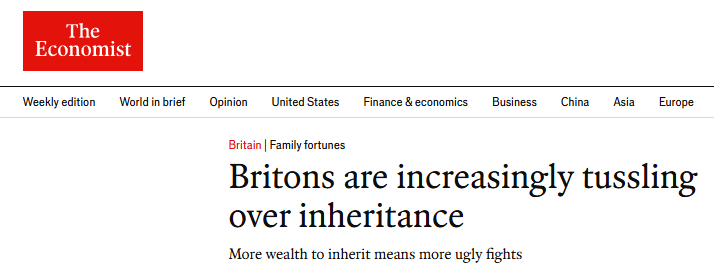
In The Economist, this week, the above, and:
When there’s a will, there’s a war. Or so they say in the courts of England and Wales, which are growing busier with fights over the dead’s estates. The number of probate claims listed at the High Court has grown by over 400% over the past decade, according to Solomonic, a legal-analytics company.
https://www.economist.com/britain/2026/07/23/britons-are-increasingly-tussling-over-inheritance
If you’re a regular here, you will have spotted the problem above with ‘Britons’ and ‘England and Wales.’ Not for the first time, Scotland has been disappeared.
Reader Derek Scott alerted us yesterday to this and noted:
An article in the current issue of The Economist reminds me that Scotland, like most of the rest of Europe, has a “forced heirship” system. Under Scots Law, you cannot completely disinherit a spouse, civil partner, or children because they hold automatic “legal rights” to a share of your moveable estate.
In England, Wales, and Northern Ireland, however, complete testamentary freedom exists, though dependants can challenge a will in court. In other words, they can disinherit anyone they wish. I think I know which legal system I prefer to live under.
Indeed, so how does the system in Scotland compare?
Scotland’s succession (inheritance) system differs significantly from that of England and Wales, particularly in limiting testamentary freedom through automatic “legal rights” (a form of forced heirship).
Testamentary freedom vs. legal rights:
In England and Wales, people generally have broad freedom to leave assets as they wish in a will (subject to claims under the Inheritance (Provision for Family and Dependants) Act 1975 by spouses, children, cohabitants, or dependants who were not reasonably provided for). Courts decide these discretionary claims.
In Scotland, spouses/civil partners and children (including adult children; adopted children count as children) have automatic legal rights to a fixed share of the net moveable estate (cash, investments, personal belongings, etc.—not land or buildings/“heritable” property). These cannot be overridden by a will. Approximate shares:
- Spouse/civil partner + children: spouse gets ⅓, children collectively get ⅓ of net moveables.
- Spouse only: ½.
- Children only: ½ (split among them).
Claimants who take legal rights typically forgo other provisions in the will. This reduces the ability to fully disinherit close family and can force liquidity issues or sales if assets are illiquid, but it also provides clearer entitlements that may avoid some purely discretionary court battles. https://www.andersonstrathern.co.uk/insights/private-client-law-key-differences-between-scotland-england/
Intestacy (no will):
Both systems prioritise spouses and children, but details differ. Scotland uses “prior rights” for a surviving spouse/civil partner (rights to the dwelling house up to a value limit, furniture, and a cash sum) plus legal rights, then the free estate follows a fixed order. England and Wales use a statutory legacy (around £322,000 in recent figures) plus personal chattels and a share of the residue. Cohabitants have stronger (though still limited and time-bound) application rights in Scottish intestacy than under English intestacy rules. https://willsafe.org.uk/blog/intestacy-rules-scotland-uk
Discover more from Talking-up Scotland
Subscribe to get the latest posts sent to your email.


Someone should write to complain and ask for an editorial correction re Briton comment. The Economist one would have thought should have known better
LikeLiked by 1 person
I have given feedback to The Economist, although they no longer accept comments on individual posts. It’s either a letter to the Editor, which won’t get published, or nothing.
The paper copy of the magazine uses a more appropriate heading of “Family Fortunes”. The word “Britons” only appears on web versions as it’s taken from
the “Britain” section of the weekly magazine.
When you read that one of The Economist’s short-form political newsletters is called “Blighty”, I think you get further sense of their Anglo-centrism.
Although it’s possible that Scots soldiers in WW1 adopted the same expression too?
Blighty is adapted from the Urdu word bilayati (meaning foreign or British India’s term for home/Britain), adopted by troops on active service there.
The Economist’s comments on Scottish politics are without exception written from
a pro-Union standpoint btw.
LikeLike
‘Blighty is adapted from the Urdu word bilayati (meaning foreign or British India’s term for home/Britain), adopted by troops on active service there.’
Thanks, I like that stuff as I sit in my bungalow in khaki slacks. Pukka!
LikeLiked by 1 person