

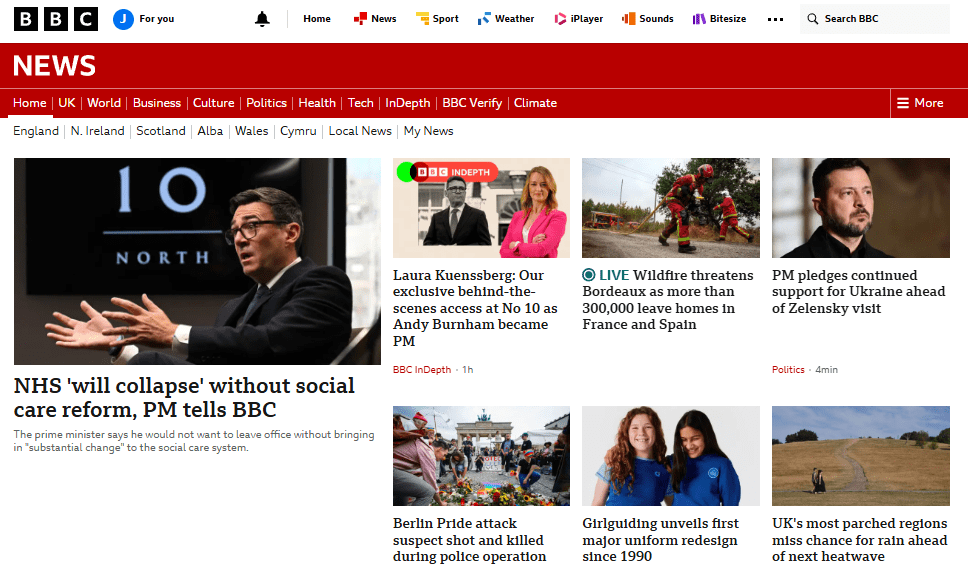
As the new PM is pressed on England’s failing social care system, we sometimes hear, not on BBC Scotland of course, that though still challenged, Scotland system after nearly 20 years of centre-left government by the SNP is well ahead.
What’s the evidence? What has the SNP done differently?
In Scotland, there is free personal care for all adults assessed as needing it. This was introduced for over-65s in 2002 and extended to working-age adults in 2019. This covers help with personal hygiene, continence, diet, mobility, and simple treatments, whether at home or in a care home. The upper threshold for residential care funding is £35,000.
In England, social care is fully means-tested and the upper capital limit is only £23,250. There is no state help above this level. There is no free personal care. A planned lifetime care cost cap was repeatedly delayed and has been effectively scrapped.
Scotland spends substantially more per person on adult social care, around 36% higher than in England. This supports the free personal care policy and contributes to higher rates of state-funded recipients, especially for home care among older people. https://ifs.org.uk/publications/public-service-spending-and-performance-scotland
Analysis by the Nuffield Trust shows Scotland has higher rates of state-funded care home and home care recipients per 100,000 population than England, driven by free personal care. In England, the proportion of older adults (65+) receiving long-term publicly funded care has fallen sharply over two decades, from ~8% to ~3.5–3.6%. https://www.nuffieldtrust.org.uk/news-item/offer-and-eligibility-who-can-access-state-funded-adult-care-and-what-are-people-entitled-to-1
That Scotland still has a serious problem with delayed discharges comparable with England is often used to cast doubt on the SNP success but is simply evidence that the demand is enormous and despite greater investment in Scotland, still unmet.
To conclude, Scotland performs better on equity and access to personal care. Fewer people face means-test barriers for core personal support. Higher public investment supports broader reach and the policy is popular. It better aligns social care with a more universalist approach, closer to the NHS model. However, it faces rationing and similar capacity issues as England. England is less effective at protecting people from high care costs and has seen declining state-funded access rates for older people. Its means-tested model creates greater inequality and financial risk – people may need to sell homes. It may have more market diversity but at the cost of complexity and postcode variation.
Discover more from Talking-up Scotland
Subscribe to get the latest posts sent to your email.


Yet another example of the SNP deliberately doing things to help people. What on earth are they up to these devious SNP types?
LikeLiked by 2 people
I didn’t know that. What do people in England think they pay NI for?
I know the UK long ago abandoned the notion that NI was introduced to pay for health and social care. Now it just melts into the general taxation pot and the narrative now is that younger generations have to pay tax to pay burgeoning numbers of old people their pensions.
I know that this is a myth serving to divide generations. But cant Westminster at least get the priorities right.
LikeLiked by 1 person
I’ve become heavily involved with the care system recently and have to admit I was horrified when organising full time care for someone (not family) just what it costs. Anything between £1500 and £2000 per week depending on the facility and the quality of care, so the free personal care element, whilst a help, is only a small percentage. If the person is deemed to need additional nursing care there is a further £110 or so on top of the personal element.
I was informed by the Social Work team that the situation in this rural area now is that if someone is assessed as being able to pay, they will get priority because places are so scarce despite there being a number of local facilities. That seems unfair but is the economics of the situation, I daresay. That is, of course, unless the person can no longer look after themselves or are in danger if left alone at home for any length of time, even with some support throughout the day so becomes an emergency referral. And there’s the additional problem of finding good, reliable and well-trained staff to provide care at home for people who want to stay at home especially in rural areas with a very high percentage of elderly people.
Funding is available, and will be paid when funds run out, but so many nursing/care homes are privately owned now that they say they can’t provide the level of care required with the money the NHS provides. Most people in full time residential/nursing care these days are absolutely in need of care and it is expensive to provide if you want good quality staff and facilities.
I think there may have been a misinterpretation of Free Personal Care initially in that it would mean that people in Scotland would be looked after ‘for free’. Definitely not the case, but I do remember the late Ann Widdecombe saying at the time that it would mean lots of English people moving north presumably to get ‘free’ care! That was about the only time I agreed with her on anything.
Personally, I would like to see many more ‘retirement villages’ and sheltered accommodations being built so that elderly and vulnerable people can live in safe communities if they wish and remain independent for as long as possible but with help/support on hand whenever required. And these shouldn’t be solely for the better off who can afford to pay market prices or high rents for a ‘nice wee bungalow’.
Apologies for the ramble.
J & J
LikeLike
Personal care payment is much less than residential care or hospital care. People can stay in their own homes. People do not pay for nursing care. The NHS covers it. Vulnerable people pay for residential care, If they have the means. They are left with £16,000. Very few people have the means.
LikeLike
There are 30,000 elderly people in care homes in Scotland. Many are very good. Some not so.
LikeLike