

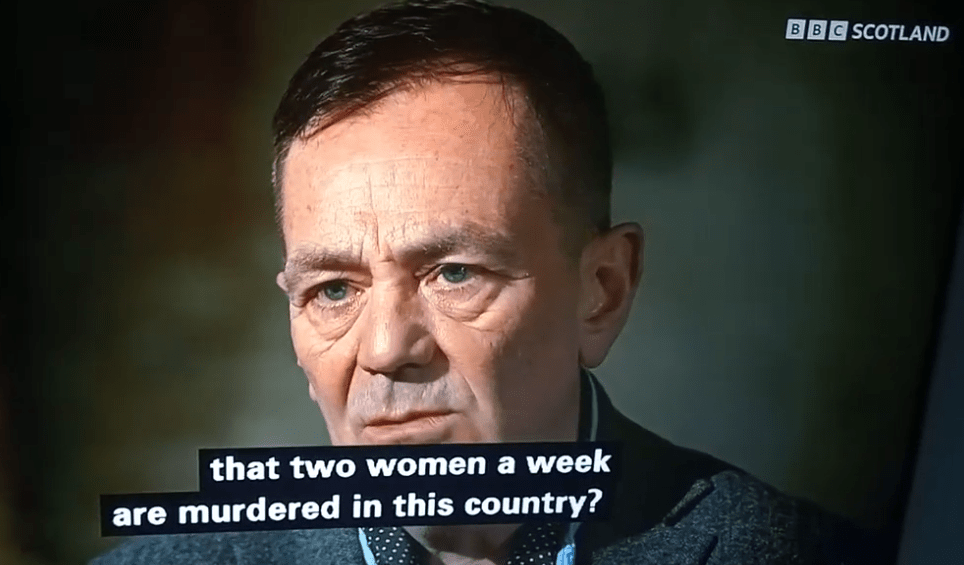
In BBC Crime Files, broadcast two days ago, Professor David Wilson, after just hearing there were only 45 murders in Scotland last year, reflects:
So in ten years’ time, could we ever get to the point where there will be no murders in Scotland at all? Or to get there, will we have to challenge misogyny so much that we will get rid of that appalling statistic that two women a week are murdered in this country?
His interviewee, Karen McCluskey of the the Violence Reduction Unit, apparently accepting that claim then says:
Oh wouldn’t that be wonderful. When I shut my eyes, I can still think what a safer Scotland looks like, I really do. And wouldn’t it be fantastic to lead the way, to lead the world.
So, 45 murders in Scotland in total but 2 women murdered every week ‘in this country’ – 104?
Was Professor Wilson thinking of England?
The often-cited claim of “two women a week” murdered (typically by current or former partners) in the UK (England & Wales statistics from ONS) is outdated and no longer accurate for recent data, though the actual numbers remain tragically high. https://www.femicidecensus.org/data-matters-every-woman-matters/
Over the last 10 years, the average is closer to ~80 women per year killed by current or former partners in England and Wales (~1.5 per week). https://www.femicidecensus.org/data-matters-every-woman-matters/
There were 15 women out the 45 murdered in Scotland last year. https://www.gov.scot/publications/homicide-scotland-2024-25/pages/main-findings/
Just over one a month?
The above misleading of the programme’s audience is, of course, unfortunate. Some in Scotland will now repeat it but there is another, more significant error in the programme. At the end of this:
In 2005, a United Nations report described Scotland as one of the most violent places in the developed world. Through the decade, Glasgow topped the bill as a murder capital. The comedian David Bridges pointed out that Glasgow simultaneously ranked as the UK’s friendliest city. “We’ll stab you but we’ll give you directions to the hospital”, prosaically put. But not that reputation has been radically turned around. Violence has been reduced so much so that the programme responsible for it has been seen as the model to resolve the knife crimewave that’s engulfed London and indeed, many other areas in England. That programme is the Violence Reduction Unit and earlier I spoke with one of its co-founders, Karen McClusky.
Scotland’s Violence Reduction Unit was an inspired, visionary project which has made, no doubt, a major contribution to the undeniable, from police records and hospital admissions data, reduction in violence and, in particular, amongst the under 24 year-olds who commit most of these crimes.
However, it is not credible to attribute it entirely to the VRU.
Youth violence, in almost every developed country and in countries with no VRU or equivalent, has been falling over the long term (roughly since the 1990s). https://www.mpg.de/25556841/youth-crime-rates-in-sharp-decline
What is thought to have caused this?
The answer is complex and not closed, but first, changes in daily lives of under 24s, especially no longer gathering in public spaces but rather in smaller groups inside homes and engaging with social media and online entertainment. https://eucpn.org/document/declining-juvenile-crime-explanations-for-the-international-downturn-0
Ironically, these technological changes are still thought by some to be responsible for increases in youth crime.
Second, under 24’s drink alcohol significantly less than previous generations. Alcohol is a major driver of impulsive violence and risk-taking, so lower use directly correlates with fewer incidents. https://www.mpg.de/25556841/youth-crime-rates-in-sharp-decline
Third but more controversial, the Lead-Crime Hypothesis – Lead is a neurotoxin that affects brain development, particularly in children. Even low levels can impair impulse control, attention, IQ, and increase aggression and antisocial behavior. These effects often manifest years later as higher risks of delinquency and violent crime in adolescence.
Leaded petrol, banned in Scotland in 2000, 26 years ago, was the biggest source of airborne lead exposure.
https://en.wikipedia.org/wiki/Lead%E2%80%93crime_hypothesis
Finally, programmes like the above and with TV drama full of female victims and TV News prioritising the coverage of violence against women, have distorted the real lived experience of women in Scotland.
See these:
Discover more from Talking-up Scotland
Subscribe to get the latest posts sent to your email.


Is it too much to ask that the BBC would FACT check contributions by its reporters and other contributors ?
Apparently , YES ! Or is this misinformation deliberate ?
LikeLiked by 2 people
No ? required…
LikeLiked by 1 person
David Wilson is a Scottish emeritus professor of criminology at Birmingham City University. Either simple maths is beyond the good professor or else telling the truth about the murder rate in Scotland would not make him popular with BBC or the English. I wonder which one it is?
LikeLiked by 1 person
The BBC is a propaganda service and it always has been since its inception. A great deal of propaganda is useful public information and that is valuable.
However, propaganda is also used for political purposes and, in the case of the UK, a major purpose is to project ‘British’ identity – not English, Irish, Scottish or Welsh identities- although British and English are usually conflated.
This leads to the use of data which mainly refer to England and Wales (surely, with devolution, there must be England only and Wales only data?), and these data are wrongly generalised to Northern Ireland and Scotland (but also to the various regions of England, and there are big variations among them.)
This shows the seriously limited value of using these ‘national’ data. If Burnham is serious of extending the scope of devolution and significantly empowering local communities, then we can get more specific initiatives like the Violence Reduction Unit which was developed by Strathclyde Region.
Strathclyde Region was, of course, destroyed by the Tories because it was demonstrating the falsity of Mrs Thatcher’s, ‘there is no alternative’, by, for example keeping water in public ownership.
LikeLiked by 2 people
Only one in eight people watch the BBC
Abused women do not get legal aid
LikeLiked by 1 person
1 in 8 is still too many.
LikeLike
THE LIES AND DECEIT COMING FROM A SO CALLED HONEST BUSINESS
IS ASTOUNDING
LikeLike