

In the Guardian today:
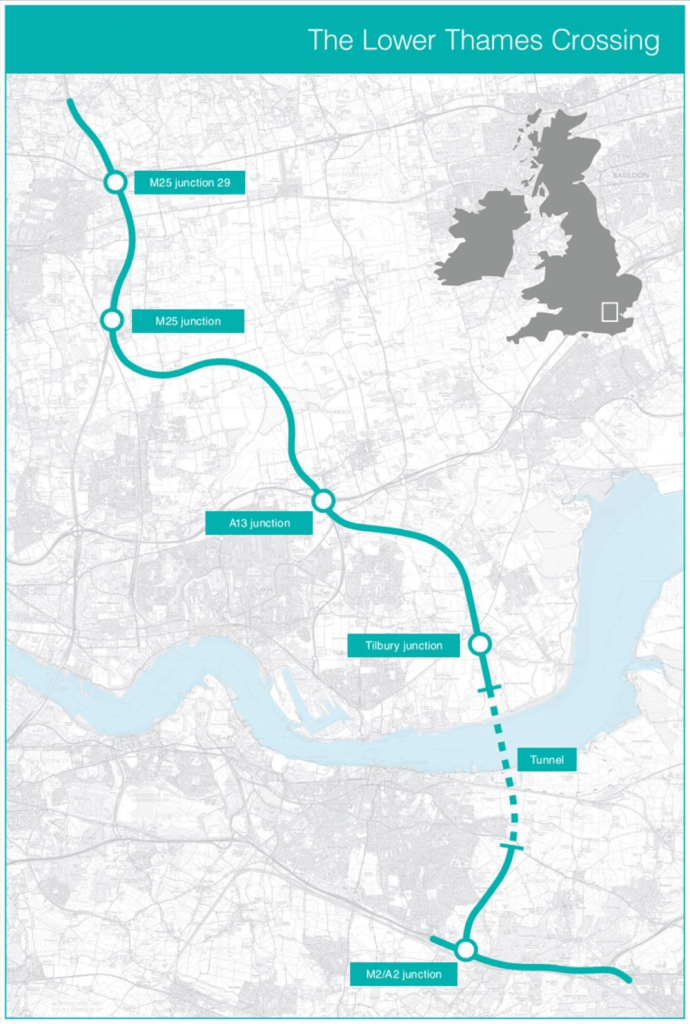
The UK’s public spending watchdog has said it plans to investigate the Lower Thames Crossing, as campaigners voice concerns over the rising costs of one of the UK’s largest infrastructure projects.
The head of the National Audit Office (NAO) said he anticipated the agency would “examine and report” on the planned £11bn road tunnel between Kent and Essex, and that work to monitor the project had already started.
It emerged last month that £174m of additional public money was being made available for the scheme, which is estimated to cost more per mile than the HS2 high-speed rail link from London to Birmingham.
The government has committed £3.1bn to the construction of the twin 2.6-mile tunnel, which is designed to ease congestion on the Dartford Crossing, with the rest of the project expected to be financed by the private sector. 1
No major UK Treasury-funded major capital project has been further from Scotland and further from its interests than this.
The LTC is an England-only road infrastructure project. It’s a new tunnel and linking roads between Kent and Essex, east of London managed by the UK Department for Transport. Total estimated costs have risen to around £10–11 billion or higher in some projections, with the government providing £3.1 billion upfront including recent additions like £891 million in the 2025 Budget and £174 million more to support planning, public works, and unlocking private finance for the rest.
If the private finance is not ‘unlocked, the UK Government would have to borrow the nearly £8bn difference. 2
How certain is it?
Not.
LTC’s own assessments highlight potential challenges in market appetite, legislation, toll levels. Private finance for roads is less common than for utilities/nuclear, which adds some uncertainty. 3
Will Scottish taxpayers pay a share?
Scottish taxpayers will contribute to the Lower Thames Crossing (LTC) project primarily through UK-wide taxation. This means Scottish taxpayers directly fund a share of the £3.1 billion potentially 300 million or more just as they do for other reserved UK-wide or England-delivered projects. If the private funding fails to be ‘unlocked’, it’ll cost Scots around £1bn.
Will we get it back via Barnett Consequentials?
In principle, increases in UK government spending on the LTC (classified under England-comparable transport budgets) should generate Barnett consequentials for Scotland, Wales, and Northern Ireland. This has happened for similar large English projects like aspects of HS2. 4
However, the Treasury decides case-by-case for specific projects whether spending is “comparable” or treated as UK-wide/national. For example there were no full consequentials for the 2012 Olympics. Critics and analysts such as the IFS5 noted disputes over projects like the 2012 Olympics and HS2. So it’s by no means guaranteed that Scotland will receive equivalent extra funding that fully offsets or matches.
Just these two?
No.
Kew Gardens and certain cultural/regeneration spending: Disagreements over comparability.
Various England-only prison, police, or local transport projects where classifications limited or excluded consequentials.
Targeted funding deals such as some City Deals or post-Brexit funds have sometimes bypassed Barnett entirely.
Broader Treasury decisions on capital projects such as certain London-centric infrastructure have been treated as non-comparable or UK-wide. 6
Clearly, here, with this project, as far as you can get from Scotland, Scots could be paying near £1bn for something that’s not of any meaningful benefit to Scotland.
Sources:
- https://www.theguardian.com/uk-news/2026/jul/12/public-spending-watchdog-investigate-lower-thames-crossing-project
- https://www.gov.uk/government/publications/department-for-transports-accounting-officer-assessment-summaries-for-the-government-major-projects-portfolio/lower-thames-crossing-ltc-accounting-officer-assessment-summary-february-2026
- https://www.gov.uk/government/publications/department-for-transports-accounting-officer-assessment-summaries-for-the-government-major-projects-portfolio/lower-thames-crossing-ltc-accounting-officer-assessment-summary-february-2026
- https://www.instituteforgovernment.org.uk/article/explainer/barnett-formula
- https://ifs.org.uk/articles/barnett-formula
- https://www.instituteforgovernment.org.uk/article/explainer/barnett-formula
Discover more from Talking-up Scotland
Subscribe to get the latest posts sent to your email.


While it’s clear that the UK government tends to spend more on big projects in the south of England than elsewhere, it’s not true that Scots are paying for it through their taxes. UK government expenditure is not funded by taxes or anything else. UK government expenditure works by instructing the Bank of England to create the money required and credit it to the relevant payee, just as when one takes out a high street bank loan that bank creates the money and credits it to our account. The big difference is that, whereas the high street bank also creates a debit in our name for the same amount as the credit and when it is finally paid off the money lent has been withdrawn from the economy, the Bank of England doesn’t have to hit the UK government with a balancing debit as the government owns both the Bank of England and the currency. There are several reasons for taxation, one of them being the validation of the currency by only accepting payment in that currency, and another being the withdrawal of money from the economy to reduce the risk of inflation, but funding expenditure isn’t one of them.
If you don’t believe all this, ask the Bank of England.
LikeLike
Doesn’t it amount to the same thing?
If the UK government creates billions and pours it into the economy of SE England, does that not risk increasing inflation? So if then the UK government raises taxes from the whole UK to remove money from circulation to control inflation, we are paying to reduce the inflation rather than paying to fund the tunnel directly.
SE England gets the infrastructure, Scotland (and everyone else) pays to keep inflation down?
LikeLike
Thanks so much Capella.
Well put.
Roger?
LikeLike
Government spending does not of itself generate inflation. Only if the spending is on resources in short supply will that tend to have an inflationary effect. As I said, reducing the risk of inflation is just one of the purposes of taxation but it’s not aimed any specific possible cause of inflation. The government doesn’t have enough information to know exactly where or when shortages of supply will arise but it knows that some inflation is likely.
I share the resentment of th UK government’s propensity to spend down South rather than here in Scotland but that propensity is probably not unconnected with the fact that they’re not going to get many votes here whatever they do.
LikeLike
Either way we still pay?
LikeLiked by 2 people
I struggle to understand economics and read/watch Scotonomic’s excellent posts on MMT. So I’m interested in how this works as I’m convinced it’s a grift!
LikeLike
Westminster borrows and spends £100Billion more in England. Equivalent of Scotland losing £10Billion. On average the UK raises £600Billion in taxes. Borrows another £200Billion. Scotland raises £80Billion. Spends £52Billion. Westminster spends the rest. Scotland Block Grant £42Billion. Gov accounts. Easy to look up.
Scotland pays too much for the military. £5Billion. Should be £4Billion. 180,000 military personnel. 10,000 based in Scotland. Scotland pays for Trident and redundant weaponry. Westminster defence contracts that never are received. Out of date. Then they order more.
Westminster spent £270Billion over two years on Covid. Fraudulent contracts. HS2 £Billions overspent and years late. Westminster spends £13Billions a year decommissioning nuclear. £130Billion over 10 years.
Brexit cost Scotland £Billions. Scotland did not vote for it.
LikeLike