

In the Guardian today:
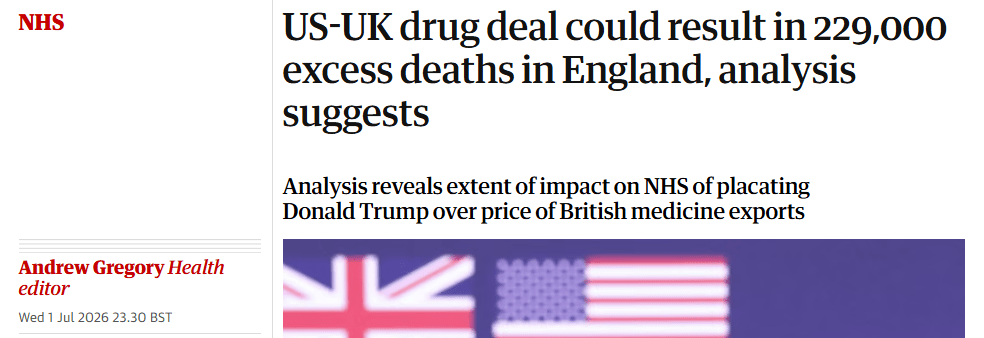
The NHS will have to divert £45bn from essential services to pay for new medicines under the terms of the UK-US trade deal agreed last December, leading to more than 200,000 avoidable deaths [229 000] of patients, analysis has found.
Ministers have defended the deal as a way of helping British drug exports to the US avoid tariffs, and giving patients in England access to potentially life-extending drugs that would otherwise be denied.
But they have been accused of caving in to US demands to spend billions of pounds a year extra on drugs supplied to the NHS after pressure from Donald Trump. The potentially devastating impact on NHS care has also caused growing alarm among health experts.
Now analysis, published in the British Medical Journal, lays bare the likely cost of the deal to the NHS – and the projected deadly impact of cuts to health services on the population in England – for the first time. 1
There is of course no mention of Scotland in this report but might Scotland be able to avert her share or part of these deaths, around 20 000?
It won’t be easy and it would be naive to think we can avert them fully but there are aspects of NHS Scotland‘s greater resilience which may reduce them.
First, the deal centres on NICE (England/Wales-focused) raising cost-effectiveness thresholds, making more expensive new drugs approvable. Scotland uses the independent Scottish Medicines Consortium (SMC), which isn’t directly bound by the deal’s NICE changes.2
Second, the Scottish Government has historically spent more per person on health than England. This could giver it more headroom to absorb higher drug costs without as deep cuts as elsewhere. It also has more potential to maintain or expand services like prevention, community care, or staffing and has greater flexibility to prioritize differently e.g. via SMC approvals for medicines, which are independent of NICE changes. 3
Third, Scotland has more integrated health and social care than England which could increasingly keep more people out of hospital reducing pressure on funds that do need to be diverted to meeting increased drug costs.
Finally, Scotland’s relatively better nurse and doctor-to-patient ratios should provide a meaningful buffer against excess deaths risks from the UK-US drug deal. Stronger staffing is one of the most evidence-based factors for protecting patient outcomes during resource strains.4
Sources:
- https://www.theguardian.com/society/2026/jul/01/us-uk-drug-deal-could-result-in-229000-excess-deaths-in-england-analysis-suggests
- https://commonslibrary.parliament.uk/research-briefings/cbp-10850/
- https://commonslibrary.parliament.uk/research-briefings/sn00724/
- https://pmc.ncbi.nlm.nih.gov/articles/PMC6868706/
Discover more from Talking-up Scotland
Subscribe to get the latest posts sent to your email.


Isn’t it pathetic that we have to constantly “mitigate” problems we would not have but for Westminster’s baleful control over so many vital aspects of life. What a useless drain on time, energy and resources.
LikeLiked by 2 people
All of our personal data including health is already being centralised by our own Scottish Government via multinational ‘big tech’, all the usual suspects and many more – except Palantir! The privacy pages are continually changing but try playing ‘spot the company holding my data’ with https://www.mygov.scot/privacy-notice-scotaccount (try ‘Who your data will be shared with’) noting the temerity of stating that Atlassian may transfer your data outwith the EEA (?!) and https://mycare.scot/public/information/privacy (most recent version lists Google Firebase (AI) for the first time). Terrifying, yes, but also of highly questionable competence and likely to waste £OOs of millions
LikeLike