

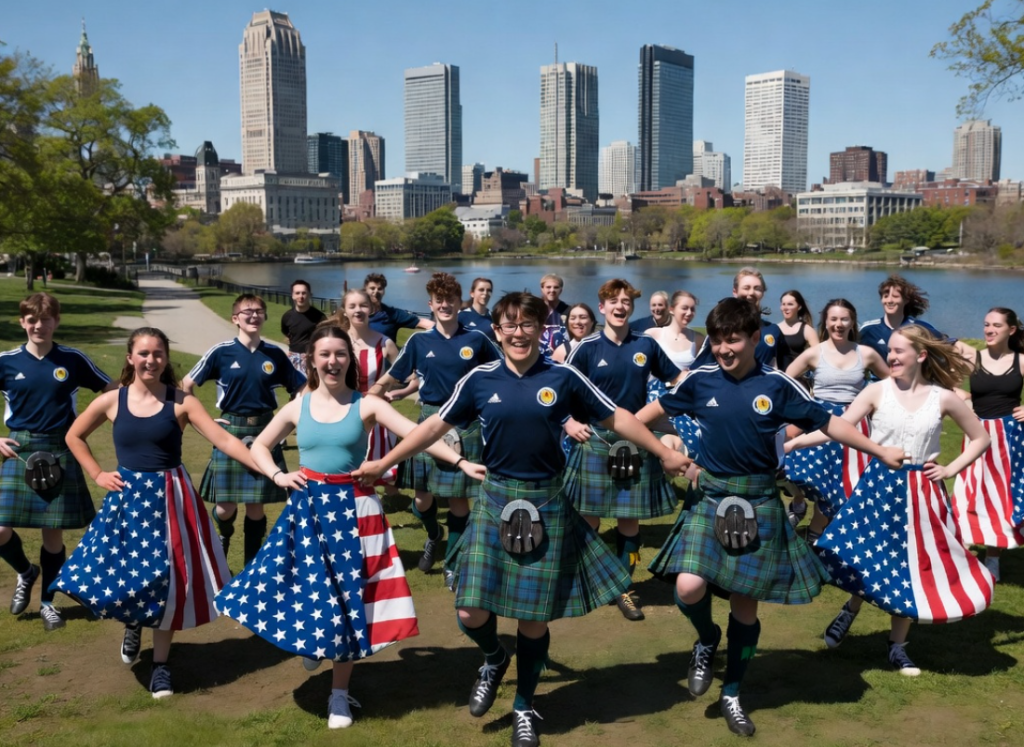
It’s been suggested by leading Ayrshire academic dancer, Gavin Ochiltree, that:
‘Scotland’s football went backwards when Scottish country/highland dancing was done away with in schools. Balance and fleetness of foot were what gave us the edge when we had decent Scottish football teams.’
Is there evidence to support this?
Scottish country dancing involves precise footwork, quick changes of direction, balance, rhythm, coordination, agility, and partner awareness in a group setting. These overlap with football demands (dribbling, turning, stability, spatial awareness). Highland dancing emphasizes explosive power, balance, and control.
Dance training (including ballet or similar) is used by some modern athletes for injury prevention, proprioception, and motor skills. In eras before specialized gym work, video analysis, or professional academies, school activities like dancing could have provided broad foundational benefits to coordination and “fleetness of foot.” Many older Scots recall it as part of a varied PE experience alongside games.
Analysis
Scottish Country Dancing: Precise Footwork, Quick Changes of Direction, Balance, Rhythm, Coordination, Agility, and Partner Awareness
- Royal Scottish Country Dance Society (RSCDS): Official site highlights SCD’s benefits for balance, strength, coordination, agility, posture, and precise footwork. It involves lively stepping, hopping, and directional changes in group formations. https://rscds.org/benefits-of-scottish-country-dancing/
- Research on functional ability: Scottish country dance improves balance, agility, gait, lower-body strength, and coordination in participants (including studies on older women showing delayed aging effects on locomotion). https://pubmed.ncbi.nlm.nih.gov/23538484/
- Additional descriptions: SCD builds agility, stronger legs, brisk movement, musical awareness, physical coordination, and group spatial awareness through formations and partner work.https://www.gscdc.org.uk/why-do-it
Highland Dancing: Explosive Power, Balance, and Control
- Highland dance emphasizes strength, agility, explosive power (leaps, sharp knee actions akin to sprinting), balance, coordination, flexible bodies, and bone density.https://www.facebook.com/Cowal.Highland.Gathering/posts/highland-dance-is-about-strength-and-agility/1724380230943040/
- It builds strong, flexible lower bodies with controlled, high-impact movements requiring power and precision. https://www.thistleshoes.com/highland-dance-the-toughest-sport-youve-never-tried/
Overlaps with Football Demands (Dribbling, Turning, Stability, Spatial Awareness)General dance benefits (applicable to SCD/Highland styles) include improved coordination, agility, flexibility, balance, spatial awareness, and quick directional changes—skills that transfer to football actions like dribbling, turning, and maintaining stability under pressure. https://www.betterhealth.vic.gov.au/health/healthyliving/dance-health-benefits
Dance Training (Including Ballet/Similar) for Modern Athletes: Injury Prevention, Proprioception, and Motor Skills
- Proprioceptive and balance training (body awareness) in soccer: Multiple studies show it improves balance, agility, technical skills (e.g., juggling, passing, shooting), and reduces injury risk (e.g., ankle sprains by ~50%, overall lower-limb injuries). It enhances motor control, joint position sense, and performance in young and amateur players. e-https://www.e-jer.org/journal/view.php?number=2013601026
- Dance-specific applications: Proprioceptive training benefits dancers and athletes alike for postural stability, reaction time, strength, flexibility, and injury prevention. Many modern programs (including for soccer) incorporate balance/proprioception drills similar to dance elements. https://iadms.org/media/3592/iadms-resource-paper-proprioception.pdf
- Broader evidence: Dance training supports neuromuscular control, core stability, and dynamic balance used in sports injury prevention protocols (e.g., FIFA 11+ program elements). https://healixtherapy.com/balance-proprioception-injury-prevention/
Historical/School Context: Pre-Specialized Training Era and Older Scots’ Recollections
- In earlier decades (before widespread professional academies, gyms, and video analysis), school PE activities like Scottish dancing provided broad foundational motor skills and “fleetness of foot” through varied physical experiences alongside games. http://www.mindwavesnews.com/nine-things-youll-only-understand-if-you-did-scottish-country-dancing-at-school/
- Many personal accounts from older Scots describe it as a standard (often December/seasonal) part of school PE, contributing to coordination and social/physical development in a less specialized sports environment. https://www.instagram.com/reel/DC6wSyns10H/
These points are grounded in established exercise science: Dance forms build transferable athletic attributes, especially proprioception and agility, which have been studied in soccer contexts.
Final comment – I always hid in the toilets to avoid dancing at school. I am a terrible footballer – more proof?
Gavin?
Discover more from Talking-up Scotland
Subscribe to get the latest posts sent to your email.


It was originally a warrior training exercise. So – yes – the football team could benefit from taking it up!
AI answer:
Also, why has it disappeared from the curriculum?
LikeLiked by 1 person
overload?
LikeLike
It’s very aerobic so schools could just teach Highland dancing and that would be the health and fitness box checked for the whole school.
LikeLiked by 1 person
I missed this one but here goes. A long time ago now I met a man from the NE Scotland who had gone to South Africa 1928 never to return me being from NE as well I was very surprised when he broke into broad Doric so it just proves you don’t lose your mother tongue unless you are ashamed of it,we had a good old chat with the others looking on out of it.
LikeLiked by 1 person
When was its stopped being part of school education in Scotland, was it when English parties were in full control of Scotland?
LikeLike
Still part of curriculum in non-Highland Perth & Kinross, although a few may opt out.
https://www.gov.scot/publications/foi-202400443463/
LikeLike
For a different point of view – one of personal experience. When I moved to Scotland from Australia 20 years ago, my youngest son (six years old) expressed an interest in playing soccer – which delighted me as I had played for 10 years in Australia, and coached children from ages 6 to 15 for 15 years.
So we went along to three local clubs to see which one he preferred and for me to check out their training methods. I was horrified to find that there were no qualified coaches, no specific coaching done, and that training consisted mainly of jogging a couple of laps then choosing sides for a game amongst themselves – no focus on any skills. Not wishing to make waves, I kept my mouth shut and he chose one club to join – somewhat ludicrously after he had a trial. He lasted three years before giving it up – as he had simply gone backwards in terms of skills over that time, and lost interest.
I’ve often wondered if it was any better in other areas of Scotland.
LikeLiked by 2 people
Had the same experience with my boys in the mid 90s in Ayrshire.
LikeLiked by 1 person
Scotland do better now. Without the dancing.
Need more funding and support. Less bigotry about.
LikeLike