

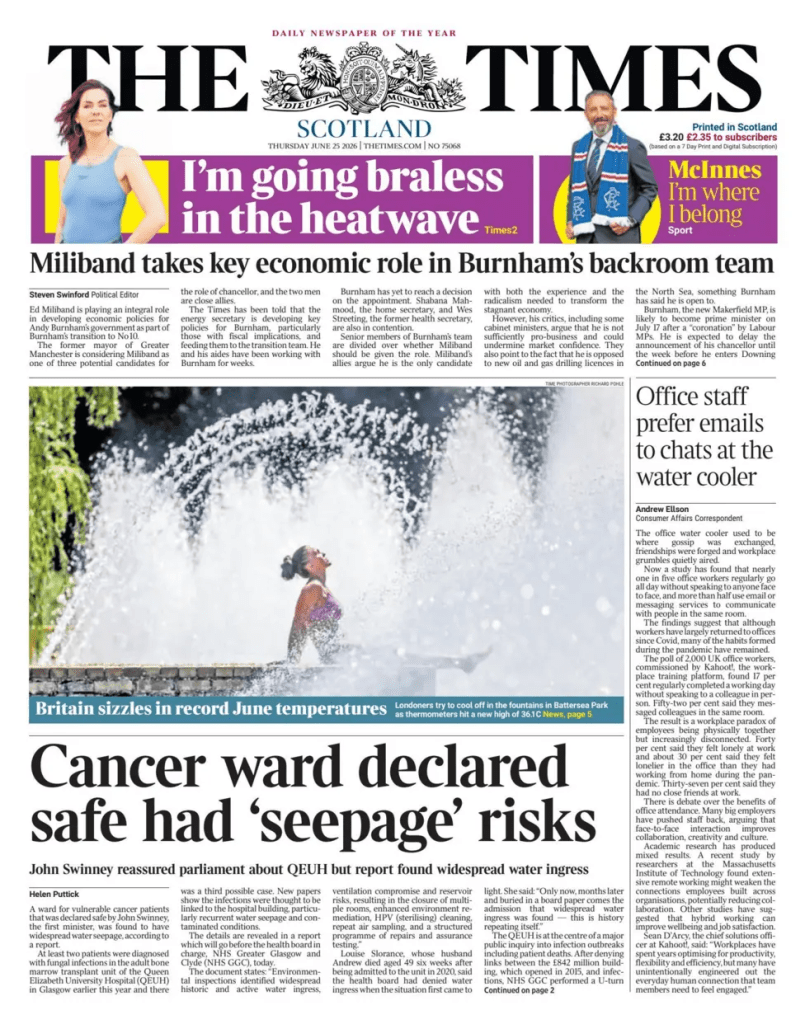
The Times today reporting cases of fungal infections in a QEUH cancer ward apparently declared safe by John Swinney. He’s a busy man. There’s no mention of a direct connection between these infections and deaths but a death with no mention of an infection is mentioned.
What are the chances of anyone actually having been seriously harmed by these fungal infections?
Near zero but it’s a popular media pursuit.
Is it possible for any large hospital to be 100% free of any water ingress and mould growth and consequent fungal infections, at all, in at least one of its hundreds of wards?
Experts and industry sources consistently state that no such thing as a completely “mould-free” facility exists in practice, especially not in a massive hospital with hundreds of wards. One source from healthcare facility management notes: “In a large, complex facility, having a mould-free facility isn’t realistic short of a heroic team effort to avoid mould formation.” 1
Another expert emphasizes there are “no guarantees to yield a zero mould growth in a health care facility.”2
Sources:
- https://www.healthcarefacilitiestoday.com/posts/Design-and-maintenance-key-to-avoiding-mold-in-healthcare-facilities–23782
- https://www.achrnews.com/articles/108935-preventing-mold-growth-in-hospitals
Discover more from Talking-up Scotland
Subscribe to get the latest posts sent to your email.
 Talking-up Scotland
The QEUH campus is enclosed on two sides by sewage plants – the Waste Water Treatment Works (WWTW) to the north across Renfrew Road and the almost equally large Shieldhall Waste Transfer Station (SWTS) directly contiguous with the QEUH campus to the west and in plain sight as one walks along the Hospital Boulevard! SWTS receives vast quantities of raw sewage now including waste from the Shieldhall Sewage Tunnel and removes unprocessable material before passing raw sewage to the interconnected WWTW. The QEUH should have been sited at the former Cowglen Hospital but Greater Glasgow Health Board (GGHB) all but ignored the results of its own consultation during April to September 2000 and received approval from successive Scottish Labour Health Ministers, the official sign-off being given by Malcolm Chisholm in 2002. It would be nice to see Anas Sarwar acknowledge this – his father was MP for the area (1997-2005). What were the deals with the housing estate developers at Cowglen.
LikeLiked by 1 person
The infection problems will persist at the Shieldhall s(h)ite forever and a future Scottish Government will at some point have to close the hospital complex entirely, hopefully before deaths escalate. The wealthy of Glasgow can no longer turn to the former Victoria Infirmary or former Royal Hospital for Sick Children at Yorkhill for emergency or life-threatening conditions uncommercial to treat in the private sector by Consultants in their social peer group who moonlight from the NHS. They must join the great unwashed in a repeat of history. Merryflats Workhouse/Poorhouse was build in Govan between 1867 and 1872. The poorhouse included a hospital site which was expanded and was renamed the Southern General Hospital (SGH) in 1923. The Poorhouse itself fully closed in 1936 leaving only the hospital which became part of the NHS in 1948 and has now been largely replaced by the QEUH and RCHG. Presumably no-one who had a say cared about the opening of Shieldhall sewage works across the road from a poorhouse in 1910. Shamefully the sewage works were almost completely redeveloped to near their current extent around 1980. Within the past year the WWTW and SWTS have been complemented by the Shieldhall Sewage Tunnel, Scotland’s largest ever sewer tunnel. Read Tom Makin’s evidence at the Scottish Hospitals Inquiry: https://hospitalsinquiry.scot/inquiry-document/witness-statement-tom-makin-270824
LikeLike