

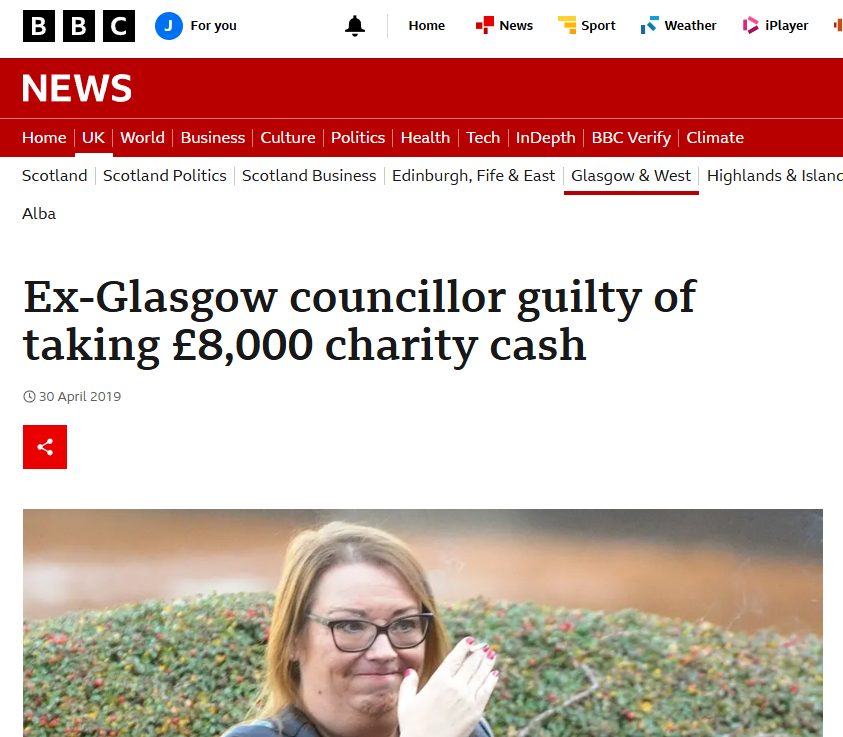
From BBC Scotland in 2019:
A former [Labour] councillor has been convicted of taking more than £8,000 from a local charity where she worked. Yvonne Kucuk, 52, was the company secretary for the People’s Development Trust in Dalmarnock, Glasgow.
The trust ran the £3.5m Commonwealth Games legacy hub in the area, which was launched by football legend Sir Kenny Dalglish in 2015. But, later financial concerns led to auditors looking over the organisation’s books.
Kucuk – ex-Labour councillor for the city’s Calton area – and the trust’s project manager William Faulds, 55, were eventually held by police. A trial heard that payments had been made to someone called “Johnny the Turk” for apparent literacy services. The individual was never traced.
https://www.bbc.co.uk/news/uk-scotland-glasgow-west-48109151
Kucuk did not plead guilty and the People’s Development Trust collapsed into administration but she was still not jailed.
Why was that surprising?
Breach of trust is a key aggravating factor in fraud/embezzlement cases across the UK. Scottish legal resources explicitly note that offending against a charity or where the victim is vulnerable raises seriousness because of the “special or heightened level of trust.”
See:
The nature of the trust that has been betrayed is also relevant. If the accused is solely entrusted by the owner or company and has complete autonomy over the movement of the funds for example that would be considered adversely against an accused.
The nature and vulnerability of the trustor is also relevant. For example, if the trustor was a child, or was otherwise incapable of looking after their own affairs, that would be taken into account in sentencing, as it would if the trustor was a charity. In these circumstances a special or heightened level of trust exists which makes the offence more serious.
Whether the nature and extent of the embezzlement calls for a deterrent sentence of imprisonment to be imposed.
The consequence of the embezzlement on the victim. For example, if a business has been forced to cease trading, or the quality of the victim’s life has been badly affected.
https://criminaldefencesolutions.com/embezzlement-defence-lawyers-scotland.html
Here’s why the Labour councillor’s crime was, to my mind, greater:
The Trust went into administration in January 2019 and closed suddenly. This led to:
- Nursery closure (major disruption for local families).
- Other community services stopped.
- Around 23 staff made redundant.
- A petition with over 1,000 signatures calling for it to reopen.
This caused real, tangible harm to vulnerable people in a deprived community — lost services, lost jobs, lost opportunities. https://tfn.scot/news/legacy-hub-closes-suddenly
Might media coverage of these two crimes have influenced the judge’s discretion?
Yes, media coverage very likely played an indirect role in shaping the broader context and scrutiny around both cases, though direct influence on a judge’s sentencing discretion is limited and officially discouraged.
Scale of Media Coverage
- Kucuk case (2019): Primarily local Glasgow/Scottish media (BBC Scotland, Glasgow Times, Herald). Coverage was factual, focused on the trial details, the small sum (£8k), the charity’s collapse, and the non-custodial sentence. No sustained national or political firestorm. Little criticism of the sentence itself was reported. https://www.bbc.com/news/uk-scotland-glasgow-west-48109151
- Murrell case (2026): Intense national and international coverage (BBC, Sky, ITV, Guardian, Al Jazeera, etc.). It was tied to Nicola Sturgeon, the SNP’s finances, Operation Branchform, and Scottish independence politics. Headlines focused on the £400k, luxury purchases (motorhome, cars, jewellery), fake invoices, and the “gross breach of trust.” There was live court reporting, political commentary, and significant public/political pressure for a “hefty” sentence. https://www.bbc.com/news/articles/c5yzlqv4dyeo
Murrell’s case generated far more heat due to its high political profile.
Could This Influence a Judge?
Indirectly, yes — through heightened public and institutional awareness:
- Judges in Scotland (especially in the High Court for serious cases like Murrell’s) are aware of public interest and media scrutiny. High-profile cases often attract more detailed written sentencing statements to explain reasoning and demonstrate fairness.
- Intense media focus can amplify perceptions of harm (e.g., damage to public trust in politics for Murrell) and increase calls for deterrence. Studies in various jurisdictions show media/public opinion can subtly influence sentencing in high-visibility cases, even if judges deny it. https://iacajournal.org/articles/10.36745/ijca.528
In low-profile local cases like Kucuk’s, lighter sentences attract less attention and less pressure for toughness. In politically charged national cases, outcomes face far greater public and media examination, which can indirectly reinforce stricter application of aggravating factors.
Media coverage likely contributed to the atmosphere of scrutiny in Murrell’s case making a lenient outcome politically and publicly harder.
Discover more from Talking-up Scotland
Subscribe to get the latest posts sent to your email.
 Talking-up Scotland
”Justice is blind” …unless the crime can be connected in any way to the SNP .
Compare the coverage of the Murrell embezzlement affair with the infinitely more serious Donaldson case of sexual abuse and rape of young girls .
I rest my case , M’Lud !
LikeLiked by 2 people
There was a big difference. She was Labour.
LikeLiked by 2 people
The SNP’s did propose cutting the number of staff at its headquarters by more than a third, from 26 to 16, in November 2024.
Will have to wait and see the 2025 accounts (due to be filed with the Electoral Commission) to confirm whether or not those voluntary redundancies were actioned.
LikeLiked by 1 person
Also Natalie McGarry. Seems you get a hefty jail sentence for being an SNP thief. Not Labour.
Former SNP MP Natalie McGarry has been jailed for embezzling £25,000 from the SNP and a pro-independence group.
The 40-year-old was sentenced to two years in prison.
Former SNP MP Natalie McGarry jailed for embezzling £25,000 – BBC News
LikeLiked by 2 people
The Westminster crooks never go to jail. Cheat, lie and steal £Billions. Never go to jail. Mone. Ilegal wars. Wasting £Billions Hickley Point, HS2 etc. The Civil Service cover up.
The money is being paid back. £40,000 a year for expenses for the biggest political party in the UK. Cambridge Analytica. Breaking data protection Act. No one went to jail.
LikeLiked by 1 person
Farague says ‘he can spend the illegal £5million donation on cars’. Does not got to jail for embezzling EU money. Brexit losing £Billions.
LikeLiked by 1 person
For those interested in PPE Medpro, Mone and Barrowman, you may find latest news at https://x.com/danneidle/status/2069709214985924676
LikeLiked by 1 person