

By Mark E. Saunders of “The Scottish Minuteman” https://www.facebook.com/profile.php/?id=61575625542197
Something Wicked This Way Comes
Fraud within a political party is serious. Any organisation can suffer from a rogue individual abusing trust, and when that happens it should be investigated properly.
But what should concern us more is not money disappearing from political party coffers through ordinary light-fingered theft, but money quietly entering through darker channels.
There is a difference between a “dark element” of human nature and what is commonly referred to as “dark money”.
The first is familiar.
It arises through greed, dishonesty, or opportunism.
The second is more corrosive.
Put simply, it is political funding via hidden donation routes. It is backed by influence-seeking wealthy individuals, operating within politics without meaningful public scrutiny.
One is criminal. The other can reshape the very heart of our democracy without ever triggering a police investigation.
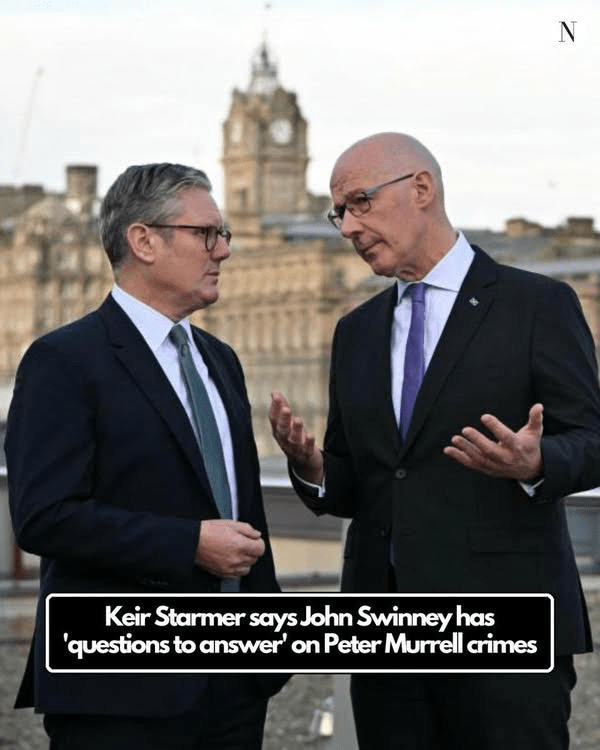
Recent allegations of internal financial misconduct within the SNP have generated sustained political and media attention and have prompted repeated calls for accountability from Dame Jackie Baillie, Russell Findlay and Lord Malcolm Offord in Edinburgh, and from Sir Keir Starmer in London.
Yet the allegations concern internal financial management rather than the kinds of opaque third-party funding networks that have increasingly become a feature of wider UK political finance debates.
By contrast, cases involving broader political finance issues — such as the Electoral Commission’s finding that Labour Together breached reporting rules in relation to hundreds of thousands of pounds in donations — have generally been covered in procedural terms, with less sustained follow-up after the initial reporting cycle.
The point is not that one matters and the other does not. Both matter. Nor is it that any one party is uniquely implicated. Rather, it is that different categories of political wrongdoing attract different forms of scrutiny.
Internal party scandals tend to generate sustained political hysteria, while structural questions of funding, lobbying, and influence are more often treated as technical issues and sadly receive less sustained public attention.
My concern is not partisan. I am not defending anyone. My concern is democratic.
Because democracy is not safeguarded by prosecuting wrongdoing after money is taken or lost. It is protected by ensuring that money cannot quietly enter politics in ways that remain unexamined until long after its influence has been exerted.
It is a question of balance — one that the UK political system has repeatedly failed to strike.
Discover more from Talking-up Scotland
Subscribe to get the latest posts sent to your email.


For detail, see our earlier – Businessmen and wealthy donors ARE bankrolling Scottish politics but only the Unionist parties at https://talkingupscotlandtwo.com/2026/05/06/businessmen-and-wealthy-donors-are-bankrolling-scottish-politics-but-only-the-unionist-parties/
John
LikeLiked by 3 people
Good to see this topic appearing here. There are critical voices raised regarding the financing of politics in the UK but the issue seems to gain little immediate and certainly no sustained MSM attention. (A bit like wider electoral reform?)
The Electoral Reform Society on February 19, 2026 published this: ‘Briefing on Political Finance’ (https://electoral-reform.org.uk/latest-news-and-research/parliamentary-briefings/briefing-on-political-finance/ )
It’s very revealing about political financing in the UK, and worrying for UK democracy especially in the context of Westminster’s FPTP voting system that can give so much power to a party achieving a minority of the popular vote, enabled by huge and often ‘dark’ donations and loans.
Examples from the Briefing. Firstly on the role of Unincorporated Associations (UAs) – ‘there are currently no requirements for those who give money to UAs to themselves be permissible donors. This opens-up the possibility of UAs being used to channel funds from impermissible sources such as overseas donors. ‘
‘It is clear from the lack of information provided by UAs that a considerable amount of funding is passing below the reporting requirements. Transparency International UK have found that of the £40.4 million in donations made by Unincorporated Associations since 2010 only £127,500 has been reported in the gifts register and only £1.7 million has come from UAs that are also member associations. This leaves £38.6 million in party funding coming from unknown sources.
‘Moreover, donations to candidates, rather than political parties, from Unincorporated Association are not covered by any transparency requirements.’
And with respect to peer countries internationally: ‘.. comparatively the UK’s disclosure requirements are weak and there is little justification for the recent increase in threshold. ‘
On digital campaigning: ‘The amount spent on digital communications has grown exponentially over the last three General Elections creating new problems for transparency in political spending. Research has found that spending on digital platforms increased by 50% between 2017 and 2019 and that over half of advertising spend in the 2019 General Election was spent on social media.
‘However, online advertising does not constitute a separate category of spending, and supplier invoices often lack information on what the money was spent on. (Might want to read that last phrase again!!!)
‘In addition, researchers have found that in the 2019 General Election, around 14 per cent of campaign expenditure (£6.6 million) could not be categorised because the invoices were unclear.
‘A lack of detailed information means voters are unaware of the how they are being influenced.’
The Society’s briefing concludes: ‘Unequal distribution of political funding can create skewed electoral outcomes reducing competition and limiting voter choice. Unrestricted use of financial and other resources mean unequal distributions of wealth are transferred to the political system and this threatens the principle of equal votes. For these reasons, trying to ensure a reasonably level playing field is a condition of electoral fairness and an important component of political finance regulation.’
LikeLiked by 2 people
Absolutely. Look at the corruption of US elections where every senator is bought and paid for.
LikeLiked by 1 person
The debate in Holyrood this afternoon will provide an opportunity to investigate ALL political party donations, thanks to Ross Greer’s amendment. Let’s see if it will pass.
Ross Greer has risen in my estimation today after calling the racists in Glasgow “scumbags” on air in spite of Martin Geissler’s efforts to steer the conversation into the “legitimate concerns” buzz phrase territory.
LikeLiked by 1 person
Starmer was getting clothes and glasses paid for by a millionaire. That is fraud.
LikeLike