

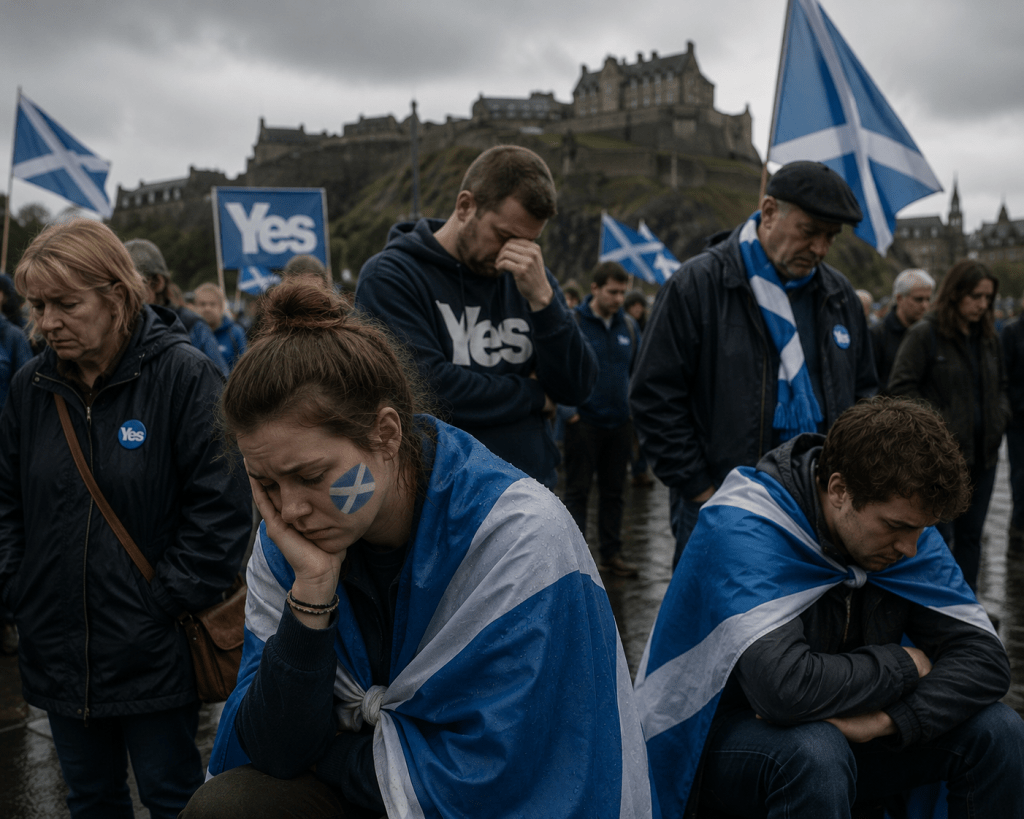
By Mark E. Saunders of “The Scottish Minuteman” https://www.facebook.com/profile.php/?id=61575625542197
This will be my final article on the SNP/Nicola Sturgeon/Peter Murrell saga. Not because there is nothing more to say, but because I have no wish to add more fuel to a fire that is already burning.
Yes. Political parties must be scrutinised. Politicians must be held accountable. Nobody is beyond criticism. That is the beauty of a healthy democracy. But what I am now witnessing goes far beyond that.
As I watch the endless stream of anti-SNP memes, AI-generated cartoons and social media derision — fed relentlessly by a 24-hour news cycle — I am acutely aware of something more calculated.
My concern is that an insidious attack is now being formulated front and centre across the UK: not on policy, politicians, fraud, secrecy or constitutional preference, but on something far more fundamental — the self-confidence and self-belief of an entire nation.
In recent years, Scotland dragged the age-old constitutional question from the political margins into the very centre of British politics. We were once proud as punch that support for Scottish independence rose from around 27% to over 50% in some polling. That was not incidental. That was a political shift of seismic proportions — to quote Alex Salmond.
Yet what we are now witnessing is a steady reversal of that momentum. And it is happening not through argument, but through ridicule. Assisted, somewhat ironically, by those who once celebrated that very momentum.
Many Scots who were not initially interested in self-government — and who once saw the UK as a stable constitutional settlement — began, in recent years, to seriously consider life in an independent country. I know them. I have spoke to them. I have honestly watched that shift happen in real time.
But those people are now being saturated with a constant diet of anti-Scottish government headlines, factional noise, all punctuated by AI-generated sarcasm masquerading as legitimate political commentary. And predictably, those people are drifting away from a burgeoning sense of possibility — back towards a position where self-government is not a question to be answered, but a doubt to be cemented.
For those who read my musings, it should be obvious by now that I do not deal in opinion pulled from thin air. Where possible, I ground it in historical precedent. And in an echo of what is being done to Scotland today, history offers a very clear example.
In nineteenth and early twentieth century Britain, Irish people were not just criticised for their views on Irish nationalism — they were caricatured into political incompetence. These were not harmless jokes floating in a vacuum. They sat directly alongside political arguments that Ireland could not govern itself. The exact place the British establishment wanted it to sit.
Over time, the propaganda did not need to be stated so explicitly. It had become cultural. Habitual. Absorbed. Accepted. The humour outlived the argument. It functioned as entertainment but doubled as political conditioning.
That is the real lesson from our shared history. Not equivalence between Ireland and Scotland — but mechanism. Repeated cultural framing, especially when delivered through mockery, does not just reflect opinion. It manufactures it. It shapes instinct before argument. And that is precisely why the incessant political humour that is happening now really matters. It is dangerous.
And it is why I have become increasingly blunt about this: even supporters of independence who take part in this cycle without thinking are not innocent participants with an axe to grind. They are feeding negative thoughts about independence. Whether they intend to or not, they are helping to normalise the very doubt that weakens their own position.
Because this is how confidence dies in a political project. Not through one decisive argument being lost, but through thousands of small cuts of ridicule, repetition, and resignation. I think the phrase, “death by a thousand cuts” fits the situation rather well.
The lesson of history is brutally simple: before a nation loses its chance of freedom, it loses its confidence. However, all said and done, if you feel the need to carry on with your fun — fill yer boots!
I will have no part in it.
Discover more from Talking-up Scotland
Subscribe to get the latest posts sent to your email.


This absolutely, utterly is the tactic and game being employed by the union and its media. Imagine how it would feel to have a media that promoted Scotland, celebrated our assets, resources and achievements, highlighted our potential and contrasted it with the negativity and exploitation by Westminster. We’d be Independent already.
LikeLiked by 2 people
I don’t believe that the majority are so easily demoralised by frantic attempts to insult us. The latest Norstat poll has independence on 52%. Of course it should be 92% and the reason it’s not will be relentless propaganda sapping confidence as you point out.
But the majority say YES and Ireland became independent in spite of the jokes.
Keep calm and carry on.
LikeLiked by 3 people
Absolutely Capella…well said.
LikeLiked by 1 person