


Over the years, I’ve noticed that no matter the issue, experts and journalists will never dream of looking north for a solution.
Yesterday, in the Guardian:
A shock government-backed report this week warned of the danger of a “lost generation” of young people in Britain, as the number of 16- to 24-year-olds not in education, employment or training (Neets) rose to more than 1 million.
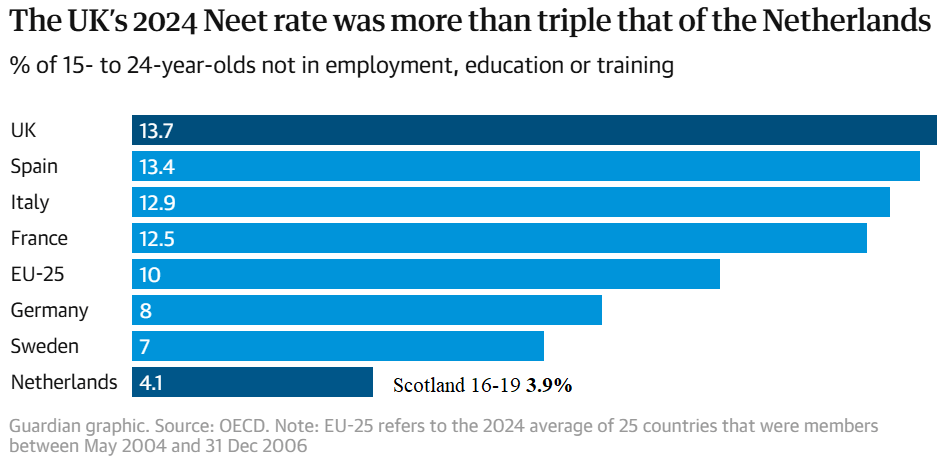
According to official UK statistics, roughly 13.5% of young people are not in work or college. Among 18- to 24-year-olds the share rises to 15.8% – nearly one in six.
In the Netherlands, the equivalent figure has been below 5% for well over a decade. According to Eurostat, whose wider 15-29 age bracket produces a higher figure, the Dutch Neet rate was 5.3% last year. The Resolution Foundation concluded in a recent report that if Britain could match the Dutch Neet rate, 600,000 more 18- to 24-year-olds would be learning or earning today.
https://www.theguardian.com/society/2026/may/29/netherlands-britain-youth-jobs-crisis
Gee, I wonder what’s the NEET rate in Scotland? An exact comparison is no more possible than that between the ‘UK’ and Netherlands, but as we’re talking percentages so they’re still pretty informative.
Scotland’s primary official measure (via Skills Development Scotland) focuses on the 16-19 age group using the Annual Participation Measure, which reported 3.9% not participating (NEET-equivalent) in 2025 (for the period covering April 2024–March 2025), with 93.3% participating in education, employment, or training.
Perhaps, Scotland is doing better on NEETs than Netherlands too?
If we are, why?
- Stronger emphasis on apprenticeships and vocational pathways: Scotland’s Modern Apprenticeships system is more established and integrated than in much of England. It provides paid, work-based training routes for 16+ year olds, helping smooth the school-to-work transition and keeping more young people in employment or training. High completion and retention rates in these programmes contribute to better outcomes. skillsdevelopmentscotland.co.uk
- Higher youth employment rates and lower inactivity: Scotland has often shown higher employment rates among 16–24 year olds and lower economic inactivity (not in work, education, or training) compared to the UK average. This reflects better overall engagement in the labour market or education. gov.scot
- Policy focus on youth employment: Successive Scottish Governments have prioritised youth employment strategies (e.g., Developing the Young Workforce), with targets, funding for training places, and careers support. This includes efforts to align education with employer needs. gov.scot
- Economic and sectoral differences: Scotland has strengths in sectors like energy, tourism, public services, and certain manufacturing that employ younger workers. The overall Scottish labour market has also shown resilience, with lower overall unemployment than the UK in recent periods. https://www.gov.scot/publications/labour-market-trends-march-2026/pages/unemployment-estimates/
In summary, Scotland’s better performance is largely attributed to a more developed apprenticeship and vocational system, plus targeted youth employment policies that improve transitions into work. These have helped it outperform the UK average even as broader economic conditions tighten.
Discover more from Talking-up Scotland
Subscribe to get the latest posts sent to your email.


The self styled ‘progressives’ of the Guardian believe that whatever is the situation in Islington is the situation in England/Britain. So, the level of NEETs in England/Britain is the level everywhere. Since those in the Celtic Fringe are incapable of running things for themselves there is no point in finding out what they do – if they do anything it will be bad QED.
Sent from my iPad
LikeLike
‘… no matter the issue, experts and journalists will never dream of looking north for a solution’ – indeed!
The interim report from the Milburn review examining the issues around NEETs gained a lot of MSM attention.
See Milburn, A. (May 28, 2026) Independent report: Young people and work: interim report. Report for the Department for Work & Pensions.
Its stated geographic scope is clear from the outset: it’s the whole of the UK. The report does acknowledge that certain germane policy areas are devolved: ‘Where policy areas discussed are devolved to Scotland, Wales or Northern Ireland, this is noted.’
However, whilst some of the statistics provided are for the UK, most are for England only. No disaggregated stats for NI, Scotland and Wales. The critique of issues around public policy design, implementation and outcomes either refer to the UK (whilst really describing England) or more commonly, explicitly focus on England. There is no attempt to document or evaluate how the devolved administrations have addressed the issues around young people and work: there is no attempt to document or assess how the interventions by devolved administrations succeed or otherwise alongside ‘reserved’, UK-wide Department of Work & Pensions (DWP) practices. In short, there is no account of what is being done and what is being achieved in NI, Scotland and Wales – for good or ill. This UK-wide review is substantially England- centred.
Just one example, in a section on the importance of access to affordable public transport for young people: ‘The relationship between transport and participation is direct and measurable. Research for the Social Exclusion Unit found that two in five young people had turned down a job, training or education opportunity because of transport problems. Transport concerns were listed as one of the three main reasons why students considered leaving college.
‘London is the exception that proves the rule. Free bus travel for those under 18 and discounted travel for anyone 18 to 21 removes transport as a barrier to participation. London also has the lowest NEET rate of any English region and the strongest post-16 destination outcomes. Transport is obviously not the only reason; but it is no coincidence that the city with the best youth transport offer has the best youth participation outcomes.’ Nothing happening in Scotland?
The report makes much about negative consequences for the support system in England that arise from an overly complex array of organisations that play a role in this policy space. In this context, the absence of a systems-level assessment in the review of what is being done by the devolved administrations is all the more odd when the report acknowledges in this context (in Para 603): ‘There are examples of good practice we can build on, including Skills Development Scotland’s 16+ Participation Portal, and the government’s work with local partners in the Sheffield Community Mission Challenge. But these are currently exceptions in the wider UK context.’ (For info, see https://www.skillsdevelopmentscotland.co.uk/what-we-do/scotlands-career-service/16plus-participation-portal )
To be fair, there are other positive references to Scotland:
‘The lack of evidence concerning targeted and individual approaches that seek to reduce the exclusion of autistic pupils who are vulnerable to exclusion is a significant gap in the literature and this needs to be addressed. This may involve looking to other countries, where exclusion rates are lower or alternative approaches are taken, to explore their policy and practice in this area. For example, the approach to school exclusions by the Scottish government provides a useful counterpoint to the English model given the much lower exclusion rates in Scotland.’ (my emphasis)
And: ‘Looking at England specifically, a far smaller proportion of apprenticeship starts are made by younger people aged 16 to 18, around 20%, compared with Scotland and Northern Ireland at around 40% and 46% respectively for 16- to 19-year- olds. The post-16 system needs to learn from parts of the UK and examples internationally where younger people are more effectively connected to work-based pathways from compulsory education.’
These positive references to Scotland are provided in isolation: there is no attempt to place them in a policy framework that exists in Scotland .. or in NI or Wales. Only England merits such treatment within a UK-wide policy review! Anyone surprised?
LikeLike
On a subject area favoured by opponents of the SNP government, another topic covered in the Milburn review is ‘interesting’ – ‘What happens outside the school gates’:
Para 293. ‘But first, an important piece of context. A study for the Department for Education found that 84% of the variation in GCSE attainment is explained by individual pupil factors or factors outside the school gates. Schools matter enormously. But they operate on only a minority of the factors that shape outcomes. (my emphasis)
294. ‘What happens at home – parenting, family composition, cultural expectations and the wider community – does most of the heavy lifting, for good or for ill. Yet this is too often the missing piece in the debate. Much of the focus in this report is rightly on public services and employers. But their actions alone will not shift the life chances of 1 million young people. Families are not a peripheral influence but are central.’
And from para 310: ‘… the relationship between social background and educational attainment in England is unbroken. It has survived every reform of the past three decades. Disadvantaged children still perform substantially worse at every stage of education. The gap does not close as children move through the system. It widens.’
LikeLike
THEY ‘THE ENGLISH’ WILL NEVER EVER ADMIT TO FRAUDULENTLY TAKING LARGE AMOUNTS OF MONEY
OUT OF THE COUNTRIES COFFERIES
LikeLike