

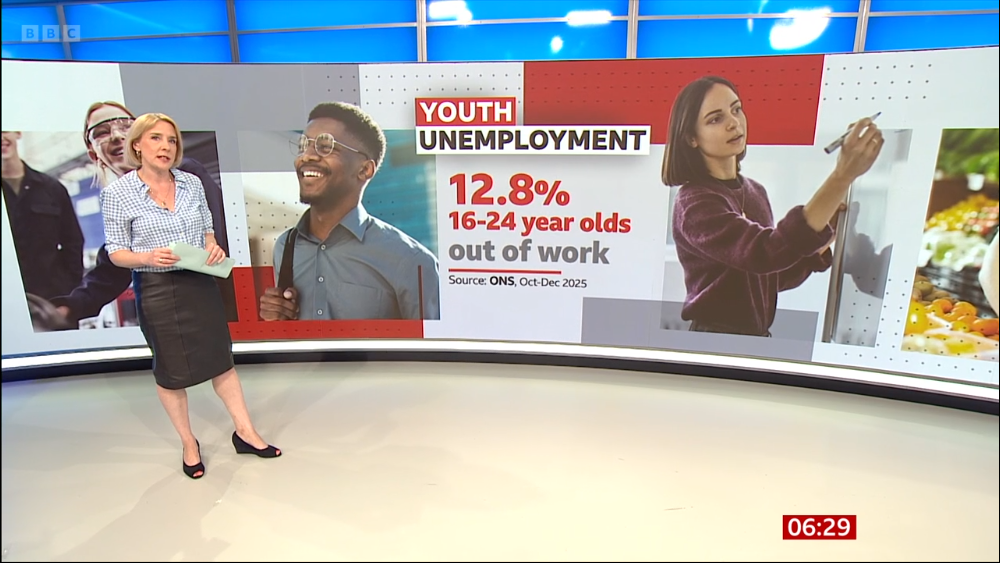
BBC Breakfast this morning, in an extended piece on the number not in work or in education – NEETS – seems to have confused that group – all 16-24 year-olds including economically inactive (not looking, e.g. due to illness, caring, discouraged) – with the unemployed, looking for work and available to start.
The figure should be 16.2% in the UK1, 16.3% in Wales2 and only 10.2% in Scotland.3 England drives most of the UK figure; regional highs in London (24.9%), Yorkshire & Humber (17.6%), North East (17.2%). England overall is slightly above the UK average.4
So, youth unemployment in the UK is almost 60% higher than in Scotland (6 as a percentage of 10.2).
Why is it lower in Scotland?
Scotland’s youth unemployment rate (around 10–12% in recent available periods, e.g. ~10.2% for Sep–Nov 2025) has consistently been lower than the UK average (currently 16.2% for Jan–Mar 2026). This gap has persisted over many years, though figures are volatile due to small sample sizes in the Labour Force Survey.
Contributing Factors
Several structural and policy differences help explain the gap:
- Stronger emphasis on apprenticeships and vocational pathways: Scotland’s Modern Apprenticeships system is more established and integrated than in much of England. It provides paid, work-based training routes for 16+ year olds, helping smooth the school-to-work transition and keeping more young people in employment or training. High completion and retention rates in these programmes contribute to better outcomes. skillsdevelopmentscotland.co.uk
- Higher youth employment rates and lower inactivity: Scotland has often shown higher employment rates among 16–24 year olds and lower economic inactivity (not in work, education, or training) compared to the UK average. This reflects better overall engagement in the labour market or education. gov.scot
- Policy focus on youth employment: Successive Scottish Governments have prioritised youth employment strategies (e.g., Developing the Young Workforce), with targets, funding for training places, and careers support. This includes efforts to align education with employer needs. gov.scot
- Economic and sectoral differences: Scotland has strengths in sectors like energy, tourism, public services, and certain manufacturing that employ younger workers. The overall Scottish labour market has also shown resilience, with lower overall unemployment than the UK in recent periods. https://www.gov.scot/publications/labour-market-trends-march-2026/pages/unemployment-estimates/
In summary, Scotland’s better performance is largely attributed to a more developed apprenticeship and vocational system, plus targeted youth employment policies that improve transitions into work. These have helped it outperform the UK average even as broader economic conditions tighten.
Sources:
- https://commonslibrary.parliament.uk/research-briefings/sn05871/
- https://www.gov.wales/labour-market-statistics-annual-population-survey-october-2024-september-2025-html
- https://www.skillsdevelopmentscotland.co.uk/media/l2qpgqbx/economy-people-and-skills-january-2026.pdf
- https://www.statista.com/statistics/280326/uk-youth-unemployment-rate-by-region/
Discover more from Scotland's First and biggest Rebuttal Service -Talking-up Scotland
Subscribe to get the latest posts sent to your email.


…and of course the MSM are talking up the UK wide issues, never a mention of Scotland doing significantly better!
LikeLiked by 2 people
I have just posted a reply to the National article on this very subject. The national tv news annoyed me so much that I had reached for my keyboard before I even realised what I was doing.
Luckily I did proof read and edit it before finally posting otherwise it wouldn’t have been allowed.😉
LikeLiked by 2 people
A blind man running for a bad could see this happening. Raise the retirement age and the younger generation suffers as there are far fewer vacancies. No doubt another YTS (Youth Training Scheme) will be thought up and young people will be exploited once again for a few £s.
LikeLiked by 2 people