

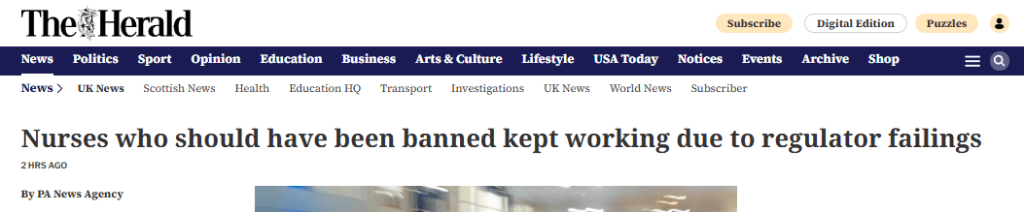
In the Guardian today:
Nurses and midwives who should have been banned from treating patients have practised over the last 12 years because of “potentially dangerous” failings by a medical regulator.
The Nursing and Midwifery Council (NMC) has admitted that its “completely and utterly unacceptable” mistakes meant it failed to protect the public from about 15 professionals whom it should have banned from ever working in healthcare in the UK because they had broken the law.
The nurses and midwives told the NMC about their criminal convictions when they applied to join or stay on the regulator’s register, which they need to be on in order to practise in Britain. However, NMC staff who assessed their applications did not then refer them on to an assistant registrar at the regulator to investigate and decide if they could treat patients, which they should have done.
The Herald, above, and all other MSM are reporting this scandal with no suggestion that NHS Scotland may be any different because it details a systemic failure by the Nursing and Midwifery Council (NMC)—the regulator for nurses, midwives, and nursing associates across the entire UK (including Scotland).
Like you, I’m guessing, I’ve learned not to give up at the first such assertion.
Might unique NHS Scotland regulations practices and procedures make this less likely even non-existent, in Scotland?
Yes, Scotland’s unique requirements — particularly the Protecting Vulnerable Groups (PVG) scheme managed by Disclosure Scotland — add extra layers of safeguarding that could make undetected serious cases less likely (or shorter-lived) compared to reliance on NMC processes alone. https://www.rcn.org.uk/Get-Help/RCN-advice/disclosure-and-barring-service
NMC Role (UK-Wide)The NMC handles registration and revalidation across the entire UK, including the “health and character” declarations that failed in this case. This administrative/process error affected applicants/renewals UK-wide, so Scotland is not exempt from the initial oversight.
Scotland-Specific Additional Safeguards
NHS Scotland (and other employers) rely on NMC registration but also require:
- PVG Scheme membership (Protecting Vulnerable Groups) for nurses/midwives in regulated roles involving contact with children or protected adults. This is a legal requirement in Scotland and involves ongoing monitoring. mygov.scot
- Disclosure Scotland checks (Level 2 or PVG scheme records), which provide criminal record information (convictions, cautions, and sometimes other relevant police info). These are employer-driven and often required at recruitment, with updates recommended for new posts. workforce.nhs.scot
Key differences that add protection:
- Continuous monitoring under PVG: Disclosure Scotland notifies employers of new relevant information, unlike a one-off NMC declaration. gov.scot
- Employer risk assessments: NHS Scotland boards have policies for reviewing disclosures, discussing convictions, and deciding suitability (with options for interim restrictions or removal from regulated work). A barred individual cannot legally work in regulated roles. rcn.org.uk
- Separate barring/listing: Disclosure Scotland makes its own suitability decisions for vulnerable groups work, which can operate independently of NMC processes. nmc.org.uk
These checks act as a backstop. Even if the NMC missed escalating a declaration, a robust Disclosure Scotland/PVG check at employment (or renewal of post) could flag issues, trigger employer review, and lead to restrictions or referral back to the NMC. Scotland’s system is more integrated with ongoing criminal record updates than in some other UK nations.
Discover more from Talking-up Scotland
Subscribe to get the latest posts sent to your email.


THIS THE TRUE HONETY OF UNIONISM
NEVER EVER TO BE TRUSTED
LikeLike
GIVE SCOTLAND AND ITS CITIZENS
THEIR BIRTHRIGHT OF FREEDOM REFUSING THESE
BASIC RIGHTS IS SAME AS THE TYRANY APPLY TO RUSSIAN CITIZENS
LikeLike