


In the Guardian today:
A Scottish government policy designed to encourage datacentres to build in Scotland could lead to a massive volume of carbon emissions being ignored, according to an analysis by a Scottish charity.
“Green datacentres” are at the heart of Scotland’s ambitions to develop economically. Enshrined in national policy, they are part of a larger, UK-wide effort to attract big AI investment to Scotland.
But Scotland appears to have no clear definition of what a “green datacentre” is. This means that current AI developments might call themselves “green” while their impact on the climate are ignored, according to Action to Protect Rural Scotland (APRS), an Edinburgh-based charity. The Green MSP Ariane Burgess, representing Highlands and Islands, said: “We urgently need transparency around what constitutes a ‘green datacentre’ and how their huge energy demands will be accommodated by our grid infrastructure.
I know this is a very complex issue, so what follows is, of course, entirely open to critical comment.
Quickly, before the more controversial issues, that last point – ‘how their huge energy demands will be accommodated by our grid infrastructure.’
Surely energy demands use up supply and build grid infrastructure to meet the demand which you then tax?
How is our supply?
So, in 2024, Scotland consumed 21.7 TWh but generated 51.8 TWh of supply making for a 30TWh surplus which was just transferred to England.
Now, if the SM is correct and these new AI data centres would need three quarters of our demand, that’d be about 15TWh from the 30TWh over-production which an independent Scotland could just sell to the companies owning them and then sell the rest to rUK. Of course, the huffy rUK, after independence, might just refuse to buy it and insist on paying more to the French whom they, especially the English, love so much.
Finally the demand on the local water environment? Already answered here in October 2025:
Chill – Scottish data centres powering AI only require 0.00004% of Scotland’s 745 trillion litres of water
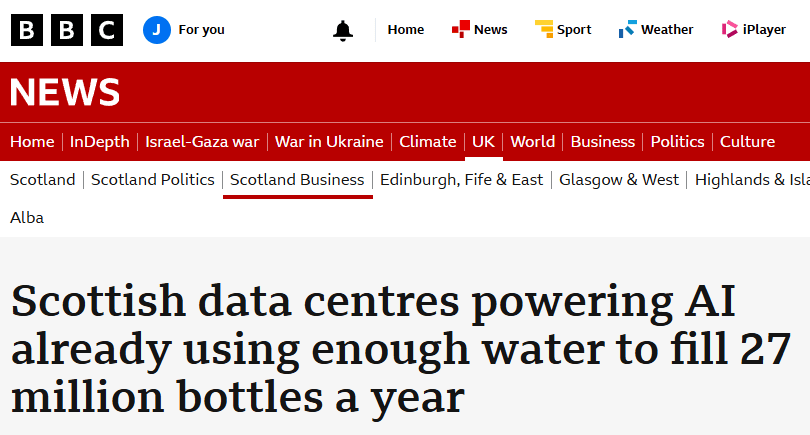
BBC Scotland had the above headline and:
Data centres powering artificial intelligence (AI) in Scotland are using enough tap water to fill 27 million half-litre bottles a year, according to data obtained by BBC News.
AI systems such as the large language models (LLMs) that power OpenAI’s ChatGPT and Google’s Gemini require warehouses full of specialist computers.
The equipment is power-hungry, consuming large amounts of energy, but they also use tonnes of water in their cooling systems to stop the servers overheating.
Freedom of Information data shows the volume of tap water used by Scotland’s data centres has quadrupled since 2021. https://www.bbc.co.uk/news/articles/c77zxx43x4vo
OK, 27 million half -litre bottles is 13.5 million litre bottles.
Where on earth will we get that? We’ll, in Scotland from just three of us?
Scotland has 5.5 million litres of water per person, 40 times that in England
Scotland’s Loch Ness alone contains 7,452 million cubic meters [745 million litres] of water, which is more than the combined volume of all lakes and reservoirs in England and Wales.
https://www.environment.gov.scot/our-environment/water/scotland-s-freshwater/ https://www.nature.scot/landscapes-and-habitats/habitat-types/lochs-rivers-and-wetlands/freshwater-lochs
England and Wales, by contrast, have far fewer natural lakes, with reservoirs like Rutland Water (12.5 km²) and Kielder Reservoir being among the largest, but their total volume is significantly less than Scotland’s.
http://www.fao.org/3/T0798E16.htm
Scotland’s water reserves are estimated at 30 trillion litres [5.5 million litres per person], compared to England’s 134,000 liters per person, highlighting a vast disparity due to Scotland’s smaller population (around 5.5 million) and abundant resources compared to England’s larger population (around 56 million). Scotland is often cited as having around 90% of the UK’s freshwater resources, largely due to its extensive loch system and higher rainfall (averaging 1,500–3,000 mm annually compared to England’s lower averages, particularly in the south).
https://www.studycountry.com/wiki/does-scotland-have-more-fresh-water-than-england https://www.thenational.scot/news/19515230.big-corporations-could-make-scotlands-water-next-oil/
So, the data centres need 13.5 million litres. Three of us, 16.5 million litres, should do that. That is only 0.00004% of the 30 trillion available.
Discover more from Talking-up Scotland
Subscribe to get the latest posts sent to your email.


Project Fear starting early……though it has never really stopped in our colonial/imperial media.
Data centre jobs, investment in Scotland, usage of our assets to enhance Scotland’s economy ?
Anathema for the Unionists…….they take control of Scotlands oil and gas industry, and then have the brass neck to criticise the SNP for the actions taken by the majority-English parliament in London.
LikeLiked by 1 person
They profit billionaires, not the people where they are built. I suggest you take a hard look before cheerleading.
LikeLiked by 1 person
Yeah unfortunately they are not good for the environment or the people living nearby etc. Just have to look at some of the problems in the US with these data centres, they are redirecting energy and masses of water from domestic supplies et, to power these things…
LikeLike
While I agree we have the resources to service data centres I am deeply suspicious of the whole concept. Who controls the data? What is this data for?
Scotland has the deep water lochs to house nuclear submarines but I don’t agree that it’s a good or proper way of using our resources or that Scots profit in any significant way.
Who makes the decisions and who is in control?
LikeLiked by 2 people
I’m sorry but just no. Slapping the word ‘green’ on them does not turn them into anything but a scourge.
LikeLiked by 1 person
By the way, the typical massive data centre employs around 20 people. Even the largest ones employ only around 50 people. So much for those employment claims.
LikeLiked by 1 person
There is a growing economic development literature on the topic of data centres and their likely impact on local, regional. and national economies.
The scale of energy and water consumption coupled with minimal direct employment impact after the construction phase are widely acknowledged. Notwithstanding this, there is ‘serious’ work going on – notably in the USA where there is an explosion of data centres – about how the tech companies establishing data centres can be incentivised to partner with others in the public and private sectors to make substantial, longer lasting contributions to local/regional innovation capabilities, business growth and re-industrialisation (to what some refer to as an area’s industrial ‘ecosystem’) in return for access to energy, water and land. Otherwise, the up-side benefits of a data centre will be largely limited to the collection of corporate tax revenues – something the Scottish Government doesn’t do.
For anyone interested, for one insights into the economic development challenges, below is a useful article (albeit from a US perspective):
Goetzel et al (2026) Turning the data center boom into long-term, local prosperity. Brookings Institution. (https://www.brookings.edu/articles/turning-the-data-center-boom-into-long-term-local-prosperity/ )
‘… local elected officials are frequently rushed into hasty sprints to negotiate complicated power, permitting, and financial incentives with community benefits often tacked on at the end of the discussions only as a supposed sweetener or to counter community unease. As a result, few negotiations explore how siting for data centers can be leveraged into truly win-win partnerships for economic development—ones that unlock high-value tech opportunities in host regions while preserving hyperscalers’ and data center developers’ core business models and timelines.‘
My concern is that the Scottish Government – even with the nouse and ambition – may not possess the agency in the Union necessary to leverage access to energy infrastructure etc. in ways that would ‘incentivise’ tech companies to contribute systemically to local/national economic development goals. After all, past attempts by Labour governments in Holyrood to grow tech-based industry ‘clusters’ in Scotland were hardly transformational for Scotland’s economy.
LikeLike
There has yet to be anywhere that any benefits have outweighed the very serious costs. This is a costly fad benefiting tech-bro billionaires rather than workers or people in any region, and Scotland should not be jumping into it.
LikeLike