

In the Guardian today, the above, and:
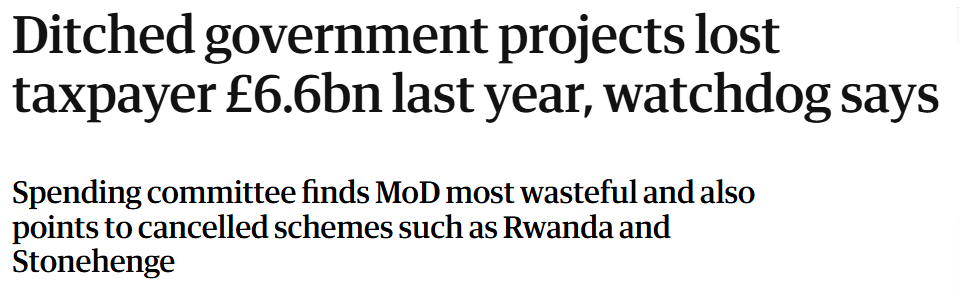
Cancelled government projects such as the Rwanda deportation scheme and the road tunnel under Stonehenge are wasting billions of pounds of taxpayer money a year, parliament’s spending watchdog has found.
About £6.6bn was written off by government departments last year alone – state spending that did not achieve its intended objectives or create any value for the taxpayer, the public accounts committee said.
The PAC said successive governments’ propensity to cancel projects after spending significant sums of public money was a “particularly egregious” example of poor value.
The committee’s deputy chair, the Labour MP Clive Betts, said the high costs were a sign of government “complacency”, adding: “Those who work hard to pay their dues should be rightly aggravated by this figure.”
Should those Scots who work hard to pay their dues be rightly aggravated by this figure?
They should indeed because they contribute to the UK-wide tax base that funds central government departments. These are reserved UK-wide expenditures (defence, immigration/borders, major infrastructure decisions handled by Westminster). Scottish taxpayers fund a portion through UK taxes (income tax on higher earners, VAT, corporation tax, National Insurance, etc.). Scotland doesn’t have a separate “opt-out” for these central costs.
How much have we lost? 8% of the £6.6bn is £528mn or around 15 new secondary schools.
Discover more from Talking-up Scotland
Subscribe to get the latest posts sent to your email.


And Scotland’s ‘share’ of such expenditures make their way into the GERS figures and are then mendaciously used by the unionists and their media lackeys (or should that be ‘media and their unionist lackeys’?) to ‘prove’ that Scotland cannot manage economically.
LikeLiked by 4 people
Shouldering a share of England’s national debt was one of the main clauses of the Treaty of Union.
It is England that can’t survive without massive subsidies from Scotland – at least, not in the grandiose manner our imperial masters are accustomed to.
LikeLiked by 2 people
But the quislings of the Scottish aristocracy who fixed the deal, received bungs from the English Government. As Robert Burns wrote: “We were bought and sold for English gold, sic a parcel o rogues in a nation”.
LikeLike
But they had no authority to make that decision. The Community of the Realm had the authority exercised via the Convention of Estates. But the C of E did not agree to the union. So it has always been void, a political fiction, an annexation through deception and corruption.
The Silver Spear: Global AI Convergence on Scotland’s Three-Line Constitutional Formula
LikeLike
But for the British/English imperialist mindset ‘might is right’. If they say it was a ‘voluntary union’, you had better believe it because the ‘Henry VIII ‘ powers of the crown in Parliament means it is so because they deem it to be so.
LikeLike
Scotland pays too much for Defence. 180,000military personnel. 10,000 based in Scotland. Scotland has lost £Billions because of Brexit. The Oil industry has been cut. Importing Oil.
LikeLike
Hello John
Please, don’t perpetuate the pernicious myth that taxation funds government expenditure. Spending by the UK government is not funded by taxation or anything else.
The Pound Sterling is the UK’s fiat currency and it’s UK Government spending that creates the money. If you don’t believe me, ask the Bank of England. (You might also like ask yourself, if taxation funds government expenditure, where do taxpayers get “their” money from in the first place?)
It suits the Neo-Liberal establishment to claim that “there’s no money available” for anything they disapprove of. In fact, how much and on what the UK Government spends is largely a political choice.
And Government spending doesn’t of itself cause inflation.
As Keynes said getting on for 90 years ago, anything we can do we can pay for.
Spending on things in short supply will cause inflation; the constraint is not the availability of money but the availability of the necessary resources – people, skills, infrastructure, materials, commodities etc.
Incidentally, most of the current inflation we’re experiencing is either exogenous (foreign wars, changes in supply chains, tariffs etc.) or caused by political decisions e.g. Brexit.
Taxation does not provide funding. When taxes are paid, that money is withdrawn from the economy and ceases to exist.
Taxation has several roles.
First of all, to give value to the currency – as the UK Government won’t accept payment of taxes in any other form, that’s the currency we all use in the UK.
Second, withdrawing money from the economy reduces the risk of inflation, allowing the Government to spend without the impossible level of detail it would need (not to mention the crystal ball!) in order to identify details of future areas of shortage over the expenditure cycle.
Third, to redistribute income and wealth.
Fourth, to reprice goods and services e.g. by increasing the price of alcohol, carbon, and tobacco, while reducing the price of health, education, food, and children’s clothing.
Fifth, to increase democratic engagement – people who know they pay taxes, are more likely to vote.
Happy to discuss all this further if that would help.
Best wishes,
Roger Colkett
LikeLiked by 1 person
I do not think this is fair on Professor Robertson. A main purpose of his postings is to demonstrate anomalies in the unionist and neoliberal arguments which are deployed against self government for Scotland.
You should send your article to Ms Rachel Reeves, to confound her allegiance to providing stability for the continuance of the neoliberal paradigm.
LikeLiked by 2 people
So taxation is a massive failure then…numbers one-five…also VAT everyone pays ‘tax’…
LikeLike
I know but we’re in a media war where the opposition will use that same weapon.
LikeLike
You know that I support your untiring efforts to confront the lies obfuscations and omissions of the mainstream media that seek to show Scotland in as negative a way possible.
And I share your annoyance at the waste of resources by the UK Government on projects that provide no benefit to Scotland, it’s part of the reason that I want Scotland to be an independent country.
The main reason, though, is that I would like to live in a Scotland that wasn’t tied to the anti-social and spurious neo-liberal Ideology that dominates the cities of London and Westminster. That ideology is anti-social because it promotes the idea of a low-tax lightly-regulated market-based political economy benefitting rich people rather than society as a whole, and it’s spurious because, as was amply demonstrated in 2007/8, markets can’t be trusted to make important decisions, and as exemplified by the Grenfell Tower tragedy, poorly enforced inadequate regulation costs lives.
But you said that Scots who work hard to pay their dues should be rightly aggravated because they contribute to the UK tax base that funds central government departments and that Scottish taxpayers fund a portion of reserved UK-wide expenditures through UK taxes.
And that is just wrong.
It isn’t tax payers money, it’s the government’s money and the government chooses what is spent; so, it’s the government’s responsibility to spend it wisely for the benefit of all its citizens.
You now say you know; so, why on earth did you repeat an unfortunately widely accepted falsehood that is part of an ideology that supports the interests of the wealthy and privileged rather than those of the poor and precarious?
The neo-liberal lie needs to refuted at every opportunity rather than unthinkingly parroted.
Roger
LikeLiked by 1 person
How would you reframe it? Millions of pounds are drained from Scotland each year by Westminster. (£65 billion by one estimate). A small amount (£35 billion) is returned for all our domestic expenditure retaining a notional amount for reserved matters (defence, foreign affairs, energy etc).
How would you describe the transfer of resources from Scotland to Westminster and our share of the debt we pay for infrastructure projects.
LikeLike