

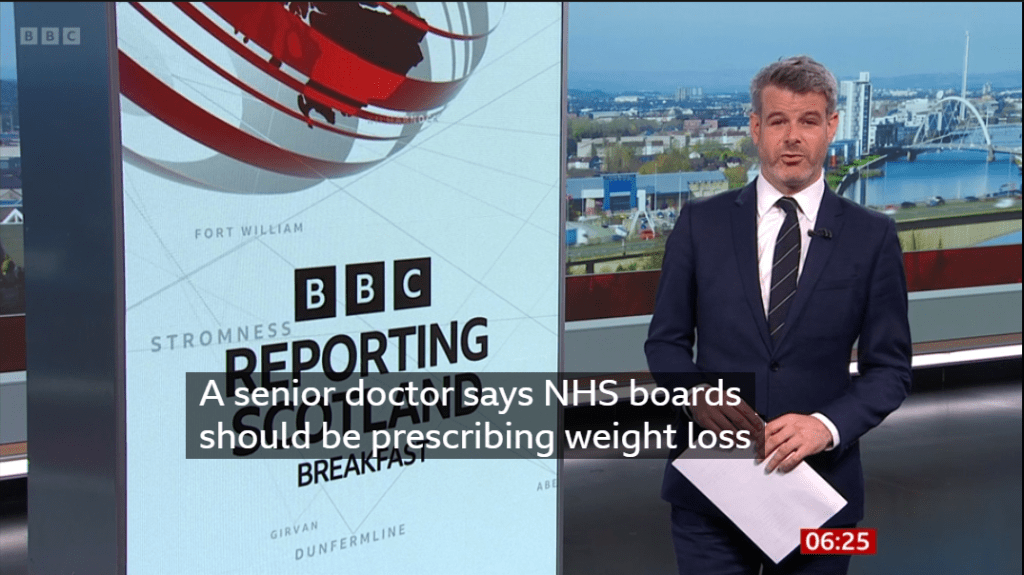
jabs to patients with obesity. The latest figures say one in three Scots are obese. Dr Mark Strachan is president of the Royal College of Physicians of Edinburgh and says more people need access to what he calls the ‘astonishing drug.’ NHS Greater Glasgow and Clyde says it’s looking into the prescribing of weight loss jabs (sic) Mounjaro and Wegovy.
BBC Scotland‘s insert in BBC Breakfast this morning has the above.
How strong is the evidence for Dr Strachan’s view which I note has not appeared widely in news media today?
A ‘senior’ doctor you might think better qualified to comment – Dr Andrew Fraser, of Obesity Action Scotland – says the drugs are not the answer and estimates the cost would be around £3bn per year.1
BBC Scotland here is pushing a very one-sided argument contrary to their charter to inform and to educate.
Experts at the heart of NHS Scotland2 rather than any old senior doctor worry that relying heavily on drugs could “medicalise” obesity while ignoring the underlying drivers:
- poverty
- unhealthy food environments
- housing and transport issues
- stress and inequality
NHS Scotland itself describes obesity as a complex condition shaped by social and environmental factors, not simply individual behaviour.
So many public health researchers argue the drugs should complement — not replace — broader measures such as:
- healthier school food
- active travel infrastructure
- anti-poverty policies
- prevention programmes
Sources:
- https://www.thescottishsun.co.uk/health/15646086/fat-jabs-not-enough-transform-scottish-diet/
- https://www.nhsinform.scot/illnesses-and-conditions/nutritional/obesity/?utm_source=chatgpt.com
For those with the time, there are powerful sources casting doubt on Strachan’s simplistic announcement which a ‘senior’ doctor should know of and which the researchers at BBC Scotland should have used to make a more balanced report:
Some notable examples:
- PLOS Global Public Health paper on the social implications of GLP‑1 drugs
Researchers from universities in Denmark, Brazil, the US and elsewhere argue that GLP-1 drugs will have “complex social implications” and discuss concerns about inequality, stigma, and over-medicalisation of body weight. - Oxford Academic: “Behavioral medicine in the GLP‑1 era” by Janet Tomiyama (UCLA)
Tomiyama argues obesity treatment still needs behavioural and environmental approaches alongside medication, and warns against reducing obesity to a purely pharmaceutical problem. - University of Bristol study on GPs’ perspectives on GLP‑1 obesity drugs
English GPs interviewed by researchers said they worried GLP-1 drugs could detract from tackling the broader determinants of obesity”, become an “overly simplistic solution” be introduced without adequate social and system support. - SAGE article on GLP‑1 drugs and health equity divides
Researchers Kateri Spinelli and Allison Oakes argue that GLP-1 access may widen health inequalities because wealthier patients are more likely to obtain and sustain treatment. - Social Science & Medicine article on “stratified biomedicalization” and weight‑loss drugs
This sociology research examines how obesity increasingly becomes treated through biomedical solutions, while social inequalities (including race, gender and class) shape who benefits. - SAGE article on cultural discourses around GLP‑1 agonists
The authors argue weight management is often framed as an issue of “individual choice” and personal responsibility, even though broader social factors strongly influence obesity.
So the concern is not fringe or purely political. There is a substantial strand of academic research arguing:
- GLP-1 drugs are genuinely effective medical treatments,
- but obesity is also socially patterned,
- and relying too heavily on medication risks neglecting structural drivers such as poverty, food systems, inequality, stress, and the built environment.
Discover more from Talking-up Scotland
Subscribe to get the latest posts sent to your email.


It wouldn’t surprise me that the push for weight loss medications is part of a trade deal with the USA. We’re slowly giving up tobacco, there are plenty of warnings about vaping and alcohol, but countries risk losing the profits that come with an addicted society. Keep weight jabs as a tool for doctors to prescribe and monitor, not as an unregulated diet aid that low income individuals might struggle to afford. Tackle supermarkets and ultra processed food manufacturers.
LikeLiked by 1 person
NO NEED TO GUESS WHAT POLITICAL PARTY THESE
people vote for
LikeLike
Do you mean you can tell who John and I vote for? At least we add our names to our posts, I’m not ashamed of my views and I’m happy to take part in discussion no matter what your views are as long as you actually express your opinion on the topic rather than my voting intentions
LikeLike
There has for many decades been an unhealthy (that is, unhealthy for the public) relationship between some ‘top’ doctors and pharmaceutical companies which amounts to a conspiracy against the public purse and the common good.
It is a betrayal of the trust many of us have in the ethical integrity of people in the medical profession, trust based on the ‘Hippocratic oath’.
In the majority of cases we are justified in placing this trust in medical staff, but, sadly, some are willing to promote drugs, not for the common good but for personal gain.
This might or might not be the case with this particular drug and this particular doctor.
LikeLiked by 1 person
I certainly didn’t mean to point the finger at doctors Alasdair, I’m sure most prescribe the drug on the basis of medical need. It’s the unregulated field I worry about where folk can order supplies on the internet without proper medical scrutiny and the opportunities for untested copies of the drug to be offered to desperate people.
LikeLiked by 1 person
Brenda, I was not criticising your statement and apologise if I have given that impression.
I was seeking to present another factor to your ‘US trade deal’ hypothesis.
I have several friends and acquaintances with whom I was at university who studied medicine. (I studied Sciences.) As we moved into our respective careers, I noted that some of them were being given things like golf outings as part of sponsorship for conferences they were promoting or were attending. There were other unsolicited gifts. Nothing was explicitly asked for in return, but, there was a feeling, ‘were some providing a quid pro quo’?
It was a gradual acceptance of an ‘I scratch your back, you scratch mine’ relationship. These were people who were competent in their medical practices and compassionate and humane towards patients. In their daily dealings with others they were honest and friendly. They were intelligent and savvy people and could see that there were temptations to go a little bit further. Some spoke to me about these tensions and, I think in most cases they resisted temptation. But one or two did not. They were still competent in their practice, but they had new incentives.
There is a phenomenon in organisation theory called ‘goal displacement’ whereby people who operate an organisation change ways in which it benefits themselves more than it benefits those for whom the organisation was set up to serve. Usually, they justify this by asserting that if it makes things easier for them they are able to do the job better.
LikeLiked by 1 person
No offence taken Alasdair, I was just afraid I’d come across as a critic of medicine & health care.
Speaking of unsolicited gifts, look at how many MPs accept donations from private health providers! I don’t buy into the Nigel Farage theory that there are all these generous donors out there just desperate to give their money away for no reason whatsoever – I certainly never came across any when working with children, and our code of practice would have barred me from accepting anyway
LikeLike
There is so much evidence implicating UPFs in all sorts of chronic disease – obesity, diabetes, heart disease – that it is true that obesity drugs are just a massively lucrative way of carrying on increasing the profit of supermarkets.
I hear that medical training spends very little time on nutrition. Take a look at hospital food!
Poor people eat industrially manufactured food and can’t afford gym memberships. Tax supermarkets to pay for Mounjaro and exercise plans for the poor. Problem solved.
LikeLiked by 1 person
From the few friends and people I know that have used this drug many struggled with the side effects and dealing with weight gain again after stopping with some turning to cheaper and less effective ‘substitutes’ on the internet. Healthy eating and exercise are the only true alternatives that should be pursued by Government more vigorously. Just saying.
LikeLiked by 3 people