

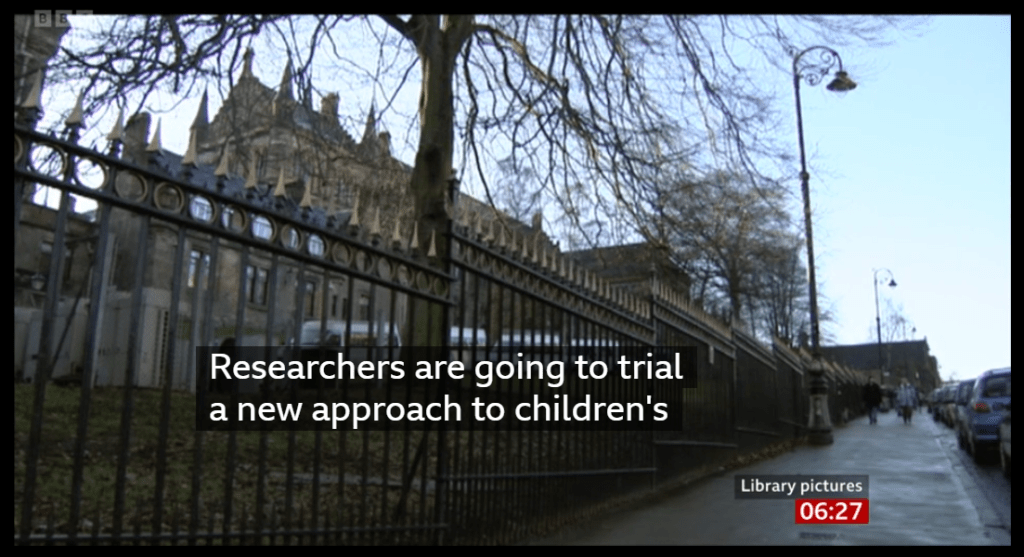
mental health services. The scheme led by the University of Glasgow – is inspired by services in India and Uganda where members of the community are trained and supported by expert clinicians to provide assessments and treatments. It’s hoped the five-year project will highlight new and quicker ways to diagnose and treat mental health illnesses in young people. Public Health Scotland figures show that, as of December last year – more than 4 000 children and young people were on a waiting list to start treatment.
This is another story fed to BBC Reporting Scotland but not featuring on the BBC Scotland website.
Now, I’m sure the researchers have found something worth pursuing here but this context-free reporting by BBC Scotland is frankly absurd and offensive.
To imply as they are that mental health treatment programmes in these three places are somehow comparable is astonishing.
There are between 25 and 30 clinical staff, depending on health board, per 100 000 in Scotland.1
In India, at best around 0.7 per 100 000.2
In Uganda, only 5 for around 20 000 000!3
As a result, there is virtually no science-based mental health care for children and adolescents in Uganda, many face violence, stigma and other abuse rather than treatment and what treatment is received is often from ‘traditional healers’ and a few NGOs.4
In India, many face stigma, abuse and violence too with a vast untreated population.5
In Scotland?
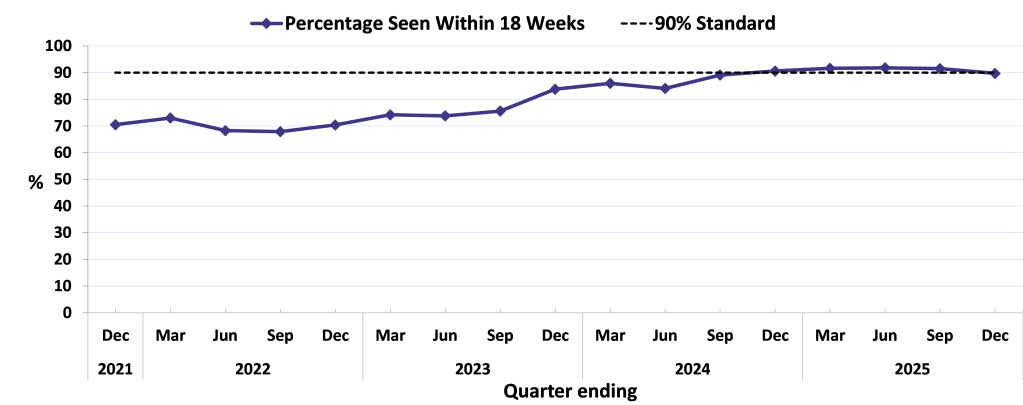
90.0% of people started treatment within 18 weeks of referral, which is a decrease from 91.5% for the previous quarter and from 90.6% for the same quarter ending December 2024. The Scottish Government standard states that 90% of children and young people should start treatment within 18 weeks of referral to CAMHS. The chart below shows performance in relation to this target over the past 4 years, illustrating the target was first achieved in quarter ending December 2024.6
Finally that last bit in the BBC Scotland report – ‘Public Health Scotland figures show that, as of December last year – more than 4 000 children and young people were on a waiting list to start treatment.’ – has been left there unexplained to suggest a problem and vast unmet need.
Sneaky.
They’re not telling you that many on the list at quarter-end were referred recently and are still well within the 18-week target. According to reports on the data, more than 80% of those waiting had been on the list for less than 18 weeks. Only a minority (roughly 9.5%, or ~385) had waited 19–35 weeks, with smaller numbers waiting longer.7
Sources:
- https://turasdata.nes.nhs.scot/data-and-reports/official-workforce-statistics/all-official-statistics-publications/03-june-2025-camhs/
- https://m.economictimes.com/magazines/panache/india-has-0-75-psychiatrists-per-100000-people-can-telepsychiatry-bridge-the-gap-between-mental-health-experts-patients/articleshow/78572684.cms
- https://pmc.ncbi.nlm.nih.gov/articles/PMC8336399/
- https://brownschool.washu.edu/app/uploads/2023/04/Uganda-Combined-Policy-Brief-Report.pdf
- https://m.economictimes.com/magazines/panache/india-has-0-75-psychiatrists-per-100000-people-can-telepsychiatry-bridge-the-gap-between-mental-health-experts-patients/articleshow/78572684.cms
- https://publichealthscotland.scot/publications/child-and-adolescent-mental-health-services-camhs-waiting-times/child-and-adolescent-mental-health-services-camhs-waiting-times-quarter-ending-december-2025/
- https://www.rcpsych.ac.uk/members/devolved-nations/rcpsych-in-scotland/scotland-news/detail/2026/03/03/rcpsych-in-scotland-comments-on-latest-camhs-waiting-time-statistics
Discover more from Talking-up Scotland
Subscribe to get the latest posts sent to your email.


The Scottish Parliament Information Service (SPICe) has compiled time series data on the performance of NHS Scotland against the following target: ’90% of young people should begin treatment for specialist Child and Adolescent Mental Health services within 18 weeks of referral.’
See https://spice-spotlight.scot/health-performance/
In graphs with data back to Quarter 1, 2025, SPICe shows that the poorest performance for Scotland overall was in Q2 2020 when just 61.7% of referrals began treatment within 18 weeks. Since then there has been steady improvement: in line with the main blog post, during Q4 2025 (the latest period charted by SPICe), the Scotland figure is 90%.
However, even this 90% compliance figure underplays what has been achieved by health boards. Below are the board level performance figures for Q4 2025: Lothian is an outlier and of course, will impact negatively on the overall Scotland figure.
Ayrshire & Arran = 100% started treatment within 18 weeks
Forth Valley = 100%
Greater Glasgow & Clyde = 100%
Orkney = 100% Shetland = 100%
Western Isles = 100%
Borders = 98.3%
FIfe = 97.9%
Grampian = 97.4%
Tayside = 97.1%
Lanarkshire = 96.3%
Highland = 88.4%
Dumfries & Galloway = 81.4%
Lothian = 62.9%.
LikeLiked by 2 people