

By stewartb
Recall that Prime Minister, David Cameron announced on 23 January 2013 that if the Conservative Party was elected to power following the 2015 general election, it would hold a referendum on the UK’s membership of the EU in the next Parliament. Cameron’s government published a draft European Union (Referendum) Bill in May 2013. The Tories won the 2015 GE: the European Union Referendum Bill 2015-16 was introduced in the House of Commons in May 2015 and it received Royal Assent on 17 December 2015.
In the 2015 general election, the Conservative Party won:
- 330 out of 650 UK seats, with a 36.8% share of the vote
- 330 out of 632 seats in Great Britain with a 37.7% share of the vote
- just 1 out of 59 seats in Scotland with a 14.9% share of the vote.
The referendum was held with the majority of Scotland’s electorate voting to remain in the EU to no avail. Leave majorities in England and Wales prevailed and a ‘hard’ Brexit as then implemented
Source: House of Commons Library on ‘General elections and governments’ (110 KB , Excel Spreadsheet) available at https://commonslibrary.parliament.uk/research-briefings/cbp-7529/
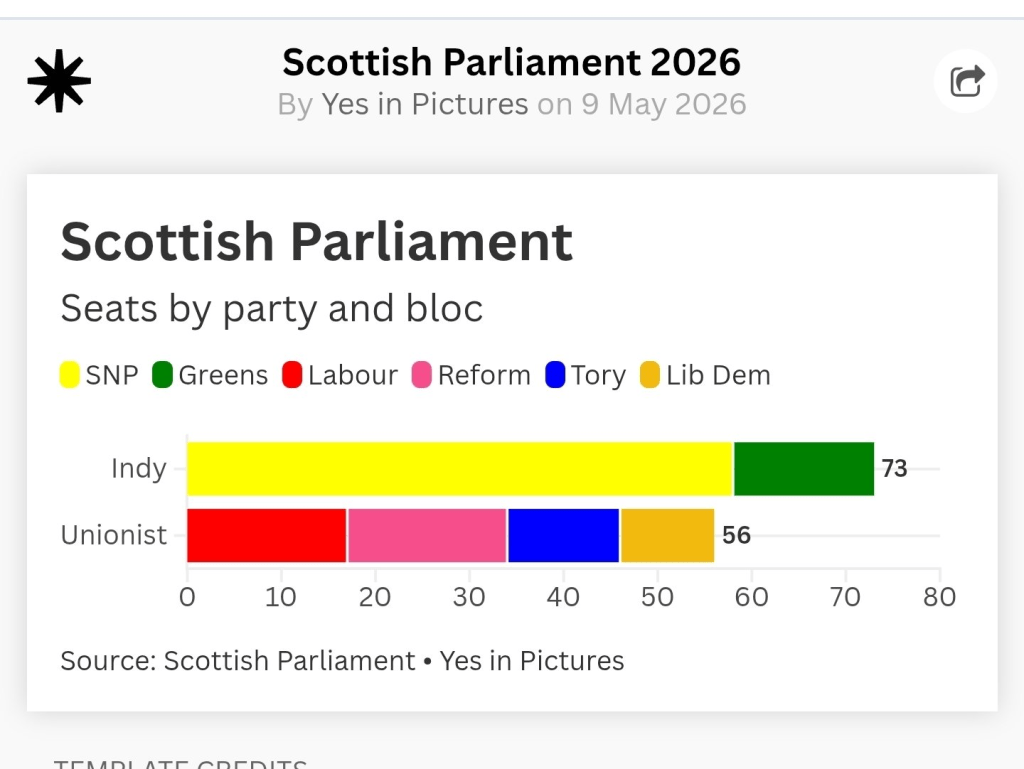
The electoral statistics from 2015 help put the results of the recent Holyrood election into perspective. Overall, the SNP gained 58 of the 129 seats in the Scottish Parliament. Fellow pro-indy party, the Scottish Greens gained 15 seats. The SNP’s share of the FPTP constituency vote – the close comparison with the UK GE system of voting – was 38.18%: the Scottish Greens achieved a 2.2% vote share, a total of 40.38% for pro-indy (pro-referendum) parties. Recall Cameron’s Tory Party in 2015 had less than 38% of the UK vote when it pressed on with holding an in-out EU referendum.
The SNP gained a 27.18% share of the Regional votes: the Greens achieved a 13.98% share. So the total vote share for these pro-indy (pro-referendum) parties was 41.16%.
To another question: what might a political mandate to DENY the right to put a major constitutional question to the electorate look like in the UK?
In the 2024 UK 2024 General Election, the Labour Party won:
- 411 out of 650 UK seats with a 33.70% share of the vote
- 411 out of 632 Great Britain seats with a 34.6% share of the vote
In the 2024 UK GE, Labour gained a 35.3% share of the vote in Scotland. (For completeness, in the recent Holyrood election, Labour gained a 19.18% share of constituency votes and a 16.01% share of the Regional votes.)
Source: https://researchbriefings.files.parliament.uk/documents/CBP-10009/CBP-10009.pdf
Discover more from Talking-up Scotland
Subscribe to get the latest posts sent to your email.


Interesting, thanks Stewart. Something to use as a tool and argument for Scotland’s democratic rights…
LikeLiked by 1 person
Thanks Stewart. As a long standing SNP member and Indy campaigner I have put the Party on notice that this is their final warning that they will only rely on my furure support with the proviso they immediately negotiate another Referendum. I am in my laste 70’s and cannot afford any further delay in securing our freedom for my children and grandchildren.
LikeLiked by 3 people
Urgent need to shift the dial, and beyond (hypothetical) ‘process’: we need the Scottish Government to implement tangible political action to advance constitutional change which, yes, will involve risk taking. Otherwise, it’s not stasis we will experience but a decline in the SNP’s vote share over time.
We also need to see a bold plan now to counter a potential big rise in support for Reform at the next diet of Scottish local government elections, as seen in England.
LikeLiked by 1 person
Ditto,but quit the SNP over the Salmond imbroglio+ the(too slow!) recognition of what Sturgeon was about- late 70’s too, and very annoyed!
LikeLike
???
LikeLike
Very interesting article……has anyone heard a cheep from wee Dougie Alexander on the election result seems he has crawled under ground.
LikeLike
Scotland needs to vote out all of the Unionists next GE. Increase the Independence vote.
LikeLike