

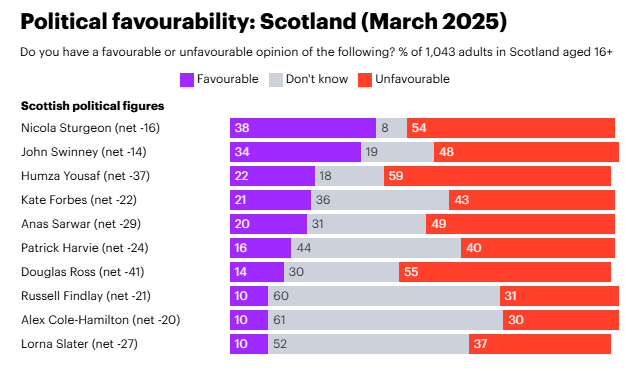
The Guardian‘s supposed Scottish correspondents, Libby Brooks and Severin Carrell, today, repeat this myth:
Starmer’s unpopularity was insurmountable for Scottish Labour – and a boon for Reform – Long before the final votes were counted in Scotland, veteran Labour politicians said it was a defeat made in Downing Street.
When the Scottish Labour leader, Anas Sarwar, strode into the Glasgow count arena on Friday afternoon flanked by sombre-faced activists, the scene was a mirror image to the same venue in 2024, when his resurgent party won 36 seats from the Scottish National party, playing a significant part in Keir Starmer’s landslide victory.
Two years later, Starmer’s unpopularity proved an insurmountable obstacle for Sarwar, despite record donations [from the ricj] to Scottish Labour and a formidable electoral machine, honed over the past five years. And with only a handful of constituencies declared, he decided to concede defeat before the real scale of Labour losses across the country was known.
They’ve be working this line for years.
Last September, 7 months out from Holyrood 26, they knew they were in trouble despite the July 2024 Labour ‘Change’ wave in the General Election, when we in the SNP got s chilling reminder of just how easily influence most of the electorate is.
In the Scotsman 7 March 2026, Prof Curtice claimed:
Sir Keir Starmer’s Labour Party “really are in deep doo-doo”, polling guru Sir John Curtice has said. Sir John, professor of politics at Strathclyde University, said the party’s poll rating is arguably at an all-time low.
That was obviously true but this wasn’t:
Pollster Mark Diffley said recent developments were bad news for Scottish Labour leader Anas Sarwar as his party looks towards the Holyrood election next year. “It’s really bad timing, obviously, for Anas,” he told The Scotsman. “Hugely bad.” He added: “He must think, ‘Will I ever get a clear run to be able to make some progress?’”
Mr Diffley said Labour is polling badly in Scotland because of perceptions of the UK Government.
“It seems to me he [Mr Sarwar] just can’t get on the front foot, really,” he said. “It feels like he’s going into this with one arm tied behind his back with everything that’s going on completely outwith his control, but which is continually negatively impacting his chances. That must be hugely frustrating.” He said Scottish Labour are “hamstrung” by events down south. https://www.scotsman.com/news/politics/sir-john-curtice-starmers-labour-really-are-in-deep-doo-doo-5305573
This is an old story now – the idea than Anas Sarwar would do better in the polls if it wasn’t for Sir Keir Starmer’s policies.
It’s hard to see the sense in this when it ignores so much.
First, the people now know that, despite BBC Scotland’s attempts to shield him from scrutiny, Sarwar is on record as having publicly supported all of those same policies, including scrapping benefits, closing a Scottish refinery and genocide in Gaza.
Second, the people also know that their new local Labour MP has been loyally voting with the PM on all of those same policies and, I’ve heard, not responding to them.
Third, in the last 10 UK polls, Reform UK has had an average lead over Labour of 10.9 while in Scotland, the SNP has had an average lead over Labour of 14. Labour in Scotland, under Sarwar, are doing worse than Labour in the UK under Starmer.
So, it’s not Starmer to blame but Sarwar and the Scottish Labour MSPs and MPs to blame for being cynical opportunists and/or spineless lackeys
Discover more from Talking-up Scotland
Subscribe to get the latest posts sent to your email.
 Talking-up Scotland
True. One lie too many. Beats me how his sidekick managed to stay put.
LikeLiked by 2 people
Anyone who continually uses the death of a child to aid his political ambitions deserves NOTHING from the electorate !
Sarwar got his just desserts ! Good riddance !
LikeLiked by 5 people
GE next to get rid of the Labour losers. They only got it to get rid of the Tories.
Scotland needs to be Independent to be more cohesive, fair and prosperous.
The £5Billion black hole in finance does not exist.
Scotland pays too much for the military. Trident and redundant weaponry. Brexit has cost £Billions. Scotland makes loan repayments on loans not borrowed or spent in Scotland. Scotland in surplus in fuel and energy pays more. Nearer the source.
The Oil industry will have to be renewed. No point in importing when it can be produced.
LikeLiked by 3 people
“The Guardian‘s supposed Scottish correspondents, Libby Brooks and Severin Carrell, today, repeat this myth”
That is solely blaming the bad results for Labour in Scotland upon the Labour HQ leader.
This would be the same Labour HQ leader that Anas Sarwar once campaigned so very hard for in the 2024 UK GE in Scotland.
Part of that campaign by Sarwar in 2024 included pledges that he made on behalf of UK Labour to Scotland, that turned out to be either not true , or as pledges, were unfulfilled.
So this predictable political spin by some of the usual media suspects, all to try to minimise the damage for Sarwar and so somehow then justify him staying in his position as the branch office manager here in Scotland, is an exercise by them in grasping at straws or to be blunt, simply them lying (yet again) for Labour.
Not a shock nor a surprise it it really.
As that is their job.
However why not let him stay as it will only further confirm to the public in Scotland how unwilling he is to accept political reality and also unwilling to accept political rejection, plus TBH he is an asset to the SNP as an opponent.
At 8.46pm on the 8 May Sarwar posted this on ‘X’
“It’s an honour to be re-elected as an MSP for Glasgow – the city I am proud to call home. I look forward to continuing to serve the great people of Glasgow”
On Thursday Sarwar failed to be elected as the constituency MSP in his own constituency but he got in on the List.
Words matter.
As do political delusions and also political misrepresentations also matter in this particular case, so re-read Sarwar’s post on ‘X’ and just think that if you, as a voter, were unaware of the actual result in Sarwar’s constituency, then after reading his post last night you would surely think that he had actually won his own Constituency seat , when clearly he did not !
So even after losing the Constituency vote in his own seat , still Sarwar keeps trying to twist the truth to suit himself, it seems that Scotland really did dodge a you know what, in us not choosing either Labour or Sarwar to be our next Scottish government and FM.
Thank god the SNP won, though it seems that the UK media find it hard to present is as such, as instead they are mainly focusing upon the SNP having not achieved a majority……
The same majority win which Scottish parliament elections is supposed to try to prevent happening for one party in order to make the overall result supposedly fairer to all parties as in make it more proportional.
TBH even if the SNP had somehow managed to get a majority then still the UK media would have found a way to devalue their achievement in order to still say that the SNP had ‘NO MANDATE FOR A SECOND INDEPENDENCE REFERENDUM’.
That’s their job , always.
Liz S
LikeLiked by 2 people
So-called Scottish Labour performed as badly as so-called BBC Scotland. Both taking their orders from their London masters and adding their own spin. Both failing unreservedly in this election. The media in Scotland spends its time criticising and undermining Scottish institutions but this election reveals again the failures of two “Great” British institutions, the BBC and the Labour Party. Self appointed but fundamentally flawed and corrupt.
LikeLiked by 2 people
O/T What does a political mandate for putting a major constitutional question to the electorate look like in the UK?
Recall that Prime Minister, David Cameron announced on 23 January 2013 that if the Conservative Party was elected to power following the 2015 general election, it would hold a referendum on the UK’s membership of the EU in the next Parliament. Cameron’s government published a draft European Union (Referendum) Bill in May 2013. The Tories won the 2015 GE: the European Union Referendum Bill 2015-16 was introduced in the House of Commons in May 2015 and it received Royal Assent on 17 December 2015.
In the 2015 general election, the Conservative Party won:
The referendum was held with the majority of Scotland’s electorate voting to remain in the EU to no avail. Leave majorities in England and Wales prevailed and a ‘hard’ Brexit was then implemented
Source: House of Commons Library on ‘General elections and governments’ (110 KB , Excel Spreadsheet) available at https://commonslibrary.parliament.uk/research-briefings/cbp-7529/
The electoral statistics from 2015 help put the results of the recent Holyrood election into perspective. Overall, the SNP gained 58 of the 129 seats in the Scottish Parliament. Fellow pro-indy party, the Scottish Greens gained 15 seats. The SNP’s share of the FPTP constituency vote – the close comparison with the UK GE system of voting – was 38.18%: the Scottish Greens achieved a 2.2% vote share, a total of 40.38% for pro-indy (pro- indy referendum) parties. Recall Cameron’s Tory Party in 2015 had less than 38% of the UK vote when it pressed on with holding an in-out EU referendum.
The SNP gained a 27.18% share of the Regional votes: the Greens achieved a 13.98% share. So the total vote share for these pro-indy (pro-referendum) parties was 41.16%.
To another question: what does a political mandate to DENY the right to put a major constitutional question to the electorate look like (potentially) in the UK?
In the 2024 UK 2024 General Election, the Labour Party won:
In the 2024 UK GE, Labour gained a 35.3% share of the vote in Scotland. (For completeness, in the recent Holyrood election, Labour gained a 19.18% share of constituency votes and a 16.01% share of the Regional votes.)
Source: https://researchbriefings.files.parliament.uk/documents/CBP-10009/CBP-10009.pdf
LikeLike
O/T What does a political mandate for putting a major constitutional question to the electorate look like in the UK?
Recall that Prime Minister, David Cameron announced on 23 January 2013 that if the Conservative Party was elected to power following the 2015 general election, it would hold a referendum on the UK’s membership of the EU in the next Parliament. Cameron’s government published a draft European Union (Referendum) Bill in May 2013. The Tories won the 2015 GE: the European Union Referendum Bill 2015-16 was introduced in the House of Commons in May 2015 and it received Royal Assent on 17 December 2015.
In the 2015 general election, the Conservative Party won:
The referendum was held with the majority of Scotland’s electorate voting to remain in the EU to no avail. Leave majorities in England and Wales prevailed and a ‘hard’ Brexit as then implemented
Source: House of Commons Library on ‘General elections and governments’ (110 KB , Excel Spreadsheet) available at https://commonslibrary.parliament.uk/research-briefings/cbp-7529/
The electoral statistics from 2015 help put the results of the recent Holyrood election into perspective. Overall, the SNP gained 58 of the 129 seats in the Scottish Parliament. Fellow pro-indy party, the Scottish Greens gained 15 seats. The SNP’s share of the FPTP constituency vote – the close comparison with the UK GE system of voting – was 38.18%: the Scottish Greens achieved a 2.2% vote share, a total of 40.38% for pro-indy (pro-referendum) parties. Recall Cameron’s Tory Party in 2015 had less than 38% of the UK vote when it pressed on with holding an in-out EU referendum.
The SNP gained a 27.18% share of the Regional votes: the Greens achieved a 13.98% share. So the total vote share for these pro-indy (pro-referendum) parties was 41.16%.
To another question: what might a political mandate to DENY the right to put a major constitutional question to the electorate look like in the UK?
In the 2024 UK 2024 General Election, the Labour Party won:
In the 2024 UK GE, Labour gained a 35.3% share of the vote in Scotland. (For completeness, in the recent Holyrood election, Labour gained a 19.18% share of constituency votes and a 16.01% share of the Regional votes.)
Source: https://researchbriefings.files.parliament.uk/documents/CBP-10009/CBP-10009.pdf
LikeLike
The SNP vote decreased in the 2026 election, and as I predicted, The SNP do not have enough seats for a majority government.
The opposition is now tied between Labour and Reform.
I would say it is very unlikely that permission for an independence referendum will be granted before the next General Election.
LikeLike