

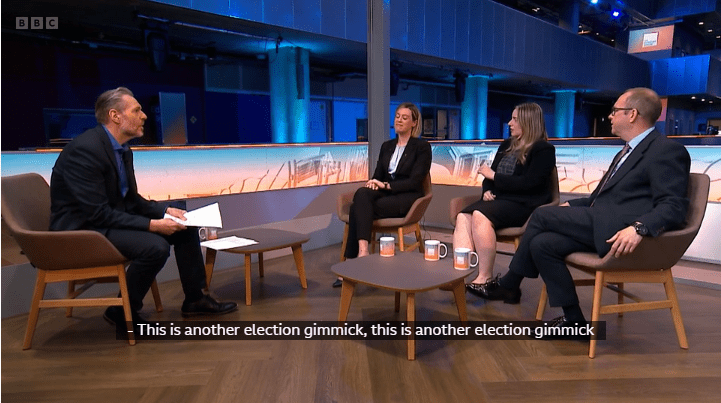
From BBC Scotland yesterday, the above and:
The SNP’s plans to expand free childcare have been criticised by Scottish Labour and the Scottish Conservatives as a “gimmick” and lacking in detail.
Is that true? Let’s ask an intelligent speedy independent source:
Look at the actual proposals and the Scottish Government’s history of action on free childcare, including relative to England or Wales to assess whether this is just a gimmick or real plan with benefits for parents.
From use.ai:
Looking at the SNP’s actual proposals and track record on childcare, it would not be accurate to characterise the current plan as “just a gimmick.” While there are legitimate questions about cost and delivery, the policy builds on a substantial history of expansion that’s already had measurable effects for parents.
1. What the new proposal includes
At the SNP’s 2026 conference, First Minister John Swinney pledged over £500 million to expand free childcare for all children from nine months to the end of primary school, available year‑round and tapered by income bbc.co.uk. The aim is to integrate breakfast, after‑school, and childminder provision — essentially a wraparound model to help parents work full time.
This goes far beyond current entitlements and is designed to ensure that support covers periods like the school holidays, when childcare remains a burden.
2. The SNP’s existing record
Scotland under the SNP already provides 1,140 funded hours of early learning and childcare for all 3‑ and 4‑year‑olds, regardless of whether their parents work — the most universal offer in the UK. In England, only eligible working parents qualify for that amount of time; in Wales, pilots offer more hours but only to working families. That move from 412 hours to 1,140, delivered by the SNP government, represented one of the largest expansions in public childcare provision in the UK over the past decade bbc.com.
So, the track record is one of delivery and expansion, not empty promises — though the rollout has experienced capacity and staffing strains (what the BBC and charities have called “childcare deserts”) similar to those seen in England when provision was increased quickly.
3. Real benefits and remaining challenges
The expansion has lowered average childcare costs for many families and given parents, particularly mothers, greater ability to return to work or increase hours. Surveys still show gaps — especially in provision for under‑twos and rural areas — but the policy shift has had real benefits for affordability and labour market participation.
The 2026 plan would deepen these benefits if implemented effectively, but funding, staffing, and infrastructure remain the main constraints.
In summary: describing the SNP’s childcare expansion as a “gimmick” would not be a fair reflection of the evidence. It’s a continuation of a sustained policy programme that has already delivered the most universal free childcare in the UK. The central debate now is about how deliverable the new pledge is at scale, rather than whether it represents real policy intent or benefit.
The summary above is supported by detailed reporting and official documents, chiefly from these sources:
- bbc.co.uk — “Swinney promises £500m childcare boost and more GP walk‑in clinics” (March 2026). Confirms the SNP’s pledge to expand childcare for all children from 9 months to 12 years old, year‑round, backed by £500 million in funding.
- bbc.co.uk — “Parents promised more free childcare by Scottish party leaders” (March 2026). Outlines competing party plans and details that Scottish Government funding for existing free childcare exceeds £1 billion a year.
- bbc.com — “Why do I get less free childcare for my two‑year‑old than in England?” (December 2024). Explains the differences between the Scottish, English, and Welsh childcare entitlement models, and notes that Scotland uniquely offers 1,140 hours a year to all 3‑ and 4‑year‑olds regardless of parental employment status.
- gov.scot — “Best Start: Strategic early learning and school age childcare plan 2022–2026”. Sets out the Scottish Government’s policy framework, confirming that the 1,140‑hour expansion was implemented and continues toward broader wraparound and early‑years care.
Taken together, these sources show that the SNP’s childcare proposals build on a sustained, multi‑year expansion with measurable benefits for families. While questions about delivery and workforce capacity remain, the initiatives have a clear track record and policy continuity rather than being a purely cosmetic “gimmick.”
Discover more from Talking-up Scotland
Subscribe to get the latest posts sent to your email.
 Talking-up Scotland
The case study by the Institute for Innovation and Public Purpose (IIPP) based at University College London on free school meals discusses the wider benefits of universal provision of free meals to all children. (March, 2026, Mazzucato and Macfarlane)
Making child care universally available would have the same kinds of wider benefits.
The IIPP study is about restoring the paradigm of universalism – which is exemplified by, for example, the NHS – which was generally accepted by Labour, Tories and Liberal Democrats – from the end of the Second World War until the Thatcher Government, when it came under sustained attack. Sadly, Thatcher was successful in changing the paradigm and universalism is no longer hegemonic within the Labour Party. But, the support for Jeremy Corbyn’s policies had significant public support.
Although Gordon Brown, as Chancellor, implemented a number of universalist policies between 1997 and 2010, he refused to make the case for it. Partly, this was due to his ‘contract’ with Blair, but, partly, it was down to him no longer being a socialist. He still has a humane attitude to many things, but, he is a Labour tribalist and a British nationalist. So, his intellectual and humanitarian drives are predicated to sustaining the Labour Party and the United Kingdom. He is prepared to promote redistributive policies, provided these do not conflict too strongly with his prime objectives.
His refusal during his Prime Ministership to set out the redistributive universalist argument, coupled with the financial crash of 2008, enabled George Osborne to impose ‘austerity’ with an intensity that even Thatcher might have hesitated to do. Labour has accepted the neoliberal economic paradigm which has progressively impoverished UK citizens. ‘Welfare’ is seen as BAD. It was these policies which have hindered the Scottish Government’s efforts to extend free meals to all schoolchildren
Hence in the debate with Jenny Gilruth, there was no shade of difference between the Labour and Tory opposition to Ms Gilruth, regarding extending universal childcare.
Commonweal has close links with the Labour Party and has well-thought out universalist and redistributive policies, but these are not appearing to any great extent in Labour’s policies for Scotland.
Let us hope that an SNP government, after Thursday, has the courage to move forward with such policies. It may well have to do so in alliance with the Greens and I hope both parties have learned lessons from the circumstances which led to the ending of the partnership in government.
LikeLiked by 1 person
I mean pot kettle and all that, the EngBrit parties are experts at ‘gimmicks’ via slogans and, sigh, I happened to see a smidgen of a Labour ad on Ytube, yep, a film of racing horses, I presume as a metaphor (‘gimmick’) Oh dear for a start horse racing is not looked upon as a sport etc by most peoples’ standards, it’s seen as utterly cruel.
The EngBrit parties see the election as a race? A race to the bottom for them, sincerely hope so.
LikeLike
As for childcare, I always find it strange that parents go to work to earn money to pay for someone else to look after their kids. I know it’s not that simple but…
LikeLike
Calm doon wid yese. It’s MacPravda. What did you expect, honest journalism?
LikeLike