

By stewartb
Views on the economic and social policy context that Scotland in Union experiences can pop up in unexpected places. In this example, it’s in a report from the Institute for Innovation and Public Purpose, University College London (UCL) on the implementation of free school meals in different countries. It’s co-authored by the Institute’s founding director, Mariana Mazzucato, professor in the Economics of Innovation and Public Value. The latter has a notably high reputation in the UK and internationally, including for work on various aspects of political economy and government policy development.
This is the source document: Macfarlane and Mazzucato (March 2026) Free School Meals in Scotland: expanding universalism in a time of austerity – Case Study. UCL Institute for Innovation and Public Purpose report.
The report emphasises the degree of policy change under an SNP government. Referring to the 2007 Scottish Parliament election: ‘The SNP’s election campaign had placed a strong emphasis on tackling child poverty and building a more universal approach to welfare, including introducing universal free school meals.’
‘… in 2010 the Scottish Government announced the rollout of universal free school meals for all P1–P3 pupils in a number of local authorities. Following the SNP’s re-election in 2011, the Scottish Government committed to introduce universal free school meals for P1-P3 pupils across the entire country. Due to funding and logistical issues however, it was not until January 2015 that the policy was rolled out nationwide.’
‘The announcement represented a landmark moment in Scotland: a clear break from the means-tested model that had been dominant in the UK since the 1980s, and a return to the universalist approach of the post-war era.’
On the wider economic context within which the SNP has been governing Scotland: ‘The period during which the Scottish Government has sought to roll out school meals has been an extremely challenging time for the UK economy. After the UK entered recession following the global financial crisis in 2008, the country experienced the slowest economic recovery of modern times. A key reason for this was the UK Government’s austerity programme, which stifled demand, undermined productive capacity and squeezed living standards.’
‘As a devolved nation of the UK, Scotland has a constrained fiscal budget and limited borrowing powers. Although spending decisions relating to education, health and social policy are devolved to the Scottish Parliament, the Scottish Government’s budget is still largely determined by the spending decisions of the UK Government. The single largest source of funding for the Scottish Government is the Block Grant received through the Barnett Formula, whereby annual funding is dependent on the UK Government’s overall fiscal plans and its spending priorities.’
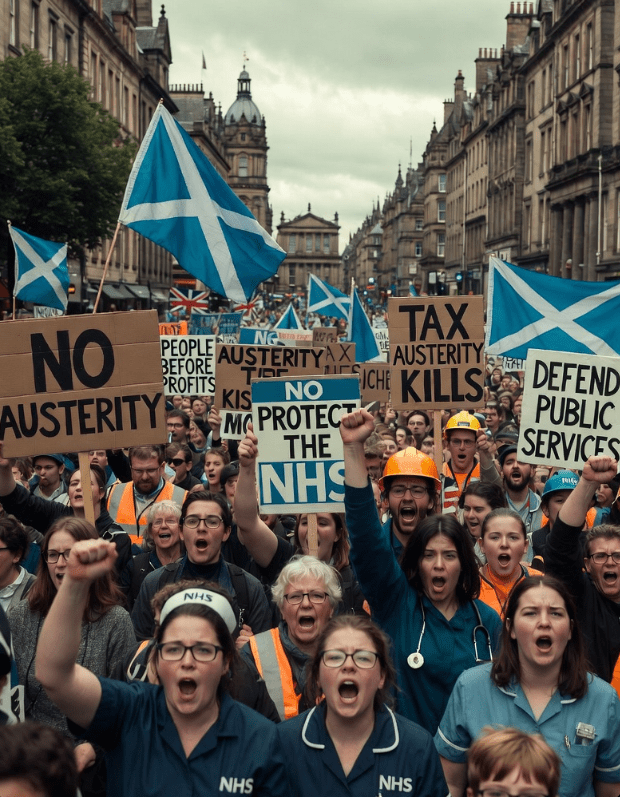
And on the negative impact of a Westminster governing party that Scotland rejected at the ballot box: ‘… the UK Government’s austerity programme, which has resulted in significant cuts to the Scottish Government budget. It has been estimated that between 2010/11 and 2019/20, these cuts resulted in £13.6 billion less being spent on public services than would have been the case if spending had been kept flat.
‘This in turn reflects a growing political and ideological divergence between the UK and Scottish governments. In 2010, the Conservative Party won the UK election on a platform of austerity, welfare cuts and ‘balancing the books’. In contrast, the SNP won the 2011 Scottish election (and subsequent elections) on an anti- austerity platform focused on tackling child poverty, reducing inequality, and building a more inclusive and universal approach to welfare.’
‘…. despite cross-party support in Scotland for extending free meals to all primary pupils, progress has been slower than intended, with delays attributed in part to the broader context of constrained devolved budgets and the lack of a shared UK-wide commitment to universal school meal provision.’
‘Governments should view free school meals not as a cost, but as a long-term investment. …. To maximise long- term impact, all investments must also be funded adequately, but the Scottish Government’s ability to roll the policy out nation-wide has been repeatedly hampered by the UK Government’s austerity programme. As a result, the Scottish Government has turned to progressive income taxation to fund its more universalist approach to welfare.’
Another authoritative source pointing out the reality of Scotland in Union!
Discover more from Talking-up Scotland
Subscribe to get the latest posts sent to your email.
 Talking-up Scotland
Health eating choices affect school meals. If pupils just want chips they have to take fish. They do not like or eat the fish. A bit of a waste. They have to take some other choices to get what they want. It would be better just to let them choose. School meals are good. Or if the pupils do not like it, they can take packed lunch.
LikeLike