

By stewartb
In its news report of the JRF’s statement on the election manifestos of political parties in Scotland regarding poverty, The National newspaper quotes the social justice spokesperson for the British Labour Party in Scotland. This demonstrates yet again the party’s political hypocrisy.
On poverty reduction, Claire Baker states: “The SNP’s shameful lack of progress over the last two decades has made this all the more challenging and all the more urgent.” And: “Scottish Labour is determined to tackle poverty at its root, support the next generation and make life more affordable.”
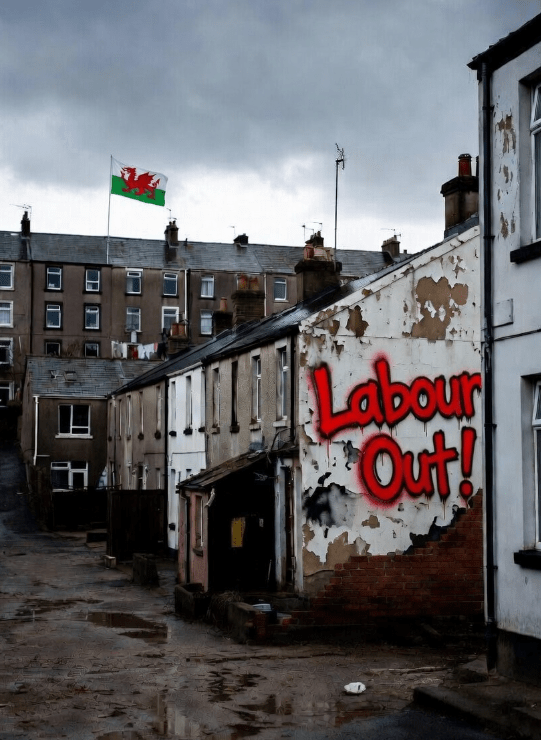
Fortunately we can assess the Labour Party’s credentials for governing successfully and addressing poverty with just devolved powers. We can call on the research findings of the very same JRF to benchmark ‘progress’ in Wales governed from Cardiff since the advent of devolution by Labour. Has Labour in Wales ‘tackled poverty at its root’ as Ms Baker promises Scotland? Has Labour in Wales succeeded in avoiding a ‘shameful lack of progress’? In short, it has NOT!
From the JRF (10 June 2025) ‘Poverty in Wales 2025 – Very deep poverty is rising in Wales. More people using food banks, unable to heat their homes, or living in temporary accommodation, means the human cost and impact on public services is huge.’
The JRF notes: ‘Twenty years ago, JRF’s first report on poverty in Wales found a sustained and welcome decrease in poverty since the mid-1990s. Its latest analysis brings no such good news, with headline rates of poverty flatlining in the 2 decades since. That is bad enough, but most worrying of all is the rise in very deep poverty. Today, almost half of all people in poverty in Wales have incomes so low that they are in this extreme situation: this means more people forced to use food banks, unable to heat their homes or living in temporary accommodation. The human cost of poverty, especially deep poverty, and its impact on public services are huge. (my emphasis)
‘Underlying this 21st-century social failure are many years of deep cuts to social security, along with a shortage of decent jobs and affordable housing. …’
The JRF adds: ‘Poverty matters. It is in every community in Wales, amongst people of all ages, all backgrounds and in all types of families. It blights lives and costs the public purse. It is a moral outrage.’ And: ‘There has been little progress in reducing poverty in Wales over the past 20 years, with poverty rates consistently hovering around 21–22%.’ Adding: ‘Alarmingly, life expectancy in the most deprived areas has declined since 2011–13.’
Is Ms Baker, are her colleagues in the Labour Party in Scotland unaware of the above? Or are they deliberately seeking to deceive voters, confident that the MSM in Scotland will not call out their duplicity?
From the JRF (February 10, 2026): ’Next Welsh Government must drive down poverty in Wales’ (https://www.jrf.org.uk/social-security/next-welsh-government-must-drive-down-poverty-in-wales )
‘Poverty levels in Wales are some of the highest anywhere in the UK. For example, almost 1 in 3 children in Wales are growing up in poverty. This shocking situation cannot persist ..’
‘Our report, Poverty in Wales 2025, sets out the extent to which people in Wales are experiencing hardship. The story is not a good one, with 22% of people in Wales (around 700,000 people) experiencing relative poverty, with little change in the last 20 years. Underlying that is the fact that poverty has deepened in Wales — with now nearly half of all people in poverty in very deep poverty, compared to a third in the mid-1990s.’
‘The story of the period of devolution, then, is that Wales has sustained some of the highest rates of poverty in the UK.’
This is important information – it’s not whataboutery – in the context of a legitimate assessment of the credentials of the British Labour Party and the worth of its promises to voters in Scotland. Given the Party’s track record in government in Cardiff over decades, what credibility can it have now in Scotland? Or is the truth that devolved powers are simply insufficient to counter the harms that come to Wales (and to Scotland) as a consequence of being within this failing, Westminster-governed Union?
Afterthought:
The JRF report on poverty in Wales also has this acknowledgement:‘In many ways it is understandable that the current Welsh Government (and their predecessors and no doubt successors) will point the finger at the UK Government’s powers to impact the standard of living of people in Wales. With significant control over the social security system, the tax system and employment rights and responsibilities, it is undeniable that decisions taken in London have significant impacts on people across Wales as well as on the spending power of the Welsh Government.’ (my emphasis)It seems that Unionists in government in Cardiff accept this whilst Unionists in opposition in Holyrood seek to deny the ‘undeniable’!
Discover more from Talking-up Scotland
Subscribe to get the latest posts sent to your email.


CLOSED DOWN THIS LABOUR MOVEMENT
THEY ARE OPENLY LYING TO CITIZENS
LikeLike
The economic dividend for Scotland and for Wales being in the Union is hard to find in this from the Joseph Rowntree Foundation: ‘Weak income growth leaves people with little resilience to shocks – With the local elections in England, and elections in Scotland and Wales around the corner, this briefing provides a reminder of the need to prioritise increasing living standards across the UK.’
Why to prioritise this ‘across the UK‘? Because only by having Westminster government prioritising actions to benefit England will the rest of the UK gain benefits too.
The JRF explains: ‘… the UK Government continues to play a significant role in shaping people’s incomes in both Scotland and Wales, as well as across the wider UK. Its decisions on employment rights, the social security system, capital investment, economic development, and the broader tax system, will all be crucial in determining financial outcomes for households over the remainder of the UK parliament.’ (my emphasis)
Then there is this to look forward too in the Union: ‘Using the latest projections from the OBR (made prior to the conflict in Iran), we estimate that average household annual income after housing costs — hereafter referred to as disposable income – in 2029/30 will only be £160 higher than a decade earlier, a rise of just 0.4% (all prices are 2025/26 prices here and henceforth).
‘Over the typical 10-year period between 1961 and 2019/20 incomes grew by 24% — equivalent to an increase of nearly £10,000 per year today.
‘April 2026 is projected to be the high point of the decade with annual incomes falling by £580 over the remaining 3 years.’
Source: https://www.jrf.org.uk/sites/default/files/pdfs/weak-income-growth-leaves-people-with-little-resilience-to-shocks-cb7e35bb8d7063558567a948cc6797ec.pdf
LikeLike
Views on the economic and social policy context that Scotland in Union experiences can pop up in unexpected places. In this example, it’s in a report from the Institute for Innovation and Public Purpose, University College London (UCL) on the implementation of free school meals in different countries. It’s co-authored by the Institute’s founding director, Mariana Mazzucato, professor in the Economics of Innovation and Public Value. The latter has a notably high reputation in the UK and internationally, including for work on various aspects of political economy and government policy development.
This is the source document: Macfarlane and Mazzucato (March 2026) Free School Meals in Scotland: expanding universalism in a time of austerity – Case Study. UCL Institute for Innovation and Public Purpose report.
The report emphasises the degree of policy change under an SNP government. Referring to the 2007 Scottish Parliament election: ‘The SNP’s election campaign had placed a strong emphasis on tackling child poverty and building a more universal approach to welfare, including introducing universal free school meals.’
‘… in 2010 the Scottish Government announced the rollout of universal free school meals for all P1–P3 pupils in a number of local authorities. Following the SNP’s re-election in 2011, the Scottish Government committed to introduce universal free school meals for P1-P3 pupils across the entire country. Due to funding and logistical issues however, it was not until January 2015 that the policy was rolled out nationwide.’
‘The announcement represented a landmark moment in Scotland: a clear break from the means-tested model that had been dominant in the UK since the 1980s, and a return to the universalist approach of the post-war era.’
On the wider economic context within which the SNP has been governing Scotland: ‘The period during which the Scottish Government has sought to roll out school meals has been an extremely challenging time for the UK economy. After the UK entered recession following the global financial crisis in 2008, the country experienced the slowest economic recovery of modern times. A key reason for this was the UK Government’s austerity programme, which stifled demand, undermined productive capacity and squeezed living standards.’
‘As a devolved nation of the UK, Scotland has a constrained fiscal budget and limited borrowing powers. Although spending decisions relating to education, health and social policy are devolved to the Scottish Parliament, the Scottish Government’s budget is still largely determined by the spending decisions of the UK Government. The single largest source of funding for the Scottish Government is the Block Grant received through the Barnett Formula, whereby annual funding is dependent on the UK Government’s overall fiscal plans and its spending priorities.’
And on the negative impact of a Westminster governing party that Scotland rejected at the ballot box: ‘… the UK Government’s austerity programme, which has resulted in significant cuts to the Scottish Government budget. It has been estimated that between 2010/11 and 2019/20, these cuts resulted in £13.6 billion less being spent on public services than would have been the case if spending had been kept flat.
‘This in turn reflects a growing political and ideological divergence between the UK and Scottish governments. In 2010, the Conservative Party won the UK election on a platform of austerity, welfare cuts and ‘balancing the books’. In contrast, the SNP won the 2011 Scottish election (and subsequent elections) on an anti- austerity platform focused on tackling child poverty, reducing inequality, and building a more inclusive and universal approach to welfare.’
‘…. despite cross-party support in Scotland for extending free meals to all primary pupils, progress has been slower than intended, with delays attributed in part to the broader context of constrained devolved budgets and the lack of a shared UK-wide commitment to universal school meal provision.’
‘Governments should view free school meals not as a cost, but as a long-term investment. …. To maximise long- term impact, all investments must also be funded adequately, but the Scottish Government’s ability to roll the policy out nation-wide has been repeatedly hampered by the UK Government’s austerity programme. As a result, the Scottish Government has turned to progressive income taxation to fund its more universalist approach to welfare.’
Another authoritative source pointing out the reality of Scotland in Union!
LikeLike