

By stewartb
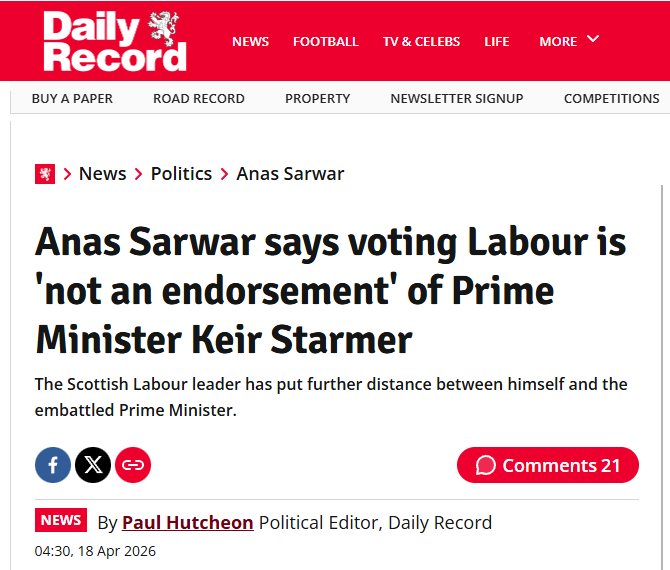
Strange times for Unionists in Scotland! The Daily Record has just told its readers that ‘Anas Sarwar has claimed voting for Scottish Labour is not an endorsement of Keir Starmer or his struggling Government‘. So casting votes in Scotland for Starmer’s Labour Party in the last General Election has been proven to be a mistake? Election promises for Scotland in Union betrayed by Labour? Westminster providing poor government for Scotland in Union?
Generally in Scotland, campaign messages from Unionist politicians and their MSM allies avoid mention of any negative UK context within which successive SNP administrations in Edinburgh have had to govern. But in an odd way, an exception to this has been Labour’s Wes Streeting, Secretary of State for Health and Social Care for England. Recently he has acknowledged, perhaps unwittingly, the UK context Scotland has been experiencing since the first SNP-led government came to power in Holyrood.
It was Streeting’s insistence on no independence referendum in Scotland, regardless of the outcome of the upcoming Holyrood election, that caught the eye but what else did he say? Regarding the recent history of the UK, he stated: “We’ve had the financial crash, we had years of Tory austerity, we had the catastrophe of Brexit, we’ve had the war in Ukraine, the war in Iran, the Covid pandemic. I think this country’s had enough of chaos.” (my emphasis) If each of these experiences did indeed result in ‘catastrophe’ or ‘chaos’ in the UK then were those parts governed through limited devolved powers and therefore to a large extent dependent on Westminster and Whitehall not impacted similarly? After all, the devolution settlements for NI, Scotland and Wales only allow for limited mitigations of UK-derived harms.
Let’s take Mr Streeting’s causes of ‘chaos’ one by one! On the ‘financial crash’, yes it had international origins but it was prior UK governments that determined how resilient (or not) the UK economy was in 2008-9 and it was UK governments that charted the response to the ‘crash’: the government in Scotland (and in NI and Wales) had little relevant agency before, at the time or in the aftermath. Scotland did not determine the severity of the UK’s negative experience of the ‘financial crash’, that was down to Westminster governments. Did the financial crash bring ‘chaos’ to Norway or Denmark?
On the matter of Tory-imposed austerity, the reality again is that the government in Edinburgh (and in Belfast and Cardiff) had very little agency here, able only to enact limited mitigations at best. But it’s worse than that as Mr Streeting and his ilk should acknowledge: Scotland in successive Westminster general elections rejected the Tories, the party that opted for austerity, but we had it imposed anyway. Scotland did not bring about the ‘chaos’ of the UK’s experience of ‘austerity’, on the contrary. And which other Western nation-states comparable to Scotland’s size and scale of indigenous, high value resources suffered ‘chaos’ from government-imposed austerity following the financial crash? And if some did, unlike Scotland, their population would have opted at the ballot box for the political party with a ‘chaos’ creating policy.
And then we have ’the catastrophe of Brexit’! Firstly, Scotland rejected the Tory government that opted to hold a referendum on the UK’s membership of the EU. And then Scotland voted by a substantial majority to remain within the EU. Notwithstanding, not only was Scotland taken out of the EU against its democratically-expressed view, it had an extreme form of Brexit imposed by a Westminster party of government, the Tories, Scotland had by majority also rejected. The resulting ‘chaos’ which Mr Streeting claims impacted the UK was not of Scotland’s choosing. How many of Mr Streeting’s episodes of ‘chaos’ would the UK have avoided if the good sense of Scotland’s electorate had been replicated across England?
From The London Economic (8 February, 2026): ‘The economic cost of Brexit has just been laid bare – and it’s devastating. A decade on, the numbers show a permanent hit to growth, wages and investment.’
‘Brexit hasn’t been a one-off hit followed by recovery – it has quietly, relentlessly drained the UK economy year after year.
‘The headline numbers are brutal. UK GDP is now 6–8 per cent smaller than it would have been by 2025 – worse than forecast, not better. That is a permanent loss of national income, not a blip.’
Even a Telegraph correspondent has had to confess! From The London Economic (30 November, 2025) : ‘Told you so! The Telegraph denounces Brexit as ‘unmitigated economic disaster. – We’ve now got The Telegraph joining the Brexit resistance, after the formerly pro-leave paper ripped into its ‘near-disastrous’ consequences.’
“From an economic perspective at least, Brexit has so far proved close to disastrous. If leaving the EU was supposed to be a moment of national economic renewal, it has comprehensively failed to deliver as it was supposed to.” – writes Jeremy Warner (Assistant Editor at The Telegraph).
‘The piece in The Telegraph was inspired by a nine-year study conducted by the National Bureau for Economic Research (NBER). Their data assessed the overall economic impact of Brexit, from the day of the referendum and into this calendar year. The figures were gruesome.
‘As per the NBR, the UK’s GDP (Gross Domestic Product) had fallen by as much as 8% from where it should be since 2016, with the impact ‘accumulating gradually’ as the years have gone by. Investment into the country is also estimated to have dropped sharply, by roughly 12-18%.’
So this is Scotland in Union – this is Scotland supposedly better together in Union – facing the outcomes and impact of the UK’s successive episodes of ‘chaos’. But when assessing how Scotland has fared in Union since 2008, this context should be ignored? Hardly!
Finally, from Streeting’s description of recent UK history, the war in Ukraine, the war in Iran, and the Covid pandemic have all caused ‘chaos’ in the UK. All three events have had widespread, negative international impact but again what does it say about the resilience of the UK if they, in Streeting’s words, caused ‘chaos’ here? How has Ireland, Denmark, Norway and many other Western nation-states of c.5.5 million population coped with such events?
The UK and the NHS
There is now a widely held view that the NHS in England and therefore throughout the UK was ill-prepared for the Covid pandemic and its aftermath having lacked sufficient investment during the years of Tory austerity. On the state of the NHS, recall Streeting again: “Right across the UK every part of the NHS is in crisis and all roads do lead back to Westminster because even though this is devolved, decisions taken in Westminster have an impact on the NHS across the whole country.” Yet more acknowledgement of failing government of the Union with knock-on negative impacts on all parts of the UK.
A comprehensive review of the state of NHS England commissioned from Lord Darzi by the incoming Labour Government in Westminster in 2024 concluded:
‘The 2010s were the most austere decade since the NHS was founded, with spending growing at around 1% in real terms.’
‘The NHS has been starved of capital and the capital budget was repeatedly raided to plug holes in day-to-day spending The result has been crumbling buildings that hit productivity – ….. The backlog maintenance bill now stands at more than £11.6 billion and a lack of capital means that there are too many outdated scanners, too little automation, and parts of the NHS are yet to enter the digital era.’ (My emphasis)
And: ‘ On top of that, there is a shortfall of £37 billion of capital investment. These missing billions are what would have been invested if the NHS had matched peer countries’ levels of capital investment in the 2010s. That sum could have prevented the backlog maintenance, modernised technology and equipment, and paid for the 40 new hospitals that were promised but which have yet to materialise. It could have rebuilt or refurbished every GP practice in the country.’
These are big numbers and therefore have had big consequences for the (so called) Block Grant to governments in Belfast, Cardiff and Edinburgh. The Union dividend?
The UK’s economy
And senior Labour politicians have been going further in their assessment of the state of the UK in which Scotland and its government in Edinburgh exists. On the economy, from the Financial Times (8 July, 2024): ‘Rachel Reeves warns UK public finances in worst state since second world war’.
“We face a legacy of 14 years of chaos and economic irresponsibility,” Reeves said. That word ‘chaos’ again – created outside Scotland against our democratic wishes but impacting Scotland nonetheless.
Source: https://www.ft.com/content/ab7a74a0-3353-4254-b112-b8fd19bf5bd2?syn-25a6b1a6=1
The UK’s longstanding, structural inequality
So a ‘chaotic’ UK since c. 2008 according to Labour Party sources, suffering longstanding under-investment and with an economy in its poorest state since the 1940s! Yet Unionist politicians are unwilling to acknowledge the blindingly obvious: all the above have had negative consequences within Scotland way beyond what a government with restricted devolved powers can fix.
And then there is this regarding the nature of the UK nation-state itself, from the Institute for Fiscal Studies (25 January, 2026): ‘Regional inequalities in the UK are large by international standards. – These inequalities span multiple dimensions, including pay and productivity, education and skills, and health and life expectancy.’
‘Many of these disparities are highly persistent. For example, most places that were struggling with low wages and employment rates 20 years ago are still struggling today, and the same is true for areas that were flourishing.’
The IFS refers to recent academic research: ‘The figure highlights a sharp divergence after 2008 between London and other UK regions, which effectively split the UK into two financial worlds: London and its surrounding areas on one side, and the rest of the country on the other, with the UK’s second- and third-tier cities facing the highest costs of capital. In fact, the difference in the risk premium investors demand to invest in London compared with these cities is about as large as the difference they demand when lending to the UK government versus lending to governments of much weaker economies, such as Romania and Chile.’
Source https://ifs.org.uk/articles/tackling-regional-inequalities-lessons-new-research
End note
When campaigning in Scotland, Unionist parties seek to emphasise the close integration of Scotland within the UK whilst airbrushing out any significance for Scotland of the context of a failing, ‘chaotic’ (UK government ministers’ word)UK.
Strangely, and only when it suits, Unionists effectively treat Scotland and its SNP government in Edinburgh as if they were in possession of all the powers, all the agency of a normal independent nation-state to pursue their SNPbad messaging. Any negative implications of the UK context is ignored. It’s as if we in Scotland are immune from the UK ‘chaos’, from the failings described by Mr Streeting and others referenced above.
And of course Scotland lacks a mainstream media – and lacks public service journalism – willing to challenge flawed Unionist narratives.
Discover more from Talking-up Scotland
Subscribe to get the latest posts sent to your email.


So , voting for Sarwar is not an endorsement of Starmer , says the man who recently called for his resignation .
Well , no surprise there . But is voting for Sarwar an endorsement of Scottish ( sic) Labour ? Or has Sarwar distanced himself from that bunch of losers too?
Perhaps by voting day it will be ”Vote for Sarwar the One Man Band !”
LikeLike
Starmer/Sarwar intertwined in their LIES. NO THANKS!!!
LikeLike
Excellent post Stewartb.
Jim
LikeLike
Spot on. Imagine saying “a vote for the SNP isn’t a vote for John Swinney!”
The UK is over. Time for the 4 nations to go their own ways and dump the international crime cartel of spivs and money launderers.
LikeLike
Let’s also not forget that Peter Mandelson once said this in relation to the former Labour leader , Jeremy Corbyn:
“I am working every day to bring down Jeremy Corbyn”.
Well now it looks as if Peter Mandelson may be the one who also “brings down Keir Starmer” as the leader who came after Corbyn.
Almost like he, Mandelson, was always toxic to Labour as a party….
In 2017 he told the Jewish Chronicle that he “works every single day to bring forward the end of [Corbyn’s] tenure in office. Every day I try to do something to rescue the Labour Party from his leadership.”
Now , it seems, he has done the same with Starmer.
So if nothing else he may have done his bit in “rescuing ” the whole UK from Starmer’s “leadership” and so “end his tenure in office”.
Ironic yet hilarious.
Liz S
LikeLike