

stewartb
Seems like another example of a potentially damaging policy in a critically important area impacting Scotland implemented not only as a result of a Westminster government’s decision but one made through secondary legislation and therefore without recourse to Westminster parliamentary scrutiny. Another example of the quality of Scotland in Union’s democracy!
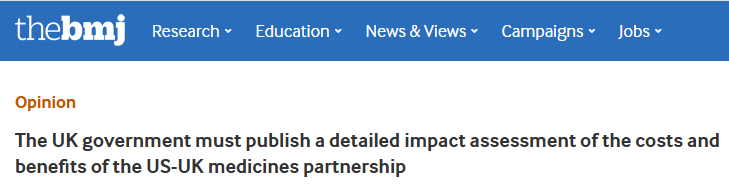
From the British Medical Journal (April 17, 2026) ‘Opinion: The UK government must publish a detailed impact assessment of the costs and benefits of the US-UK medicines partnership‘.
‘On the eve of the Easter bank holiday weekend, the UK government finally published the full text of its deal with the US government on the prices the NHS will pay for new branded drugs.
‘The central plank of the deal is to waive tariffs on UK pharmaceutical exports to the US in return for the NHS paying 25% more for new branded drugs. The initial mechanism for the latter is an equivalent increase in the National Institute for Health and Care Excellence’s (NICE) standard cost threshold from 1 April 2026, although further price increases may well be needed to meet the scale of extra drug spending the government has signed up to. This revised threshold means that a drug will be considered sufficiently cost effective if for every £35 000 extra it costs above the current standard NHS treatment for the condition, it improves health by at least one quality adjusted life year (QALY). (my emphasis)
‘The government has compelled NICE to raise its threshold by using secondary legislation that has not been subject to parliamentary scrutiny or debate.’
And: ‘The extent to which the economy will be boosted by the deal is unclear because the government has not published an analysis that would allow the assumed benefits of the deal to be examined. What is clear, however, is the substantial opportunity cost that paying more for branded drugs will impose on the health of the UK population. The Department of Health and Social Care’s own analysis estimates that the NHS generates on average one QALY for every additional £15 000 spent on existing services. By committing to pay more than twice that to gain one QALY by using a new branded drug, the government effectively sacrifices 2.3 patient QALYs it could attain by spending the same money on extending existing NHS services.‘
Adding: ‘The commitments to 2036 entail a growth rate on branded drug expenditure four to five times higher than the Office for Budget Responsibility’s estimates for overall health spending growth over the same period.‘
‘.. a curious—yet little publicised—clause in the arrangement is that drug spending won’t just increase in absolute or GDP share terms, but it will also increase as a share of the overall NHS budget. Far from offering reassurance that a higher spend on branded drugs will be afforded by a concomitant increase in tax funding for the NHS, the clause appears to command the opposite.‘
The BMJ piece concludes: ‘The NHS Constitution states that the NHS—and the Secretary of State for Health—is “committed to providing the most effective, fair and sustainable use of finite resources” and to transparency and accountability in achieving this. Yet the terms of the trade deal with the US will clearly reduce the cost effectiveness of the NHS’s finite resources and provide no transparency over (or any accountability for) any broader economic case.
‘Without this information, the public has no way to ascertain if the price paid in health is worth the apparent gains pursued elsewhere.’
No way to ascertain! And neither does Scotland’s government nor voters in Scotland: whilst in this Union, we’re just left waiting, with little agency, on the sidelines until we experience the fall-out for both the size of the (so-called) Block Grant and also the future cost to NHS Scotland of branded drugs. And we need to do so without even Scotland’s MPs having the opportunity in Westminster to exert scrutiny on our behalf!
Source: https://www.bmj.com/content/393/bmj.s733
Discover more from Talking-up Scotland
Subscribe to get the latest posts sent to your email.


Big Pharma is a byword for corruption in America. Who thought it a good idea to import their exploitation into the UK?
Can Starmer and his Private Medicine funded cronies survive much longer? Not in Scotland I hope.
LikeLiked by 2 people
‘The NHS being rewired by the policy of foreign governments is an unusual step, and needs well-informed debate. We urge the UK government to publish these details.’
This is the observation of the health think tank, the Nuffield Trust on April 3: ‘We need transparency about diverted NHS funds under US trade agreement – Nuffield Trust response to US-UK medicines partnership’.
The Trust’s press release also has this: ‘Last night’s statement commits the NHS to paying 25% more for new branded medicines, and confirms the weakening of its cost control and efficiency measures.’
‘.. the economic evidence is crystal clear: the health benefit the population as a whole gets from spending on new branded medicines is only half what it would get if the same spending was used to extend existing services such as GP care or operations from the waiting list. The agreement will mean an increasing share of the NHS budget will be diverted towards treatments that deliver lower health benefits per pound.’ (my emphasis)
The Trust reports the UK government’s response to a freedom of information request that ‘publication would prejudice the UK’s economic interests and trade relationships with the USA and other countries’.
The Nuffield Trust tends to focus on NHS England and on Westminster’s role in the resourcing and development of health services. NHS Scotland and the Scottish Government seem to have no locus, no agency when it comes to this pharma ‘deal’ with the USA.
LikeLiked by 2 people