

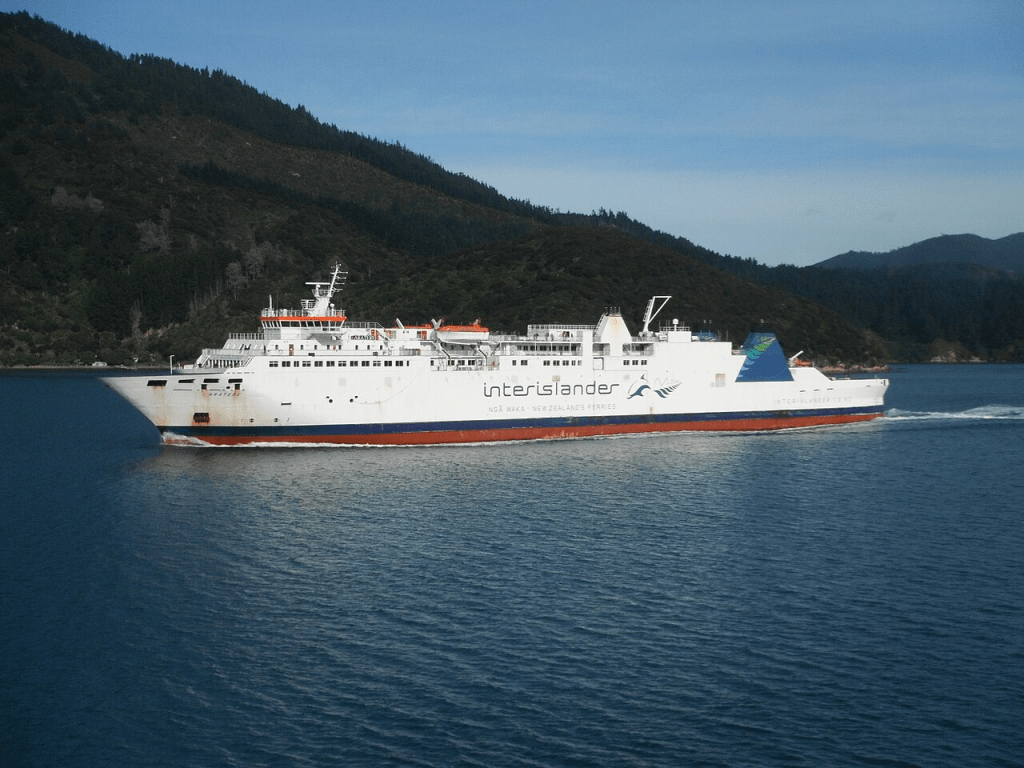
Above the only 27 year-old, Spanish-built, MV Aratere, retired after a sequence of breakdowns including two incidents of drifting out-of-control toward rocks with hundreds on board.
Cook Strait Ferries, linking the north and south islands of New Zealand, currently runs only two quite young (under 30) ferries but the service is a national scandal of poor service with dangerous incidents, unreliability and the utter fiasco of the government cancelling urgently needed replacement contracts.
The consequence of this unreliability, not of any media frenzy as there has been little, is the serious damage to tourism.
From RNZ, two days ago:
Fed-up tour operators are sounding the alarm on Cook Strait ferry services, claiming tens of thousands can be lost from a single disrupted sailing and that perceived unreliability means tourists are skipping Wellington and the top of the south.
At the world’s leading travel trade show – where exhibitors from more than 180 countries spruiked everything from luxury tour packages to adventure travel to medical and health tourism – the Middle East crisis was a hot topic of coversation this year.
But it was not the only one dominating the discourse at ITB Berlin.
According to a New Zealand-based tour operator, chatter about Cook Strait ferries was unavoidable last month and disruptions were causing “significant and lasting” damage to the country’s reputation as a world-class travel destination.
Has the so-called Scottish ‘ferry fiasco’ reduced tourism to the islands?
Quite the reverse. Numbers are are up dramatically 25% since 20171 boosted in particular by the SNP Government’s massively generous Road Equivalent Tariff (RET) slashing ferry ticket prices. 2
Sources:
- https://www.visitouterhebrides.co.uk/dbimgs/OH%20Visitor%20Data%20Report%202025%20FINAL.pdf
- https://www.visitscotland.org/research-insights/latest-research/tourism-performance
Discover more from Talking-up Scotland
Subscribe to get the latest posts sent to your email.
 Talking-up Scotland
Your interpretation of the Visit Outer Hebrides report appears to be incorrect. The 25% increase refers to tourism as a total share of the economy, not to visitor numbers. The report only compares 2024 to 2023 when looking at occupancy rates, and it notes a decrease.
RET was introduced to the outer isles routes in 2008, so the impact of RET would require analysis of carryings figures from before that date. RET has had a strong positive impact on carryings, but in recent years the unreliability of the service has led to a significant downturn. For example, passenger carryings to Mull were 15% down in 2022 compared to pre-covid 2019 levels, and have remained at that lower level since. Local island businesses are reporting significant drops in business in the past three years or so, as a direct result of ferry disruption. I can tell you that Mull is very quiet at the moment. There are noticeably fewer tourists here than would normally expected. It is not correct to say that the ferry fiasco has not impacted on island businesses. It is because of that recognised and measurable impact that Scot Gov made a £4.4m compensation fund available last year, and why John Swinney has committed to a further £10m compensation fund if re-elected.
RET has been hugely positive for the islands. The problem is that we now have a low-fares system, run by a very high-cost operator. Fares only contribute 1/3 of the CalMac’s operating costs. So whilst fares are generally good value at point of use (with the notable exception of commercial rates, that do not have RET), the cost to the taxpayer is ballooning. It is now £400m annually, excluding the cost of loans to CMAL for new vessels and ports.
The huge costs of vessel renewal are the fault of CMAL and Transport Scotland, who specify hugely expensive and over-complex vessels that are very expensive to run. Scot Gov have introduced a generous fares system, but have failed to get to grips with operating costs, or to renew vessels timeously.
joe@islandbakery.scot – happy to discuss any time.
LikeLike
Great use this.
Joe
I won’t waste your time and mine with a ‘conversation’ where I am outnumbered by you and your other members but I will do this.
If you feel you have evidence that I’m wrong, write a piece for Talking-up Scotland demonstrating that. I will not change a word of what you submit. You will decide the headline and any images. There is no word limit. Say just what you want to say and I will publish it as well as haring it with thousands in my social media links.
Send it to talkingupreminders@gmail.com
John
LikeLike
over on Facebook suggests the most recent meeting with local
Calmac staff was positive.
Does Mr Reade agree?
LikeLike
Please see my reply to the same question on the neighbouring thread.
Joe.
LikeLiked by 1 person