

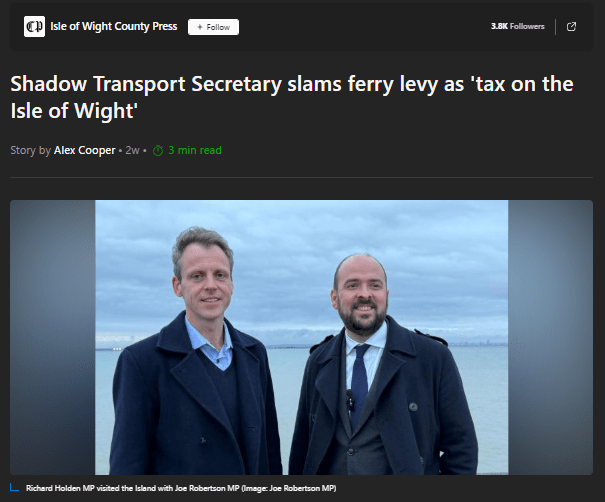
The Isle of Wight’s two ferry services, Red Jet and Wightlink, have a long history breakdowns, of mass cancellations and rocketing prices in an effort to keep paying shareholder dividends and executive bonuses.
This very real fiasco, fuelled by greed at the top, is currently attracting attention from the Conservative Party, shamelessly forgetting their key role in enabling the kind of unregulated business activity that has created the situation in the first place.
From Isle of Wight County Press, two weeks ago, the above, and:
Shadow Transport Secretary Richard Holden has slammed the government’s levy on ferries as ‘a tax on the Isle of Wight’ and promised ‘robust’ policy on the ferries if the Conservative Party were to win power, in a visit to the Island last week (Friday, March 27).
The MP and Conservative frontbencher joined Isle of Wight East MP Joe Robertson in Ryde.He described the lack of exemption for the Isle of Wight ferries in the Emissions Trading Scheme (ETS) as ‘outrageous’ and ‘quite insidious’.
The scheme, due to include ferry services from July, has been introduced as part of efforts to decarbonise the maritime sector. Routes in Scotland have been granted an exemption until 2030, while vessels in Northern Ireland have been given a 50 per cent reduction – but any Isle of Wight ferries over 5,000 gross registered tonnes will be included.
The above scheme is, of course, a very recent matter as a letter writer to the same newspaper, last week, reminds us:
The Isle of Wight can’t be held hostage to weather and ferry breakdowns. Recent Red Jet failures and mounting ferry cancellations again show how precarious island transport is across the UK. On the Isle of Wight, technical faults halted services and left passengers stranded, while thousands have signed a petition demanding fair, reliable cross‑Solent travel.
Finally, to illustrate the appalling prices, in December 2025, Joe Robertson, Tory MP for the Isle of Wight called again for measures to end the ‘ferry rip-off punishing coastal Britain’ [sic].1
We’ve highlighted these disparities and the generosity of CalMac prices several times but just last month we had:
In July 2025, a medium size car with four passengers, Portsmouth to Fishbourne with Wightlink Ferries, would cost you between £210 and £300, depending time of sailing. From Southampton to East Cowes with Red Funnel would be between £200 and £288. It’s a 12 mile, 45 minute journey.2, 3
The Oban to Mull crossing is similar at 15 miles and 45 minutes but costs only £76 to £98, a third of the cost.4
Sources:
- https://www.politicshome.com/opinion/article/its-time-end-ferry-ripoff-punishing-coastal-britain
- https://www.wightlink.co.uk/tickets/vehicle-tickets
- https://www.redfunnel.co.uk/isle-of-wight-ferry/plan/fares
- https://www.directferries.co.uk/oban_craignure_ferry.htm
How has this been achieved in Scotland?
In October 2008, Transport Scotland introduced the Road Equivalent Tariff (RET) fares policy as a pilot on routes to the Outer Hebrides, Coll and Tiree (and made permanent in 2012). The principle of RET is that ferry fares should be set on the basis of travelling an equivalent distance by road plus a fixed fare element aimed at cost recovery. RET was intended to reduce the cost disadvantage faced by island communities and promote the islands as places to live, work, visit, invest and conduct business. In 2012, the policy was extended to cover Colonsay, Gigha and Islay. It was then further extended to the two Arran routes and Campbelltown in 2014. Finally, in October 2015, RET was rolled-out to all remaining routes, including the high-volume routes of Oban – Craignure, Wemyss Bay – Rothesay and Largs – Cumbrae.
What has the RET achieved?
Increase demand for ferry services by making ferry travel more affordable and accessible. Increase tourism and supporting existing tourism markets. Enhance local economies and the wider national economy.
As well as this subsidy in the form of lost tax revenue, the Scottish Government directly subsidises CalMac, by £3.7 billion over ten years.
Discover more from Talking-up Scotland
Subscribe to get the latest posts sent to your email.
 Talking-up Scotland
Yes, RET has generally been a great success. But without addressing the operating costs of the system, the massive subsidy CalMac needs is unsustainable.
Between the introduction of RET and 2024 (which very predictably increased carryings by up to 30%), CalMac only had 2 new major vessels delivered – Loch Seaforth and Finlaggan. In that 15 year time-frame, a fleet the size of CalMac’s (major ships only) should have had around 8 new vessels, if the target retirement age was 25.
So whilst RET has been great, it has not been backed up by the necessary management changes or fleet investment.
LikeLike
Joe
I won’t waste your time and mine with a ‘conversation’ where I am outnumbered by you and your other members but I will do this.
If you feel you have evidence that I’m wrong, write a piece for Talking-up Scotland demonstrating that. I will not change a word of what you submit. You will decide the headline and any images. There is no word limit. Say just what you want to say and I will publish it as well as haring it with thousands in my social media links.
Send it to talkingupreminders@gmail.com
John
LikeLiked by 1 person
Thank you John, that is appreciated. I’ll get a piece to you in the next week or two.
LikeLike
over on Facebook suggests the most recent meeting with local
Calmac staff was positive.
Does Mr Reade agree?
LikeLike
Yes I do. This is not a black and white issue where everything about the CalMac system is bad. Our local management and staff are all excellent, and senior management at CalMac are honest and communicative.
That does not mean that CalMac are faultless – the implementation of their new e-booking system has been particularly poor for example.
The faults in the ferry network are structural. We have monopoly provider that has no incentive to be productive or efficient; a procurement agency that is divorced from commercial reality and does not have the competencies needed; Transport Scotland that is the victim of regulatory capture; and Ministers who have not got to grips with the system nor provided the investment for new vessels (until the recent panicked flurry of spending).
LikeLiked by 1 person
Has the subsidy now associated with RET reached a level that is now just too divorced from ‘reality’?
To travel the 2 hours 45 minutes by the Isles of Scilly Steamship Company – private sector and dedicated largely to an island-specific ferry service – from Penzance to the Isles of Scilly (population c.2,300 ) on (say) 1 July 2026 will cost a foot passenger £104.49.
The price of a return journey varies but a week later it would again be £104.49. (The Scillonian III ferry only carries passengers.)
As best as I can determine, to travel the 4 hours 45 minutes by a CalMac ferry from Oban to Barra (population c. 1,200) on that same day will cost a foot passenger £19.70.
More relevant perspective to take into account when thinking through this not black and white issue?
LikeLiked by 1 person
One thing that would be welcome to underpin future discussions here about CalMac services is a common understanding and agreement regarding the validity and sufficiency of CalMac’s published performance and customer satisfaction data.
Over many months (years?) there seems on the face of it to have been: (i) a discrepancy often between views expressed by certain island community groups with a media presence on the one hand and CalMac’s own performance data on the other; and (ii) a noteworthy absence of CalMac’s performance data being referenced by MSM journalists, despite the popularity of ‘ferries’ as a topic. Indeed, the latter don’t seem to have engaged even in a negatively critical analysis of the performance metrics provided by CalMac, nor advocated their reform.
I suspect it will be harder to reach useful outcomes in debate without agreement on what basic performance metrics are publicly available and generally regarded as valid.
LikeLiked by 1 person
Is the spokesman for MIFC calling for competition on the Ferry routes as he claims that a ” monopoly has no incentive to be productive or efficient ” ?
How does introducing ‘competition’ on existing ferry routes work ? Do firms have to tender along with CalMac ? Or do we invite other operators to run alongside the existing CalMac service ? What happens if a Private Company wins a contract then goes bust during the term of the contract ? Who replaces their ferry service ?
Lots to think about !
LikeLike
So seems I can’t access Bluesky now, see this…
Due to laws in your region, certain features on Bluesky are currently restricted until you’re able to verify you’re an adult.
Anyone else being blocked?
LikeLike
Seems Ok now a few people having issues with BS.
LikeLike
I had an email from an organisation, titled, ‘End Scotland’s support for the arms industry’.
I think we need to counter these misleading headlines from these organisations regarding Scotland it’s crucial that people know the facts.
Here is their blurb; so misleading have emailed them as per usual.
https://caat.org.uk/publications/arms-out-scotland-caat-demands-for-scottish-elections-2026/
LikeLike