

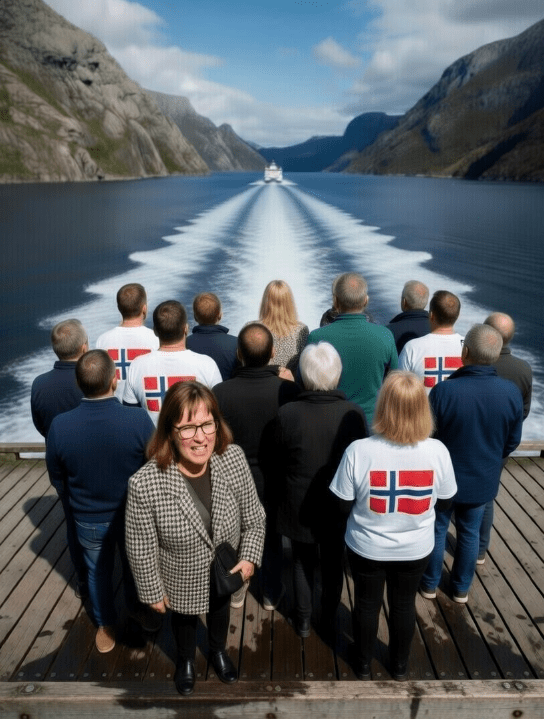
Norway’s ferry service has been recently portrayed as superior to Scotland’s. I suppose they have got $2 trillion in the bank and we’ve got SFA but, wait what’s this:
In Norway there are also reports and criticisms of insufficient or ineffective community involvement in decisions affecting ferry (ferge) and fast ferry (hurtigbåt) services, which serve as vital lifelines for coastal, island, and fjord communities.
Norway operates one of the world’s largest and most subsidized ferry networks, with many routes under public service obligations (PSOs) managed at the county (fylkeskommune) level or nationally. These connections are essential for daily life, freight, healthcare access, tourism, and economic viability in remote areas. While Norway generally has structured consultation processes (høringer), affected residents, businesses, and local authorities frequently report that input is sought too late, carries limited weight, or fails to prevent unpopular outcomes like service cuts, fare changes, or route adjustments driven by budget constraints or policy goals (e.g., zero-emission transitions or cost savings).Key Examples and Patterns
- Service cuts and route changes in Nordland (Northern Norway): In late 2024, Nordland County Council proposed (and later implemented) reductions to fast ferry routes, including the Nordlandsekspressen (NEX1 and NEX2), such as canceling Saturday services, shortening winter routes, and ending certain summer extensions. This sparked substantial backlash from municipalities, community groups (grendeutvalg), businesses, schools, and regional bodies. Critics highlighted an extensive but arguably inadequate hearing process, with dozens of submissions emphasizing severe impacts on local communities lacking road alternatives. Concerns included reduced accessibility for education, work, healthcare, and economic activity, with some arguing that local voices were not sufficiently prioritized amid fiscal pressures. The process raised questions about how user involvement translates into actual influence. https://www.nho.no/siteassets/nho-regioner-filer/nho-nordland/nf17-2025-samfunnsnytten-av-hurtigbattilbudet-i-nordland.pdf
- Broader criticisms of engagement in ferry/fast ferry decisions: Stakeholders have noted “consultation fatigue,” where repeated hearings do not lead to meaningful changes, similar to patterns seen in other ferry-dependent regions. Decisions on tendering, contracts, vessel procurement, and subsidies often prioritize cost-efficiency or national environmental targets (e.g., electrification of ferries), with local input described as secondary. Reports and studies on remote connectivity sometimes frame decision-making around cost-benefit analyses that may undervalue social and community impacts for smaller islands or coastal settlements. https://www.oecd.org/content/dam/oecd/en/publications/reports/2021/02/connecting-remote-communities_91a4fe71/a259ab33-en.pdf
- Zero-emission ferry transition and related policies: Norway has been a global leader in electrifying ferries, with mandates for zero-emission technology on many routes. While this has broad support for environmental reasons, implementation has involved procurement and operational changes that affect fares, schedules, and reliability. Some communities have raised concerns about rushed transitions or inadequate local input on how these shifts impact daily users, though formal consultations occur.
- Hurtigruten (coastal voyage) and other operators: The iconic coastal route (often called the “Norwegian Coastal Express”) has faced adjustments due to economics, tourism pressures, or operational issues. Criticisms have occasionally surfaced regarding limited community say in scheduling or capacity, particularly for smaller ports reliant on the service year-round. However, these are less prominent than route-specific ferry disputes.
Norway’s system includes public hearings, municipal input, and user groups, and decisions are often decentralized to counties, which can allow more localized influence than purely national processes. Nonetheless, fiscal constraints, EU/EEA procurement rules for tenders, and overarching national goals (climate, efficiency) frequently lead to perceptions that affected communities—especially in sparsely populated coastal or island areas—are sidelined or that their detailed knowledge of local needs is not fully integrated. Didn’t that guy from Uist say the very same thing?
I’m shocked. Didn’t someone say they were devolved?
Discover more from Talking-up Scotland
Subscribe to get the latest posts sent to your email.
 Talking-up Scotland
These extracts tell a familiar tale.
People complain that they have not been consulted. So, a consultation process is set up. People them complain that the consultation is too late or is ‘not going to make any difference because it has been decided already’. When the decision is made, some people complain that it was not the decision they voted for, even though others voted for it. Some complain that there was insufficient data presented to enable them to consider fully. So, more detailed information is provided and some complain there is too much information and others complain that what they are being asked to decide is so trivial that consultation was not needed.
LikeLike
Agreed with the comparison, but two wrongs still don’t make a right.
Don’t we have an opportunity to do something better in future?
I’m attracted, for example, to a suggestion in a letter to The Herald (yes, I subscribe to MSM if only to try to understand what other opposite views are) that Transport Scotland and CMAL should be more devolved from the Central Belt. Have some live on islands and WFH even?
CalMac in Greenock is OK, tho’, away from Edinburgh’s inward-looking bubble.
I once worked with another transport company which deliberately located its head office on the fringes of its territory rather than in the city and local government “capital”. The rural services were far better as a result, and the urban services didn’t suffer either.
We do need to do better.
Two wrongs don’t make a right, but three lefts might do …
LikeLiked by 1 person
In a country with only 5 million, would you not then be splitting the resources up so much nobody could afford to build more wee ferries for local people?
LikeLike