

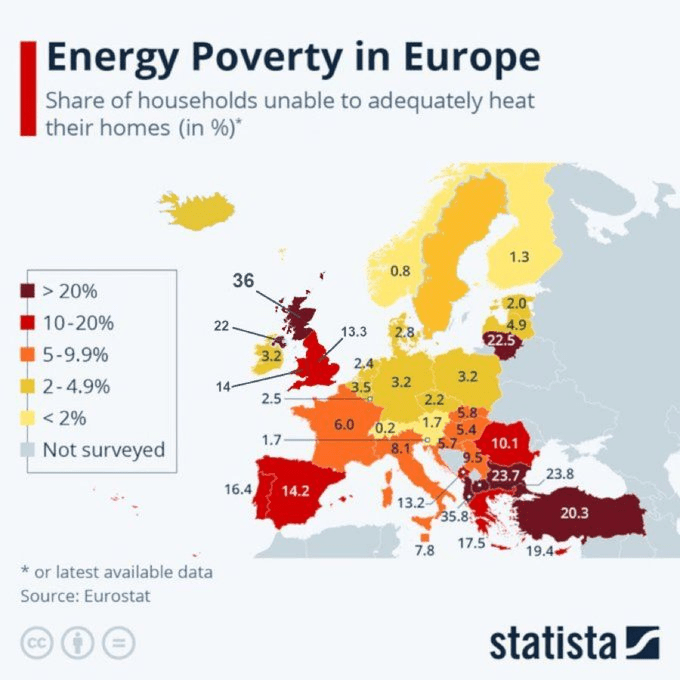
The above is frankly shocking and would still be so even if it were not for this:
Why Scots have a ‘critically low’ democratic well-being score – the 50 years theft of their energy supplies for one thing?
Carnegie UK today have reported (previous TuS post) that Scots have a ‘critically low‘ democratic well-being score of only 40%.
Who is surprised? I’m surprised it’s not zero, same as mine. If you are at all aware of Scotland’s 300 year plus and current predicament in the Union, how could you get anywhere near 40%. Given their many problems with crap governance but at least their own crap government, 40% would be a fair guess for Ireland.
I asked the document’s built in AI why this might be. It just listed all the wee parts leading to that summative score. Grok did the same. I had to ask a more pointed, admittedly leading question.
Before you see that, can we trust Grok answers? You know, Elon Musk owns xtwitter and it. The Guardian today has In Grok we don’t trust: academics assess Elon Musk’s AI-powered encyclopedia. I agree with them, generally. A few days ago, I asked it about the environmental consequences of the land-based infrastructure development of the new Ayrshire to North Wales electricity line and it kept giving me business-friendly answers. I had to specifically ask it ‘What are the concerns expressed by those groups strongly opposed to the project?’ To be fair, it then did tell me, fully and with no attempt to undermine it.
In the US, I’m sure Grok is biased against the interests of the poor, labour unions and minorities, but my experience with it so far, despite the spat with Humza Yousaf, is that it seems to have no dog in our fight for independence. His hostility to UK Labour seems far hotter.
So, I asked ‘what about the theft of oil, gas and now renewable energy?’
The phrase “theft of oil, gas, and now renewable energy” is a common refrain in Scottish political discourse, particularly among pro-independence advocates, referring to the perception that revenues and benefits from Scotland’s abundant natural resources—historically North Sea oil and gas, and increasingly wind, wave, and other renewables—are disproportionately extracted and controlled by the UK Government in Westminster, with limited reinvestment or direct gains for Scottish communities. This is framed as a repeat of historical grievances, where Scotland generates vast energy wealth but faces higher energy bills, fuel poverty, and minimal local economic uplift. thenational.scot +1Historical Context: Oil and Gas “Theft”
- North Sea oil and gas extraction began in the 1970s, with Scotland’s waters hosting the majority of UK fields. Estimates suggest £300 billion (in today’s money) in revenues have flowed to the UK Treasury since production started, largely through taxes, licenses, and royalties managed centrally by Westminster. thenational.scot
- Critics, including former SNP Justice Secretary Kenny MacAskill (now with Alba Party), argue this was enabled by the 1970s McCrone Report—a suppressed UK Government document warning that independence could make Scotland one of Europe’s wealthiest nations via oil. Instead, revenues funded UK-wide spending, including Thatcher-era tax cuts and infrastructure elsewhere, while Scottish communities saw job volatility and environmental impacts without proportional benefits. thenational.scot
- Licensing and taxation remain reserved to Westminster, meaning Scotland has no direct control despite devolved elements like onshore planning. This has led to accusations of “plunder,” with oil/gas used to support England’s energy needs (e.g., Scottish gas powering English electricity) while Scotland imports energy at market rates. yoursforscotlandcom.wordpress.com
The Shift to Renewables: A “Second Theft”?
- Scotland produces around 40% of the UK’s onshore wind power and is projected to supply up to 70% by 2030, alongside offshore wind dominance. Renewables generated surplus electricity equivalent to 113% of Scotland’s needs in recent years, much of it exported south via grid connections. heraldscotland.com +1
- Key grievances:
- Grid charges and exports: Scottish generators pay the highest transmission charges in Europe (TNUoS fees) to export power to high-demand areas in England, subsidizing the UK grid by hundreds of millions annually. English/Welsh projects often receive subsidies instead. energyvoice.com
- Higher bills despite surplus: Scots pay more for electricity (e.g., higher standing charges, colder climate needs) than many European oil/gas-rich nations like Norway. Fuel poverty affects remote producing areas (e.g., 57% in Western Isles). believeinscotland.org
- Centralized control: UK bodies like the North Sea Transition Authority handle licensing; profits from Contracts for Difference (CfD) auctions go to the UK Treasury. Critics call this “England’s giant onshore wind farm,” with pylons and cables prioritizing export over local use. heraldscotland.com +1
- Recent examples: GB Energy (UK Labour’s public company) is headquartered in Aberdeen but accused of partial “ownership” of Scottish projects without full revenue return. Closures like Grangemouth refinery highlight lost jobs without transition support. bbc.co.uk +1
Link to Democratic WellbeingThis perceived resource extraction directly fuels low democratic wellbeing in Scotland (40/100 in Carnegie UK’s 2025 index, the UK’s lowest nation-specific score). It breeds distrust: people feel powerless over decisions on their resources, with centralized UK control seen as ignoring local voices. Inequalities amplify exclusion—deprived or rural areas hit hardest by fuel poverty despite hosting infrastructure. Carnegie UK highlights how unmet needs and unaddressed grievances erode trust in institutions, creating a cycle of disengagement. thenational.scot +1 Pro-independence voices on X echo this as “colonial plunder,” demanding devolved energy powers or separation to retain benefits. UK Government counters that shared resources fund nationwide transitions (e.g., no new oil/gas licenses, £15.9 billion fossil subsidies redirected), ensuring energy security and jobs. Yet, for many in Scotland, it reinforces alienation—why export cheap green power while importing expensive energy? ukhealthalliance.org +1 Reforms like fairer grid pricing or community benefits could help, but without greater voice, democratic wellbeing stays critically low.
https://x.com/i/grok?conversation=1985294163286340045 and ask for ‘sources’ at the bottom to get those.
Critics of AI often point to its tendency to give you what you want but in the context of Scotland’s 95% pro-Union media, we need that.
Discover more from Talking-up Scotland
Subscribe to get the latest posts sent to your email.
 Talking-up Scotland
I recall back in the 1970s or even the 1960s when there was a Labour government, during a spell of very cold weather cold weather payments were introduced. These payments were highest in the South of England and non existent in Scotland.
The trigger was related to the difference between the historic average temperature at that time of year compared to the temperature during the cold spell. Thus, in the south the difference was greater, so they received higher payments (rebates). But, there was another factor which served to reduce the level of payment the further north people lived. This was based on the assumption, not backed by any data, that the further north people lived their houses would have been contructed to retain heat better.
So, if you were in Inverness at -10 degrees Celsius you got heehaw, but if you were in Eastbourne at -1 degree Celsius you received a payment.
LikeLiked by 2 people
I really don’t understand how Scotland should be such an outlier, especially compared to the rest of the UK and Ireland? As far as I am aware the building regulations in Scotland do indeed require better insulation than those further south, although it is a good few years since I knew for sure. Having lived in and worked in house building in Sweden in the 80s, the standards of energy efficiency combined with ventilation were already very high then. The UK was and seems still is far behind.
It will be another key area that independence to focus on and the abundant renewables will make it possible but a more progressive approach to housing new and refurbishment alike is needed.
LikeLiked by 1 person
I well remember all that as well but then again should we be surprised as Scotland has always been an after thought to England.
this tells us how On another energy story this week we have had a 1.5b investment blocked by London and yet the supposed great Scottish Sunday Post as far as I can see has no mention on it I would have thought it would have been headline news how stupid I am but plenty SNP bad articles.
LikeLiked by 1 person
For 300+ years the Scots have been told to bend over and accept being f*cked by England.
This abusive relationship will continue until :
a) there are no more Scottish resources for the English to steal , or
b) enough Scots realise that they are being f*cked and vote for independence .
LikeLike
In other less simple terms, ‘Scots’ are being stolen from to the tune of billions…if not in fact trillions of pounds.
I never tire of this…still true to this day but also, renewables and clean water…
LikeLike
It’s tragic, these days countries go to war over oil and gas, England just had to walk all over Scotland and take it for themselves as a freebie. No wonder they said Scotland was ‘too poor too wee and too stupid’.
Problem is there’s still masses of the dirty stuff in Scottish waters…yikes!
Just type in ‘oil’ in the search bar, there are more than 600 ‘hits’ about Scottish oil. Many ‘unavailable’ but you can get an idea of just how crucial Scotland’s oil was to England and indeed the US. See also info about Scottish shale industry which was huge.
https://movingimage.nls.uk/search
LikeLike
Talking about “Never mind those terribly inconvenient ferry delays”
I feel this is worth noting that:
We all know that there are so much negatives , as examples, connected to all of the UK parties (including the pretend one Reform UK) , that it defies belief that so many people still hold the misconception that somehow Ferries in Scotland are what the UK media and UK politicians cite as an apparent (but not) ‘significant’ and ‘winning argument’ example of the supposed (but not) case of SNP incompetence.
I mean where does one start with the (now humongous) list of examples, as in evidence of various UK political parties incompetence, corruption , failures, bad policies, lies, empty promises , waste of tax payers money, cronyism, scandals, fiascos, controversy, the various badly delayed UK government projects with huge overspends compared to what was their original (lower estimated) budgets etc etc etc
(All as increasing examples, that are heading towards…. infinity and beyond).
Liz S
LikeLike