

From UCA News two days ago on Fukushima:
15 years after Fukushima, debate continues on radiation exposure – Large amounts of radioactive material were released when the magnitude 9.0 earthquake on March 11 that year triggered a tsunami, causing meltdowns at the Fukushima Daiichi Nuclear Power Plant operated by Tokyo Electric Power Company (TEPCO).
The catastrophe killed more than 18,000 people and forced mass evacuations. It also raised fears about long-term health effects, especially among children. In response, Fukushima Prefecture launched what health professionals describe as one of the largest health surveys of its kind, covering about 380,000 residents who were 18 or younger at the time. Thyroid ultrasound examinations continued every two years until the age of 20 and every five years thereafter.
408 cases not mere statistics
Dr. Motomi Ushiyama, an internal medicine physician who works with a support group for affected families and children, said 361 people have been diagnosed with thyroid cancer or suspected cancer from the beginning of the survey in October 2011 through the end of June 2025. She said that 47 additional cases were yet to be included in the official tally.
As a clinician, I cannot see 408 as just a statistic. Each case represents a life, Ushiyama told the media at the Foreign Correspondents’ Club of Japan on March 10. Some patients have undergone repeated surgeries and continue to face long-term health concerns, while others feel social pressure not to speak openly about their illness, she added. The issue has also moved into the courts. Attorney Kenichi Ido is representing seven young plaintiffs who were between six and 16 years old when the disaster occurred and were later diagnosed with thyroid cancer.
Many have undergone multiple surgeries, including complete removal of the thyroid, he said. Thyroid cancer is extremely rare. Typically, it occurs only in two out of one million children per year, Ido told the media. The unusually high number of 408 is extremely difficult to explain by anything other than radiation exposure.
https://www.ucanews.com/amp/15-years-after-fukushima-debate-continues-on-radiation-exposure/112518
Globally:
from peer-reviewed research journal, Environmental Health on 29 November 2024:
Ionizing radiation is a human carcinogen, and there is a public concern but limited evidence that it increases the incidence of cancer among those who live near nuclear power plants (NPPs). Previous analyses of thyroid cancer in these populations have been inconsistent, and the last synthesis was published nearly a decade ago. To address these gaps, we undertook a systematic review and meta-analysis.
A search strategy was developed and applied to PubMed, Scopus, and Web of Science databases. A total of 2006 publications were identified, with 11 studies of thyroid cancer incidence that met the inclusion criteria.
Overall, the findings suggest that living near a nuclear power plant increases the risk of thyroid cancer. The small number of studies on this topic, and the finding of higher risks in studies less prone to bias highlights the need for better-designed studies. https://ehjournal.biomedcentral.com/articles/10.1186/s12940-024-01143-6
Note, jumping out at me, the researchers found that in better studies higher risks were identified.
On the Clyde:
From BBC Health 16 November 2026, the above and:
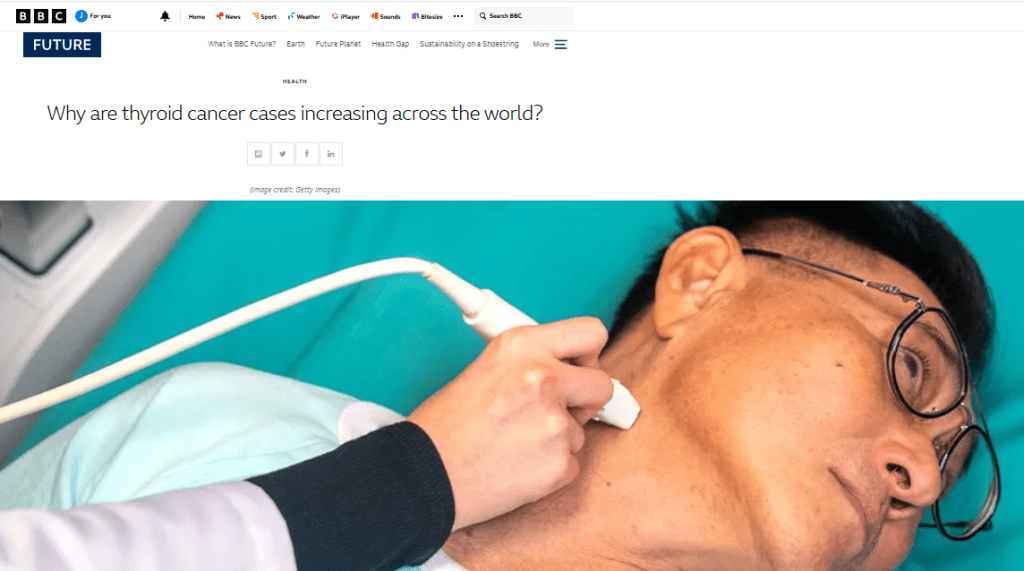
Rates of thyroid cancer are increasing at a faster speed in the US than any other cancer. But what is behind this mysterious epidemic?
Although most cases of thyroid cancer are curable, health experts are concerned by how quickly rates of the disease are increasing. According to the Surveillance, Epidemiology, and End Results (Seer) database – a cancer reporting system in the United States – the incidence of thyroid cancer in the US more than tripled between 1980 and 2016, rising from 2.39 to 7.54 per 100,000 in men, and 6.15 to 21.28 per 100,000 in women.
It’s long been known that exposure to large amounts of ionising radiation in childhood can cause thyroid cancer. In the years following the Chernobyl nuclear accident in 1986, rates of the disease skyrocketed in children in Belarus, Ukraine and Russia. One study found that amongst Japanese atomic-bomb survivors, about 36% of thyroid cancer cases since 1958 could be attributed to childhood radiation exposure. https://www.bbc.co.uk/future/article/20251114-why-are-thyroid-cancer-cases-increasing-across-the-world
Unsurprisingly given its inbuilt biases, the BBC report prefers to focus on the problem in the former Soviet Union and seems unaware of this:
Potentially fatal hypothyroidism far more common in Scotland, on the prevailing sea currents from Sellafield than in England, especially London
From the National Institute for Health and Care Excellence, in October 2024, Hypothyroidism:How common is it?:
A review article notes that the prevalence of overt hypothyroidism in Europe varies between 0.2–5.3%, depending on the definition of hypothyroidism used. A retrospective analysis of General Practice data in the North East of England (n = 66,843) found the overall single-point prevalence of treated hypothyroidism was 4.5% in 2016.
A review of UK national databases found the prevalence of treated hypothyroidism increased from 2.3% (1.4 million) to 3.5% (2.2 million) of the total UK population between 2005 and 2014. There was large geographical variation of treated hypothyroidism across the UK, with London having the lowest (1.4%) and the Western Isles of Scotland having the highest (6.3%) prevalence.1
The authors make little of the level in the Western Isles nor of its higher prevalence around the coasts of Scotland and down as far a the North-East of England, typically around 3 to 5 times that in London.
Exposure to radiation can cause hypothyroidism.2
The dominant oceanic currents around Scotland flow past the Sellafield nuclear re-processing plant, described as the most toxic in Europe.3
The presence of radiation at unacceptable levels, in the seafood gathered on the coast of South-West Scotland, has been reported in articles by former SNP MP, Alan Dorans.4, 5, 6
Sources:
- https://cks.nice.org.uk/topics/hypothyroidism/background-information/prevalence/#:~:text=A%20review%20of%20UK%20national,%2C%20White%20ethnicity%2C%20and%20obesity
- https://www.ahns.info/survivorship_intro/hypothyroidism/#:~:text=What%20are%20the%20signs/symptoms,can%20take%20years%20to%20manifest.
- https://www.gov.scot/publications/scotlands-marine-atlas-information-national-marine-plan/pages/8/
- http://www.thenational.scot/news/24044180.ayrshire-radiation-highlighted-labours-nuclear-support-attacked/
- http://www.thenational.scot/politics/24235536.study-highlights-mental-health-harms-living-next-nuclear-plants/
- http://www.thenational.scot/politics/24175238.can-labour-prove-safety-nuclear-energy-support/
Discover more from Talking-up Scotland
Subscribe to get the latest posts sent to your email.
 Talking-up Scotland
Sellafield, which was the renaming of Windscale after its three-day fire in 1957, has previous for this.
LikeLike