

Thanks, once again, to Dottie for alerting me to this:
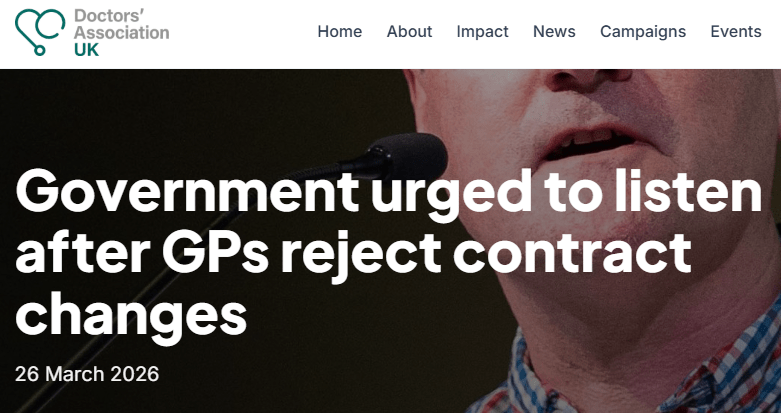
Today, from Doctors’ Association UK:
The Doctors’ Association UK (DAUK) has given its strong support to general practitioners in England after they overwhelmingly rejected this year’s imposed contract changes.
Almost 17,000 GPs and GP registrars took part in the BMA’s referendum, with 98.9% voting against the plans.
They have called on the Government to return to negotiation with the BMA’s GP committee (BMA GPC) to jointly develop and agree a brand new contract. https://dauk.org/government-urged-to-listen-after-gps-reject-contract-changes/
AI question – How does the current GP contract in Scotland compare with that for England rejected today?
Negotiation style and agreement — Scotland: Collaborative bilateral deal with BMA, multi-year funding package focused on investment in workforce/expenses/digital without major new mandates. England: Imposed changes after failed talks, leading to near-unanimous rejection.
Funding focus — Scotland emphasizes recurrent investment (£83m additional in 2026/27 rising to £249m recurring) targeted at capacity, sustainability, and enablers like digital/quality. England’s 2026/27 uplift (£485m) was smaller in percentage terms than the prior year and tied to new access requirements viewed as unfunded workload.
Workload and safety — Scotland’s recent deal aims to boost capacity and reduce pressures (e.g., better cover, workforce growth). England’s rejected changes were criticised for mandating more same-day/unlimited access and absorbing rejected referrals without support.
Pay vs. investment — Both have separate annual pay uplifts (e.g., DDRB recommendations around 3.5% recently discussed for 2026/27 UK-wide). Scotland’s package is explicitly “not a pay deal” but additional core investment; England’s uplift included pay assumptions but was rejected holistically.
Overall context — Scotland’s system has devolved elements allowing more tailored approaches (e.g., no internal market like England). England faces additional layers like Primary Care Networks (PCNs) and neighbourhood models, which added complexity to the rejected deal.
In short, Scotland’s GPs currently have a negotiated, investment-heavy multi-year package aimed at stabilisation, while England’s GPs have strongly rejected what they see as burdensome, under-resourced changes for 2026/27.
Discover more from Talking-up Scotland
Subscribe to get the latest posts sent to your email.
 Talking-up Scotland