

Please Support Talking-up Scotland at:

https://www.crowdfunder.co.uk/p/support-talking-up-scotland

Click on the above.

Or direct bank transfer at Sort Code 08-91-04  Account - 12266421 Name - JOHN ROBERTSON
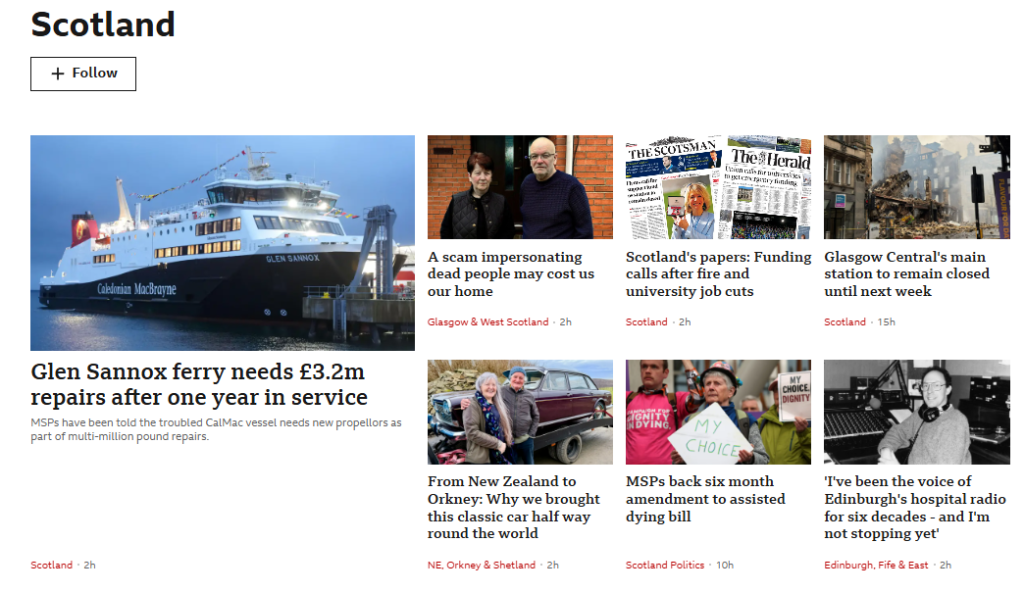
BBC Scotland headlining another story that might, they hope, damage SNP prospects in May.
Is that a big, shock, story in the public interest, or not?
This is an AI product but checked to make sure the sources are reliable ones.
How common is it that larger ships would require moderate repairs after the first year in service? Give examples for the UK since 2000?
For larger commercial ships (such as bulk carriers, tankers, container ships, or cargo vessels built as newbuilds), it is fairly common for some moderate repairs or warranty-related fixes to occur within the first year or so of service, though “moderate” depends on the scale and nature.
Shipbuilding contracts typically include a builder’s warranty/guarantee period (most commonly 12 months from delivery and acceptance, though sometimes longer for specific systems like coatings or engines). During this time, the shipyard is responsible for remedying defects in materials or workmanship at their cost (or reimbursing reasonable repair costs, often with limitations).
Issues that emerge early often stem from:
- Settling-in of systems under real operational loads (e.g., engines, propulsion, or auxiliary equipment experiencing issues like misfires, vibrations, or minor leaks not apparent during sea trials).
- Minor manufacturing/installation defects that only become evident after extended running.
- Crew familiarization or operational factors interacting with newbuild quirks.
Industry sources (including legal insights on warranty claims, insurer discussions like Gard, and equipment provider analyses) describe these as quite normal and expected in the first year. Owners and managers routinely prepare for warranty claims during this period, often conducting thorough inspections and testing shortly after delivery to identify and notify issues promptly (strict notice deadlines apply). Many new vessels see at least some warranty-related work, ranging from minor adjustments to moderate repairs (e.g., component replacements, welding fixes, or system tweaks). Serious major defects are less routine but do happen occasionally.
After the warranty expires (typically post-first year), the owner assumes full responsibility, and any moderate repairs would then be routine maintenance rather than builder-covered. Newbuilds are generally expected to enter service with high reliability, but the first year often reveals “teething problems” that require attention—making moderate interventions more the norm than the exception in practice.
For military/large naval vessels, early-life issues can be more pronounced (e.g., some notorious classes with persistent mechanical or design-related problems leading to early repairs), but the question appears geared toward commercial large ships.
Overall, while not every new large ship needs significant work, moderate repairs or fixes under warranty in the first year are common enough to be built into standard expectations, contract management, and operational planning in the maritime industry.
Examples since 2000:
Since 2000, UK examples of larger ships—particularly Royal Navy warships—requiring moderate to significant repairs or fixes in their first year (or very early service life, often within the initial few years post-commissioning) are relatively well-documented, especially for complex newbuild classes. These often stem from design, manufacturing, installation, or integration issues that only manifest under operational conditions.While commercial UK-flagged or UK-owned newbuild ships (e.g., tankers, bulk carriers, or ferries) occasionally face warranty claims for defects like engine faults, coating issues, or machinery problems in the first 12 months (standard under shipbuilding contracts like NEWBUILDCON or SAJ forms), specific high-profile public examples are rarer due to commercial confidentiality. Maritime insurers and legal sources note such claims are routine but not typically sensationalized.In contrast, Royal Navy vessels provide clearer, publicly reported UK examples since 2000, often involving moderate-to-major early-life interventions (repairs, modifications, or retrofits) due to the complexity of warships, integrated systems, and sometimes rushed programs.Here are notable UK warship examples:
Type 45 Destroyers (Daring-class, first of class HMS Daring commissioned 2009)
Propulsion/power issues emerged early, with HMS Daring experiencing total power loss (blackouts) as far back as 2010 (within ~1 year of full operational capability). This stemmed from a design flaw in the WR-21 gas turbine intercooler-recuperator, causing overheating and shutdowns (especially in warm waters). Similar problems affected sisters like HMS Dauntless (issues noted around 2010–2014). These required ongoing fixes, culminating in the major Power Improvement Project (PIP) from ~2018 onward to add/replace generators—effectively a fleet-wide moderate-to-major repair program addressing early defects. Early breakdowns were described as “teething problems” initially but proved persistent.Queen Elizabeth-class Aircraft Carriers:
HMS Queen Elizabeth (commissioned 2017): A leak developed shortly after entry into service (reported December 2017), requiring repairs (contractors covered costs). Minor issues like this are not uncommon in early carrier operations.
HMS Prince of Wales (commissioned December 2019): Flooding incidents occurred twice in its first year (2020), including engine room floods from burst pipes or leaks, causing significant damage and requiring repairs. More prominently, in August 2022 (~2.5–3 years post-commissioning but tied to build/installation defects), a starboard propeller shaft coupling failed shortly after sailing (misalignment from build, with incorrect component installation). A port shaft defect was later identified. This sidelined the ship for extended repairs (months in drydock at Rosyth), highlighting how latent build issues can emerge early in service.
Astute-class Nuclear Attack Submarines (first boat HMS Astute commissioned 2010)
Early units faced multiple issues post-commissioning or during initial trials/service entry. These included reactor/turbine mismatches limiting speed, leaks (e.g., seawater pipe issues forcing emergency surfacing), extensive corrosion (linked to cost-cutting/quality lapses), welding defects in reactor compartments requiring repairs, and electronics/instrumentation faults (wrong materials used). HMS Astute and HMS Ambush showed significant early corrosion and other defects, leading to extended repair/maintenance periods and warnings of future sustainment challenges. Later boats improved, but the first few required notable early-life rectification.
Please Support Talking-up Scotland at:

https://www.crowdfunder.co.uk/p/support-talking-up-scotland

Click on the above.

Or direct bank transfer at Sort Code 08-91-04  Account - 12266421 Name - JOHN ROBERTSON
Discover more from Talking-up Scotland
Subscribe to get the latest posts sent to your email.
 Talking-up Scotland
I believe this is true in the building trade too. After the job is finished they move on to “snagging” and correct any faults.
Does the BBC think we shouldn’t learn from our mistakes or experience? Probably. That is obviously true of the BBC. But it’s a disastrous policy for any normal rational being.
LikeLike
BBC cost £6Billion a year. Half goes on the estate. Enough to end poverty. Westminster propaganda vessel. Lie, after lie, after lie. Westminster control the Press. ‘D’ notices, under the Official Secrets Act. Swear allegiance to Westminster.
Westminster wastes £Billions on Nuclear and redundant weaponry. Enough to eradicate poverty.
LikeLike
“Does the BBC think we shouldn’t learn from our mistakes or experience? Probably. That is obviously true of the BBC. But it’s a disastrous policy for any normal rational being”
Indeed Capella.
As for any “normal rational being” then “Glen Sannox ferry needs £3.2m repairs after one year in service” , as an article, would not be their top story today on the BBC Scotland page , as there is a much bigger story that should overshadow it in significance.
A story that is far more significant for the whole of Scotland and so that far bigger story should have remained as the top story today on the BBC’s main Scotland page.
But it seems that yet again , Ferries in Scotland and the BBC , just seem to be an obsession that will not go away…….for the BBC that is…..due to it being so heavily politicised by the BBC against the SNP.
So then we in Scotland are deluged with what seems like a tsunami of various articles on Scottish Ferries, as a favourite subject matter , for the BBC.
So what is this far more significant story that I refer to.
Well on the BBC website the top story on the Wales Politics page is:
“Starmer said ministers can go against wishes of Welsh and Scottish governments in leaked memo”.
(It is on the Wales main page and currently it is the 3rd article)
Same story is on Scotland main page but it is now the 11th article.
Same story is also on the Scottish politics page but it is now the second story. (may descend even further ,far too quickly than it deserves to).
However the Ferry story is the, checks bloody notes, top article on the Scottish politics page.
This Keir Starmer story is an absolute scandal of a political story and is one that hugely impacts Scotland politically.
However for the BBC in Scotland it appears to be that it, as a hugely significant political story , is one that they , the BBC, think pales in significance when another Ferry story comes along.
Agenda much BBC ?
This hugely scandalous political story is one where:
“Sir Keir Starmer told senior UK ministers they should be prepared to go against the wishes of Wales, Scotland and Northern Ireland’s governments when taking decisions, a leaked memo has revealed”.
“The prime minister warned against showing too much respect to the administrations, telling his cabinet to feel confident spending money in each of the countries “even when devolved governments may oppose this”.
All we have had with Labour since they became the new UK government in 2024 is a succession of betrayals and now this scandalous betrayal of devolution itself, which the previous Tory UK government also was committed to doing as well.
Riding roughshod over devolution while during the 2024 UK GE campaign Sir Keir Starmer spewed out a slogan in him saying that:
“Scotland would be at the heart of his government” .
A heart that is clearly not beating for Scotland, that’s for sure.
This latest Labour scandal, if nothing else, clearly shows the people in Scotland that with Labour in charge of the UK there has been no change from the Tories .
Instead all we have had, yet again, is just another UK government acting like a control freak with all of the devolved governments.
A UK government and their contemptuous manner towards all of the nations that have devolved governments.
This is the reality of WM politics, be it in any chamber within the Houses of parliament in London.
That is , both within the HOC’s and the HOL’s , where we clearly have hostile forces within both houses acting against our best interests in Scotland , Wales and NI , while ensuring that their own individual and also their respective party’s best interests are always met.
#PowerAndMoney
They debate, criticise and so then they get to decide what they say is best for all of us within the devolved nations, all in the assumption that they assume that only they can determine what we all need and want .
In Scotland what we actually need is our independence and that is what any “normal rational being” would want to have, especially having suffered for far too many years under a UK State that fails to represent us as a people and as a Nation.
Have the BBC in Scotland doorstepped Anas Sarwar yet , upon this latest Labour scandal ?
Liz S
LikeLiked by 1 person
It’s now 12.15pm ( 25 minutes after I wrote the above comment) and the story on “Starmer said ministers can go against wishes of Welsh and Scottish governments in leaked memo” has disappeared from the BBC’s main Scotland page…..
Liz S
LikeLike
BBC website 1o March 2026.
“The leader of the Scottish Liberal Democrats has defended the prospect of helping Scottish Labour to power at Holyrood – even if the SNP have the most MSPs after the election”.
“Alex Cole-Hamilton said he would rather resign as party leader than allow John Swinney to return to Bute House”.
“rather resign” …….Cole-Hamilton ?
I second that motion……..
“He (Cole-Hamilton) also rejected the idea that a post-election deal with his “friend” Anas Sarwar would not be democratic”.
So is John Swinney someone he sees as being his enemy ?
Also whoever we vote for within Scotland , as voters, is to be considered as unimportant for Alex, as apparently our votes are to be ignored if we vote for the SNP to win in May ?
Oops…pity then that he , Cole-Hamilton , should declare that and then a certain memo is leaked that clearly undermines devolution and the culprits are the Labour party……..
Does Cole-Hamilton still aim to give his “help” to try to see Labour have power at Holyrood post the May elections, even if Labour gets less MSP’s elected than the SNP?
If so, then it also seems that the Lib Dems, just like Labour and the Tories, also want devolution to be overruled and so then undermined by WM…..so then they all , as parties, only serve their respective HQ’s and so neither do they want to , nor do they intend to , ever serve the people of Scotland, nor indeed serve and defend the devolved parliament that they all sit in.
Got it……….I hope the majority of voters in Scotland also get it too.
(I actually Knew that anyway, democracy is not something any UK party respects either in or for Scotland, as whoever we within Scotland vote for to govern us here, well that is apparently something people like Cole-Hamilton does not respect or care about, shady agreements between him as the branch office manager of the Lib Dems in Scotland and their old BT mates is far more important than upholding democracy or devolution itself).
Maybe more voters really should get round to….. #AskAlex
Liz S
LikeLiked by 1 person
I and my neighbours in this village are being bombarded every other day with glossy leaflets from the LibDums, who, sadly tend to be the Party of choice in this area of the north. Their obsessive focus is constantly on potholes, the NHS and today .. ‘helping’ to get the ferries sorted. Do they have a magic formula? Highly unlikely.
When you consider just how many seriously major issues face Scotland and its people on a daily basis, most of which have come about as a result of disastrous decisions originating from south of the border for decades, you have to ask yourself what these people are on that keeps them so passive and compliant. There are none so blind as those who will not see. Indeed.
Time for the Scots to stop being passive and compliant with their southern controllers and tell these Parties to wake up or take a hike. (I’m trying to be polite!)
J & J
LikeLike
Sent from my Galaxy
LikeLike
I totally agree John G.
I often read on some other blogs people stating that we should not be too hard on people, who as yet, have not decided to support Scottish independence.
We should take a more gentle and a more softly persuasive approach.
(Tried that , but funnily enough it does not seem to be working ).
Apparently they , as voters, need even more time in order to be eventually convinced on Scottish independence.
While apparently , one assumes then , that they are still convinced on the assumed (but not) benefits and (the not any) positives connected with Scotland staying within the UK State ?
I wonder what is it since 2014 that has failed to convince them that there surely must be a far better way (and life) for us than just staying a part of the UK State, especially with everything we in Scotland have had to tolerate and so live through since 2014?
What , since 2014, has still convinced them that the UK is best ?
You are spot on BTW as it is a case of ” There are none so blind as those who will not see” because I refuse to accept they ‘cannot see’ that , which I , you and also many others have seen , have also felt , have suffered and so then have had to live through aka that which we have had to endure , just by us still being a part of their UK State.
As to the Lib Dems , well they seem to be a bit like Teflon, where nothing scandalous seems to stick (either at all or for very long).
Former Liberal politician and then Liberal Democrat Peer David Steel’s scandal with what an independent Inquiry said was an “abdication of responsibility” over his failure to investigate allegations of child sex abuse against the former Liberal MP Sir Cyril Smith.
(The Scottish Lib Dems did an internal inquiry on this matter and then exonerated Steel…shocked I am).
#FrenchGate with another Lib Dem in the UK coalition government proved to be lying , as in Alistair Carmichael.
Nick Clegg’s Tuition fees scandal where he, Clegg, broke a Lib Dem election pledge on Tuition Fees after the GE as part of the UK government coalition.
Vince Cable, when Business Secretary (UK Govt coalition) privatising Royal Mail (it was heavily criticized as a “botched” fire sale that undervalued the company and cost taxpayers hundreds of millions of pounds – A National Audit Office (NAO) report highlighted that the shares were significantly underpriced, leading to a 38% rise on the first day of trading, which benefited private “priority investors” over the public.
Ed Davey , when UK Postal Affairs Minister in the UK coalition government, not acting sooner when there were so many red flags being waved to suggest that something was not right with so many Sub postmasters being convicted during his tenure, plus he also initially refused to meet Alan Bates (sub post Master) as he said “it would not “serve any useful purpose.
Plus the #AskAlex campaign by former Scottish Lib Dem Interim CEO and Mental Health Spokesperson, Emma Walker , whose accusations against the Lib Dems and their leaders has not generated any media interest of any significance………that it truly deserved to have. (she asked for an independent, external investigation into serious allegations of abuse, corruption, and safeguarding failures within the party, she alleges that the party, under Cole-Hamilton, covers up abuse of women and has failed to handle allegations against senior members properly. You can read online more about her allegations against the Lib Dems).
All of the above and yet what has happened ?
Well the public in Scotland keep electing Lib Dem MP’s , indeed from 2019 to 2024 they increased their seats from 4 to 6 Scottish Lib Dem MP’s elected for WM.
Mind you the public in Scotland (some of them) also forgave or forgot what Labour did in 2014 to Scotland ( as in they did the Tories dirty work) and so some of that public in Scotland decided to reward Labour in them electing 37 Labour MP’s in the 2024 GE.
Wha is like us …..anywhere in the world ?
No really, wha is ?
Liz S
LikeLike
Hi Liz, just to say it wasn’t John G whose comment you read and responded to, it was me J & J, a wummin. No hard feelings, though, as we’re definitely on the same page. Wish more were like us!
J & J
LikeLike
Oops sorry J & J.
I just read the comment “sent from my Galaxy” and assumed (wrongly) that it related to the comment above it.
Us “wummin” must stick together….for sure.
🙂
LikeLike