

Please Support Talking-up Scotland at:

https://www.crowdfunder.co.uk/p/support-talking-up-scotland

Click on the above.

Or direct bank transfer at Sort Code 08-91-04  Account - 12266421 Name - JOHN ROBERTSON
In a BBC Scotland report yesterday:
Scotland facing escalating threat from wildfires – report https://www.bbc.co.uk/news/articles/cx28wez183eo
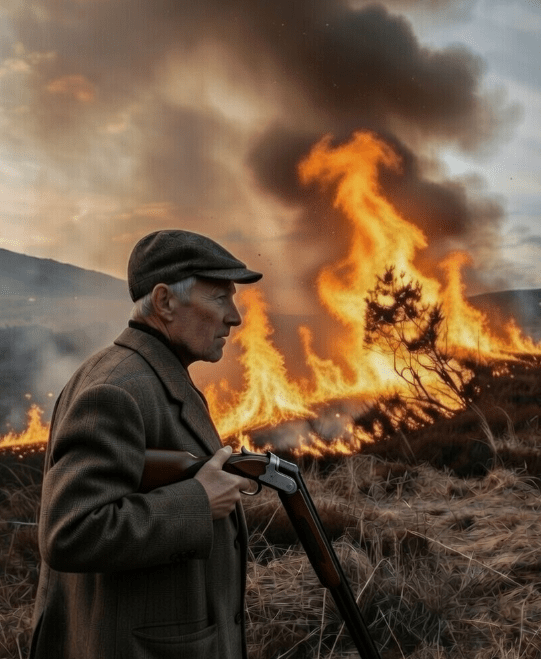
There’s not a word criticising the big grouse estates or their practice of muirburn and its role in wildfires. There is also, a complete failure to report the steps the Scottish Government is taking to manage that:
From the Scottish Government in October 2025:
New licensing conditions for muirburn will not come into force until autumn 2026, Agriculture Minister Jim Fairlie has confirmed.
In the aftermath of the wildfires which have affected many parts of the country and caused extensive damage to Scotland’s peatlands, the decision has been taken to move the commencement date from 1 January, when the relevant part of the Wildlife Management and Muirburn (Scotland) Act would have come into effect.
This follows extensive discussions with land managers, game keepers, estate owners and the Scottish Fire and Rescue Service (SFRS). Muirburn is the intentional and controlled burning of moorland vegetation to encourage new growth (either heather or grassland) for the management of moorland game and wildlife or for improving the grazing potential of the moorland for livestock or deer.
The Wildlife Management and Muirburn Bill was passed by the Scottish Parliament in March 2024 and includes a range of measures that will help tackle raptor persecution and ensure that the management of species on grouse moors is done so sustainably and with animal welfare as a priority.
The Bill:
- strictly regulates the use of muirburn, the controlled burning of vegetation on peatland
- bans the practice of snaring in Scotland
- bans the use of glue traps to catch rodents
- gives greater powers to Scottish SPCA inspectors to tackle wildlife crime
- introduces a new licensing framework for grouse moors
Link – https://www.gov.scot/news/muirbuirn-licence-scheme/
This diplomatic account conceals, I feel sure, a determined policy by the SNP to reign in grouse moor owners and managers, even if delayed by one year, who are responsible for turning Scotland’s uplands into deserts amenable only to the interests of small affluent elites and responsible for events such as the Brechin Floods of 2023 wrongly attributed to Storm Babet and to Scottish Government ‘failures.’
How so?
BBC Reporting Scotland 22 October 2024 were back on the October 2023 Storm Babet and the flood damage to Brechin, with locals complaining of a ‘ghost town‘ and an implied accusation of the Scottish Government not having done enough to prevent the floods in the first place or to help locals in the subsequent year.
There is only a simple acceptance here of climate change and the need for more flood defences, to stay in the same place.
There is no mention of research suggesting another, more scientific and forensic explanation and an identifying a cause which can easily be reversed.
In an extensive, thorough and evidence-based study, Nick Kempe, a researcher and writer at ParkswatchScotland, pins the blame squarely and simply on grouse moor management around the River Esk and upstream of Brechin and Montrose.
He writes:
The south east fringes of the Cairngorms north of Brechin include some of the most intensively managed grouse moors in Scotland or the wider UK. In many parts of the catchment of the River South Esk managing the land for driven grouse shooting is the dominant land-use.
The muirburn, besides destroying peat which helps absorb rainfall, also removes surface vegetation, including plant litter, which helps slow the flow of water downhill. The rate of water run-off is almost certainly sped up further where the burned strips are oriented downhill, rather than across slopes.
Meantime, a google search will reveal that organisations representing sporting interests have issued a stream of claims that intensive grouse moor management actually helps to reduce flood risk.
Muirburn in fact does exactly the opposite of “natural flood management”, the restoration of woodland and peat bogs to reduce the amount of water flowing into watercourses. The conclusion is obvious. If the Scottish Government and its agencies really want to reduce the amount of destructive flooding that affects places like Brechin they need to tackle grouse moor management. Unfortunately Scotland’s whole system of flood prevention and management appears designed to conceal this fact.
Full report at: https://parkswatchscotland.co.uk/2023/10/27/storm-babet-the-angus-grouse-moors-and-the-flood-destruction-in-brechin/
I suspect the Bill also has as its heart the following:
Between 12% and 18% of Scotland’s total land area is currently reserved for grouse moors. Despite this, the economics of such activity has been shown to be significantly worse than any other reasonably conceivable economic activity. https://www.commonweal.scot/policy-library/back-life-mapping-scotlands-alternative-grouse-moors-december
Of all the possible uses of this land, grouse shooting is not only the least moral, it is by far the least economically effective. In fact, almost any other use will create more value and more jobs per hectare. https://www.birdguides.com/news/grouse-shooting-is-the-least-effective-use-of-scottish-land/
Back in the day, Common Weal did things like this. In 2019, with the Revive Coalition they produced: Back to Life: Visions for Alternative Futures for Scotland’s Grouse Moors. It settled the debate once and for all. Common Weal presented some devastating numbers for the supporters of shooting. Neatly summarised for us by Bird Guides:
A new report has shown that, from an economic perspective, grouse shooting is the most ineffective use of Scottish land. The study, published on the final day of the Scottish grouse season, shows the bloodsport produced an annual gross value added (GVA) of just £30 per hectare.
The report – Back to Life – scrutinises a variety of other possible land uses, including agriculture, biomass, housing and solar power, and found all of them to produce far greater value. If the land was used for other purposes, horticulture would return the greatest GVA at £12,412/ha, followed by housing (£11,950) and solar power (£10,952).
Horticulture, which currently uses 0.26 per cent of Scotland’s land area, would create 7,370 jobs, generate £261 million for the economy and would need 3 ha to create one job. In stark contrast, the report said grouse shooting, on the current land use area of 1.5 million ha, created 2,640 jobs, had an annual economic impact of £32m and required 330 ha to create. https://www.birdguides.com/news/grouse-shooting-is-the-least-effective-use-of-scottish-land/
Please Support Talking-up Scotland at:

https://www.crowdfunder.co.uk/p/support-talking-up-scotland

Click on the above.

Or direct bank transfer at Sort Code 08-91-04  Account - 12266421 Name - JOHN ROBERTSON
Discover more from Talking-up Scotland
Subscribe to get the latest posts sent to your email.
 Talking-up Scotland
Medieval. Its an absolute disgrace that land – our most precious resource – is exploited to death. You can drive through most of Northern Scotland over miles and miles of bu**er all, MAMBA.
Then there’s the vast acres bought by hedge funds and investment banks for carbon sequestration i.e. to write off all the carbon manufacturers produce. They get grants to plant trees, Sitka spruce and Norway spruce, exotic conifers which acidify the land.
Let’s not mention the Arab sheikhs, maybe they come for the water.
For some reason, Scottish ministers are terrified of upsetting the landed gentry. Hence the licensing scheme has been kicked into the long grass. It’s not the first time. It should have been introduced in September 2025. It was postponed until March 2026. But in September 2025 the minister, Jim Fairlie, announced that it would not be introduced in March 2026 but was now postponed until September 2026.
Why? Because gamekeepers were not ready to implement a licensing scheme. There was no moratorium on burning until the scheme could be introduced.
Carry on burning.
LikeLiked by 1 person
I see the fire in the in a Motherwell tower block was contained in 1 floor
LikeLiked by 1 person
Colin and Edward explain the benefits of grouse shooting.
https://raptorpersecutionuk.org/2020/10/28/campaigners-launch-spoof-dragons-den-film-ridiculing-grouse-shooting-industry/
LikeLiked by 2 people
I think you make a fair point.
This is an example of bias by omission. Yes, there is a concern about the increase in wildfires in Scotland, but it neglects the fact that the population of Scotland is densely contained within a fairly small proportion of the land area in the central belt and on the east coast.
There are historic reasons for this, not least the ‘clearances’ in the highland and lowland areas and the creation of large estates owned by a few wealthy landowners. Sheep rearing was one of the main reasons, but there were other factors such as the creation of exclusive hunting areas, which were euphemised as ‘field sports’. The ecology of these areas was changed such as by draining bogs and planting heather. The destruction of bogs and peatland removed ‘carbon sinks’ and the resultant increase in carbon dioxide produced heating of the planet and the drying out of plants making them more susceptible to ignition.
Of course there are other factors such as the growth of heavy industry and increased use of coal, oil and gas.
The omission of the consequences of these large privately owned estates by this report is, I suspect, an editorial decision by BBC Scotland News and Current Affairs.
LikeLike
WHY ARE FIRE BRIGADE NOT CHARGING ALL OWNERS AND COUNCILS
FOR ARSON VANDALISM ARE THE “BEING BRIBED”
OR BULLIED
LikeLike
BBC ARE BESTEST PALS WITH JOLLY ESTATES OWNERS
LikeLike