

Please Support Talking-up Scotland at:

https://www.crowdfunder.co.uk/p/support-talking-up-scotland

Click on the above.

Or direct bank transfer at Sort Code 08-91-04  Account - 12266421 Name - JOHN ROBERTSON
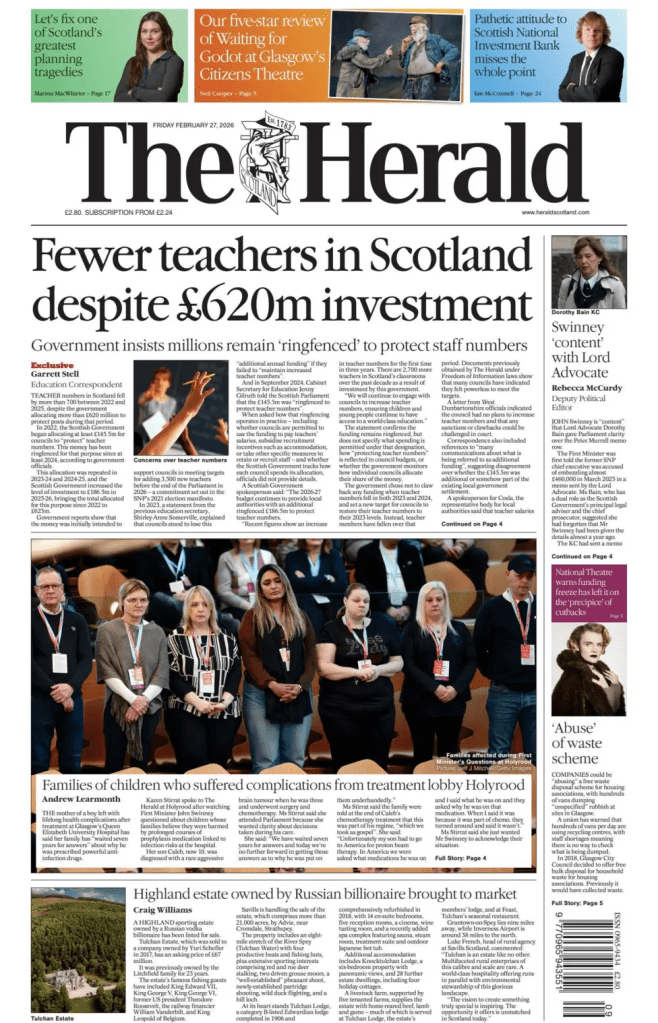
Rehashing a story from one of their December 2025 front pages, the Herald’s Garrett Stell (‘Originally from North Carolina’), has the above headline based on an apparent fall in teacher numbers from 2022 to 2025. I’m not going to check. It’s not important.
Much more important, he doesn’t seem to know about the ratio between teacher and pupil numbers. I’ll resist the temptation to do my Appalachian accent.
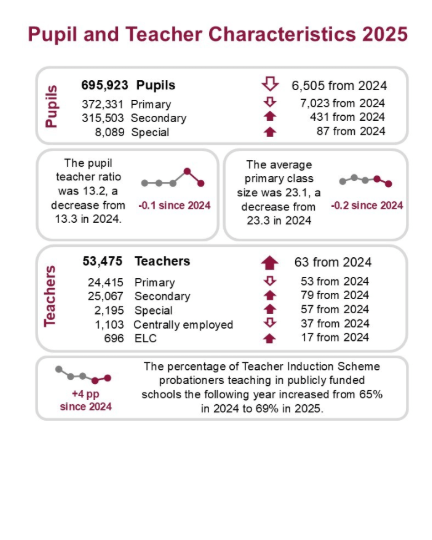
You’ll see above, in the official figures, that pupil numbers fell by thousands in Scotland in 2024, yet teacher numbers increased.
The effect of that:
The above data revealing a significant fall in pupil numbers yet a small increase in the number of teachers.1
There are 18 pupils for every teacher in England, 18.9 in Wales but only 13.3 in Scotland’s schools. That’s a huge difference that must surely transform the experience in Scottish schools.2
The Scottish Government has managed to support the far better PTR in Scotland through years of a reducing share of Scotland’s revenue being returned to us.
Sources:
- https://explore-education-statistics.service.gov.uk/find-statistics/education-and-training-statistics-for-the-uk/2025
- https://www.gov.scot/publications/pupil-and-teacher-characteristics-2025/
The pupil/teacher ratio is one of the few things central government can do to affect the quality of teaching and learning in schools and on that score, the Scottish Government is and has been, for years, doing better than those in other parts of the UK.
Why is the pupil/teacher ratio so important?
The pupil-teacher ratio (also called student-teacher ratio) measures the number of students per teacher in a school or classroom. It is a key indicator of educational quality and resource allocation.A lower pupil-teacher ratio is generally considered important because it enables more effective teaching and better student outcomes, particularly in the following ways:
- Personalized attention and individualized instruction — Teachers can spend more time understanding each student’s learning style, strengths, weaknesses, and needs. This allows for tailored teaching methods, immediate feedback, and adjustments to help struggling students catch up or challenge advanced ones. In larger ratios, teachers are often stretched thin and must teach to the “middle” of the class.
- Improved student engagement and participation — With fewer students, it’s easier for teachers to involve everyone in discussions, ask questions, monitor understanding in real time, and reduce disruptions. Students feel more seen and valued, which boosts motivation, confidence, and a positive attitude toward school.
- Better classroom management and learning environment — Lower ratios make it simpler to maintain discipline, address behavioral issues quickly, and create a supportive, less chaotic atmosphere. This reduces teacher stress and burnout while improving overall working conditions.
- Stronger teacher-student relationships — Teachers can build deeper mentoring bonds, identify issues (academic, emotional, or social) early, and provide emotional support. This is especially valuable for younger children, disadvantaged students, or those with special needs.
Research supports these benefits.
https://ncte.org/statement/why-class-size-matters
How are things in North Carolina?
January 28, 2025 RALEIGH — A majority of North Carolinians are dissatisfied with their local schools, according to the latest Carolina Journal Poll. This survey of 606 likely North Carolina voters asked participants how satisfied they are with the quality of K-12 education students receive in their local schools. Only 33.3% said they were satisfied, while 55.2% said they were dissatisfied. This is an increase of 7.2 points from last January. This year, of those who said they were satisfied, only 7.5% said they were completely satisfied compared to 27.1% who said they were completely dissatisfied.
And in Scotland?
According to the most recent data from the Scottish Household Survey (published November 2025, covering 2024 results), 69% of adults in Scotland were satisfied with their local schools. This figure has remained unchanged from 2022 (69%) and 2023 (69%).
https://www.gov.scot/publications/scottish-household-survey-satisfaction-with-schools-2024
Please Support Talking-up Scotland at:

https://www.crowdfunder.co.uk/p/support-talking-up-scotland

Click on the above.

Or direct bank transfer at Sort Code 08-91-04  Account - 12266421 Name - JOHN ROBERTSON
Discover more from Talking-up Scotland
Subscribe to get the latest posts sent to your email.
 Talking-up Scotland
The Herald’s not often right but it’s wrong again. Special measures required!
LikeLiked by 1 person