

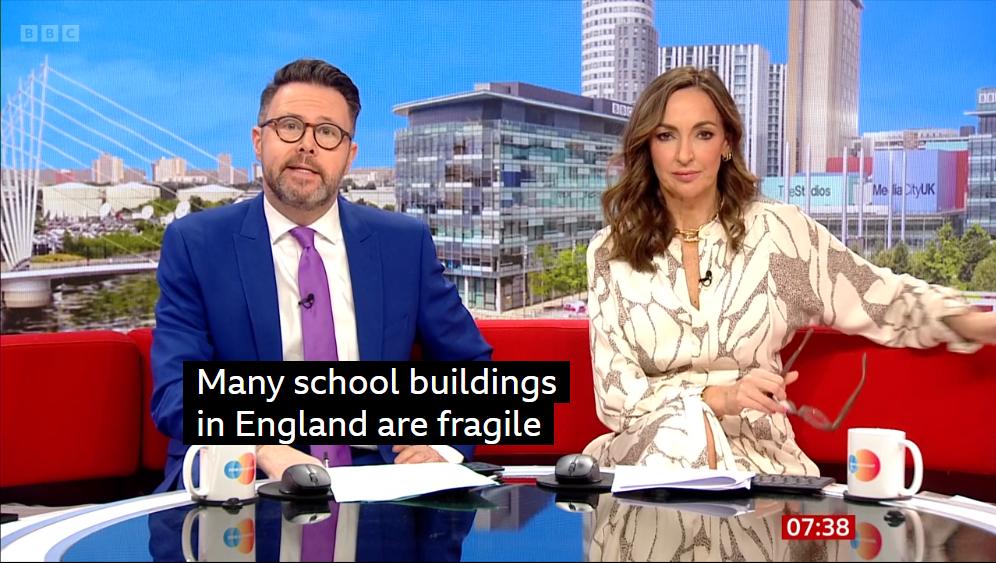
and need refurbishing or even replacing, according to a group of MPs in a report that’s out this morning.
Please Support Talking-up Scotland at:

https://www.crowdfunder.co.uk/p/support-talking-up-scotland

Click on the above.
That’s the message on BBC Breakfast this morning.
What’s the situation in Scotland?
This but you won’t be hearing it elsewhere:
By stewartb
School estate statistics 2024 provides statistics for context and perspective. It follows a BBC Scotland article on the corporation’s News website on 12 October headlined: ‘Child safety fears as ‘repaired’ ceiling falls at neglected school’.
Now don’t get me wrong, no one should have a piece of wood or plasterboard fall on or near their head, anywhere. And especially no one wants children to be at risk from such an incident in a school. It’s a legitimate BBC local news story to highlight alleged flawed repair and maintenance of Milngavie Primary School by East Dunbartonshire Council officials.
But that is not where the BBC Scotland news story takes readers.
By also referring to national statistics, BBC Scotland seeks to use this one incident as a ‘salient exemplar’, as the basis for a strongly implied, negative generalisation about Scotland’s schools. It selects statistics from a recent review (see reference below) of the condition of Scotland’s state-funded school estate. But being BBC Scotland, it does so without context or perspective. So here once again TuS takes on the role of information provider – of context and perspective provider – to offer the public service that BBC Scotland steadfastly refuses to perform!
Source https://www.gov.scot/publications/school-estate-statistics-2024/documents/
Context
It would be a legitimate story for BBC Scotland’s local news to highlight parental demand of their local council for a major refurbishment or a replacement of an aged primary school. After all, across Scotland, local councils and the Scottish Government have been replacing or upgrading much of Scotland’s school estate since the SNP first came to power in Holyrood.
This is from the Scottish Government on 10 September this year: ’During the 2023-24 year 41 school builds or substantial refurbishment projects were completed. This brings the total number of school builds or substantial refurbishment projects completed since 2007-08 to 1,139. Only builds or refurbishments costing at least half a million pounds for primary and at least one million pounds for secondary and special schools are reported here.’
To put the number 1,139 in context, the Scottish Government in this review reports that in 2024 there are 2,457 state schools in Scotland.
Better school buildings created for many teachers and young people across Scotland; many people directly employed in school construction projects plus the resulting beneficial economic impact of the employment and supply chain multiplier; community benefits delivered locally due to clauses in procurement contracts – all despite the financial challenges imposed by Westminster austerity and the Scottish Government’s severely constrained borrowing powers.
BBC Scotland and the perspective void
The BBC Scotland article tells readers this: ‘A recent review of Scotland’s school estate found that 8.3% of schools were in a poor or bad condition – which is equal to 204 schools.’ So 91.7% are good or satisfactory – so not perfect but is that not a positive?
For the benefit of BBC Scotland’s users and others: a recent review of Scotland’s school estate (the very same review that BBC Scotland journalists must have read!) reminds us that in 2007 – before the SNP came to power – 37.3% of schools were in a poor or bad condition – which equated to 993 schools! Now the figure is 8.3%!
The table below summarises further salient statistics from the same condition review of the school estate that are ignored by BBC Scotland:
| 2007 | 2019 | 2024 | ||
| Schools by condition: | Good condition | 371 schools (13.9%) of all schools) | 709 (28.5%) | 644. (26.2%) |
| Satisfactory | 1,298 (48.8%) | 1,491 (59.9%) | 1,609 (65.5%) | |
| Poor | 855 (32.1%) | 284 (11.4%) | 198 (8.1%) | |
| Bad | 138 (5.2%) | 4 (0.2%) | 6 (0.2%) | |
| % pupils in schools by condition | Poor condition | 32.9% | 10.1% | 4.4% |
| Bad | 4.7% | 0.2% | 0.6% |
Is the trend towards improvement over time here ‘perfect’, well no: is improvement over time very substantial, emphatically yes! Has the period since the SNP gained power been a time of financial plenty in UK public spending? Has it been a period of substantial UK investment to improve public infrastructure, including in education in England and therefore as a consequential spillover, in the rest of the UK? From the financial crash c. 2008 followed by Tory austerity, followed by Brexit, followed by a global pandemic as well as persistently anaemic UK growth and more recently, high UK inflation – hardly a time of plenty. And yet …..!
Statistics to be treated with care!
The BBC Scotland article goes on: ‘The number of pupils in schools with a bad condition rating has risen for the third consecutive year – from 1,736 in 2023, to 4,292 this year. And 51,905 pupils are taught in buildings with a poor condition rating.’
Firstly on the ‘three consecutive year’ claim: in 2022 the number of pupils in ‘bad’ condition schools was 1,688 and therefore the BBC Scotland report of an increase over three years is factually correct. BBC Scotland also notes that 51,905 pupils were in ‘poor’ condition schools in 2024 but fails to report that in 2023 the equivalent number was 58,116.
And recall the table above: pupils in ‘bad’ condition schools dropped from 4.7% in 2007 to 0.6% in 2024; in ‘poor’ schools, the percentage dropped from 32.1% in 2007 to 8.1% in 2024. Credit where credit is due – to Scotland’s local authorities and the Scottish Government. Addressing successfully a former British Labour Party government’s inheritance?
But why is there an uptick in the number of pupils in schools in a ‘bad’ condition in 2024? Focused on reporting statistics, the Scottish Government report offers no explanation. In terms of number of schools rated as ‘bad’ in 2024, the total is six (0.2% of all schools). The number in 2023 was just three schools rated as ‘bad’. The difference due to these additional schools equates to an additional 2,556 pupils experiencing a ‘bad’ condition school – an average school roll of 852 pupils.
The last time there were more than 6 ‘bad’ condition schools was in 2016 – there were 8 at that time. The number of pupils in those 8 schools was reported to be 3,604 – an average roll of 450. So whilst schools in ‘bad’ condition are to be deplored and need to be ‘fixed, the impact on the absolute pupil number statistic for schools assessed as in ‘bad’ condition in any single year depends hugely (obviously) on the size of the school involved: year on year statistics may therefore be ‘lumpy’ as sometimes the school falling for the first time into the ‘bad’ condition category may be a small rural primary or a large urban secondary.
Let’s hope the Scottish Government’s finances can soon be sufficient to eradicate all ‘bad’/‘poor’ condition schools, and also have sufficient funds in future to refurbish or replace schools in advance of reaching these conditions.
There is clearly ongoing positive intent. From a Scottish Government press release on 10 September 2024 entitled ‘Record number of pupils in “good or satisfactory” schools’, the Cabinet Secretary is quoted: “The Scottish Government is continuing its investment in the school estate through the £2 billion Learning Estate Investment Programme. As set out in our Programme for Government, construction will begin on a further eight school building projects over the next year. This means that by the end of 2027-28, Scotland will have seen 47 modern, state-of-the-art school buildings open, thanks to our investment.”
Note on Milngavie Primary School
East Dunbartonshire Council officials have already undertaken and have planned substantial remedial work on the Milngavie school building – for the work programme see https://eastdunbarton.moderngov.co.uk/ieListDocuments.aspx?CId=152&MId=1070&Ver=4 Appendix 2C.
Please Support Talking-up Scotland at:

https://www.crowdfunder.co.uk/p/support-talking-up-scotland

Click on the above.
 Talking-up Scotland
The Tories cut education funding £6Billion a year. Over £60Billion. Spent more on war. Redundant weaponry. Instead of economic policies. Supported war. Instead of eradicating poverty. Increased poverty worldwide. The UK pays the price of Westminster lies. Constant lying. Misappropriation of revenues.
LikeLike
Alas! You have omitted context, too.
The primary school in question is in an area favoured by BBC Scotland producers and staff as a place of residence and it is almost certain that the children of some of them attended the school and, probably, some of the staff were on the parent council. So, they were using this ‘salient example’ to put pressure on the local Council to effect repairs ahead of other schools in the area.
I suppose we should give some praise to them for sending their children to a local authority school rather than to a class segregated fee paying school as many of the high heid yins of BBC Scotland do.
LikeLiked by 1 person
‘ put pressure on the local Council’ – indeed, and it seems to have worked!
To come up to date, from the East Dunbartonshire Council website (6 Feb 2026) ‘Pupils get sneak peek of Milngavie Primary refurbishment’.
‘Some pupils from Milngavie Primary School got a sneak peek this week of the refurbishment going on at their school while they are decanted and having lessons elsewhere. ‘Work has been taking place at the 150 year old building since June 2025 and is set to be complete in time for pupils to return in August 2026. The refurbishment includes the following improvements: Full roof replacement including valleys, gutters and all sky lights Full window replacement Repair/reinstatement of stonework Internal decoration.’ (my emphasis)
As I noted in the original blog post: ‘It’s a legitimate BBC local news story to highlight alleged flawed repair and maintenance of Milngavie Primary School by East Dunbartonshire Council officials. But that is not where the BBC Scotland news story takes readers.’
LikeLiked by 1 person