

Please Support Talking-up Scotland at:

https://www.crowdfunder.co.uk/p/support-talking-up-scotland

Click on the above.
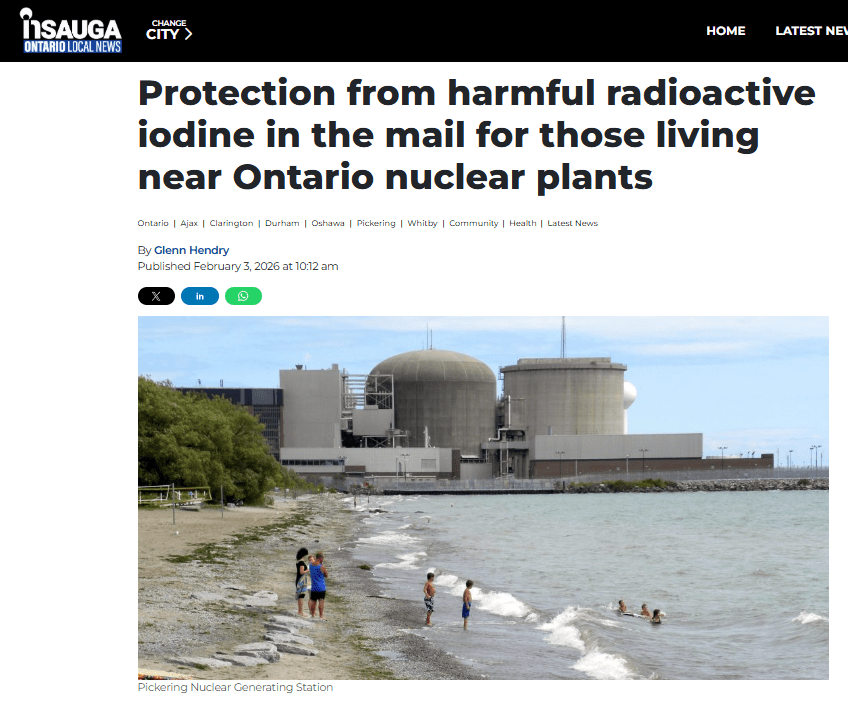
From and Ontario-based news website, nsauga, two days ago, the above and:
With potassium pills distributed to residents living in the shadow of one of Durham Region’s two nuclear plants in 2015 set to expire, a batch of replacement pills will be sent to all those living within 10 kilometres of either Pickering or Darlington nuclear generating stations. The initiative, a partnership between Ontario Power Generation, the Durham Health Department and Toronto Emergency Management, will provide residents living near the nuclear stations with replacement potassium iodide (KI) pills. These pills will replace those sent out in 2015, which are set to expire in 2027.
Has the UK Government, responsible for nuclear power regulation in Scotland ever shown such concern for Scots living near nuclear facilities in Scotland?
Of course they haven’t.
Other countries? Of course they have.

Sky News in September 2019, reported:
France is to give free iodine tablets to more people living near the country’s 19 nuclear plants. Around 2.2 million people living within 20km (12.4 miles) of a nuclear plant will be given the tablets to protect their bodies from the effects of radiation in the event of an accident. In 2016, five years after the nuclear accident in the Japanese city of Fukushima, France gave iodine to those living within 10km (6.2 miles) of a nuclear plant.
Thyroid cancer incidence in France has increased dramatically over recent decades, particularly for papillary thyroid cancer. From 1980 to 2005, the number of cases rose from 325 to 1,599 in men and from 1,027 to 5,073 in women. This period correlates with a massive expansion of nuclear energy which now accounts for 75% of France’s electricity generation.
https://www.american-hospital.org/en/pathologie/thyroid-cancer
https://pubmed.ncbi.nlm.nih.gov/26003877/
More recently, the Commonwealth of Pennsylvania Department of Health, the statewide distribution of free potassium iodide (KI) tablets on August 14 for all Pennsylvanians who live, work, or study within 10 miles of the four active nuclear power plants in the Commonwealth. It had done so the previous year too. https://www.pa.gov/agencies/health/newsroom/doh-to-distribute-free-ki-tablets-to-residents-near-nuclear-powe
Reading this, i wondered how common this practice is. From a Grok AI request:
Several countries distribute iodine tablets (potassium iodide, or KI) to residents living near nuclear power plants as a precautionary measure to protect against radioactive iodine exposure in the event of a nuclear accident. Below is a list of countries known to have such programs, based on available information:
- Belgium: Belgium provides iodine tablets to its entire population of 11 million, with distribution expanded to cover the whole country, not just areas near the Tihange and Doel nuclear plants. This was updated in 2016 following concerns about nuclear safety and potential terrorist threats.
- Canada: The Canadian Nuclear Safety Commission requires homes and businesses within 10 km of nuclear power stations to maintain a supply of KI pills, available free at select pharmacies, particularly in regions like Durham and Toronto.
- France: France has distributed iodine tablets to residents within a 10 km radius of its 19 nuclear power stations since 1997, with recent campaigns in 2024 for areas near plants like Penly and Paluel. Some groups advocate for expanding this to a 20 km radius.
- Germany: Germany stockpiles over 180 million iodine tablets across various locations like town halls, fire stations, and pharmacies for distribution in case of a nuclear incident, particularly near nuclear plants, with specific protocols varying by federal state.
- Netherlands: The Dutch government has ordered 15 million iodine pills for distribution, primarily to children under 18 and pregnant women within a 62-mile radius of nuclear plants, with plans to make them available to others if needed.
- Norway: Norway recommends that individuals under 40, pregnant women, and those with children store iodine tablets at home, available for purchase without a prescription, to be taken only on government advice.
- Switzerland: Switzerland has mailed iodine tablets to approximately 5 million residents as a precautionary measure, to be taken only upon authorities’ request in case of a nuclear disaster.
- Ukraine: Ukraine has distributed iodine tablets to residents within a 30-mile radius of the Zaporizhzhia nuclear power plant, particularly during heightened concerns in 2022 due to conflict-related risks.
- United States: In the U.S., states like Pennsylvania and New York distribute free KI tablets to residents within 10 miles of nuclear power plants. Pennsylvania, for example, offers replacements for expired tablets, with distributions planned for August 2025.
- Finland: Finland has advised households to purchase iodine tablets, leading to shortages in pharmacies in 2022 due to concerns over the Ukraine conflict and potential nuclear risks.
I can find no such iodine issue in the UK but three months ago, UK households were urged, by a retired army officer on Yorkshire Live, to stockpile (at your own expense) tinned food, iodine tablets and water in the light of the Russian threat.
The Labour Government plans to build dozens of new small nuclear plants across the UK, will keep the nuclear subs in the Clyde and has no serious plans to clean up Sellafield. You’d probably best get those tablets yourself!
Why does this matter especially so in Scotland?
We already have the highest cancer rates in the world.
From Public Health Scotland in 2023:
Cancer incidence in Scotland, age-adjusted rates and 95% confidence intervals (CI) of expected rates,* 2010-2021
The rate, or risk, of new cancers also increased to 644 per 100,000 (an increase of 3.1% compared with 2019) and was higher than expected from the long-term trend.
Imagine these were drug cases. Would our media want to know how they compare with the rest of the world? Just a bit. ‘Drug capital of Europe!!‘
Note: Cancer cases rather than cancer deaths are a better measure of the risk from pollution of the environment. Scotland’s superior NHS is, no doubt, compensating for what follows.
From the World Health Organisation in 2022:
The average level of cancer cases in Europe is only 280 per 100 000 compared with 640 in Scotland. In North America, it’s 364.7 and in Oceania (Australia, NZ), it’s 409. In Asia and Africa, I feel sure, detection rates are even lower due to ‘third-world’ health provision.
Scotland is clearly the cancer capital of the whole world. Why is that not news?
And England, most of it further way from Sellafield and Trident than most Scots are? From the Gov UK site, the rate is 540 per 100 000, also very high globally but significantly lower than in Scotland at 640.
With the most dangerous radioactive plant in Europe at Sellafield in Cumbria, only miles from the border, with the experimental nuclear facility at Dounreay in Caithness, with UK and for some time, US, nuclear submarines and missiles based only 35-40 miles from Glasgow and sailing along the West of Scotland coastline, and with two major power stations at Hunterston and Torness, both within the densely populated central belt, Scotland has been exposed to large-scale and largely unknown risks for 70 years now.
While no government-funded scientists will ever admit to any link between the contamination and cancer cases, the onus is not on us but on them to prove there is none.
And before you say it – Scots smoke more? No they don’t.
15% of Scots smoke. Fewer than in most European countries.
Links and sources:
- https://publichealthscotland.scot/publications/cancer-incidence-in-scotland/cancer-incidence-in-scotland-to-december-2021
- https://gco.iarc.fr/today/en/dataviz/bars?types=0_1&mode=population&key=asr&sort_by=value1
- https://www.statista.com/statistics/312961/new-cancer-cases-rate-england-age-gender/#:~:text=Cancer%20is%20an%20aggregation%20of,excluding%20non%2Dmelanoma%20skin%20cancer
- https://www.gov.scot/publications/scottish-health-survey-2022-volume-1-main-report/pages/11/#:~:text=As%20noted%20above%2C%20in%202022,%25%20and%2013%25%20respectively).
- https://www.euronews.com/health/2023/08/14/smoking-in-europe-which-countries-are-the-most-and-least-addicted-to-tobacco-and-vaping#:~:text=According%20to%20data%20compiled%20by,smoked%20fewer%20than%2020%20units
Please Support Talking-up Scotland at:

https://www.crowdfunder.co.uk/p/support-talking-up-scotland

Click on the above.
Discover more from Talking-up Scotland
Subscribe to get the latest posts sent to your email.
 Talking-up Scotland
YET AGAIN THE DEVIOUS ENGLISH ESTABLISHMENT
ARE VERY COMFORTABLE TO POISON ALL SCOTS IN AND AROUN
THESE POISONS COURTESY OF WESTMINSTER
TO KILL AS MANY SCOTS AS POSSIBLE
TO ENSURE ENGLAND GETS THEIR WAY TO REDUCE THE SCOTTISH POPUTION
LikeLike
AFAIK most people in the USA use iodised salt which may also boost thyroid protection.
LikeLiked by 1 person
At the time when Chernobyl went into meltdown people were advised to use iodine salt if they could not get their hands on iodine tablets. I remember buying iodine salt and using it at that time.
LikeLiked by 1 person
I still use it when not using Lo Salt – hedging my bets! Being vegan I need to get iodine somewhere.
LikeLike