Reposted with no paywall – Why the ‘hospital deaths’ won’t result in criminal charges, why Scots don’t do DIY dentistry, why we don’t need nuclear energy for radiopharmaceuticals and why the Daily Record’s ‘Scotland’s mean streets’ is a dirty big lie
Support Talking-up Scotland to keep rebutting the lies almost every day of the year, athttps://t.co/xFcIcegHTy
They will make as much as they can of this in the weeks between now and 7th May when the voters go to the polls to elect the next Scottish Government but as with the other attempts to undermine the reputation of the SNP in governance, nothing will come of it. I’ll eat my hat etc.
Have there been any comparable investigations into potentially fatal hospital acquired infections leading to prosecutions and punishment, anywhere in the UK, ever?
Yes, four. From an AI search of 80 sources:
Case
Details
Investigation and Outcome
Brighton and Sussex University Hospitals NHS Trust (Royal Sussex County Hospital, 2011)
78-year-old cancer patient Joan Rayment died after contracting legionella from the hospital’s contaminated water systems. High levels of the bacteria were found across multiple buildings despite prior warnings from 2007-2010.
Sussex Police investigated the death, finding legionella was an “endemic problem.” The HSE prosecuted the trust for failing to control risks (2007-2013). The trust pleaded guilty and was fined £50,000 plus £38,705 in costs. theargus.co.uk +1
Liverpool Heart and Chest Hospital NHS Trust (2007)
Two patients (one from Warrington, one from the Isle of Man) died from Legionnaires’ disease amid unsafe legionella levels in the hospital’s water supply for showers, baths, and sinks. Testing had been halted for nine months prior.
HSE led the investigation and prosecution for breaches of health and safety laws. The trust pleaded guilty and was fined £35,000 plus £12,862 in costs. No explicit police role mentioned, but standard protocol for unexpected deaths involves initial police assessment. warringtonguardian.co.uk
Basildon and Thurrock University Hospitals NHS Foundation Trust (Basildon University Hospital, 2004-2010)
Eight people contracted legionella, with two deaths. The trust failed to adequately manage water system risks.
HSE investigated and prosecuted under the Health and Safety at Work Act. The trust admitted failures and was fined £100,000 plus £250,000 in costs (total £350,000). bbc.com +2
Royal United Hospitals Bath NHS Foundation Trust (2015)
68-year-old Terence Brooks died from Legionnaires’ disease contracted via the hospital’s water systems, exposing ongoing control failures.
HSE investigated and prosecuted for failing to control exposure risks. The trust was fined £300,000. somersetlive.co.uk +1
These cases demonstrate a pattern where water contamination leads to fatalities, triggering investigations (often joint police-HSE) and HSE-led criminal prosecutions resulting in financial penalties. In some instances, like Brighton, police explicitly probed the deaths before HSE action. While not all led to individual charges (e.g., manslaughter), the trusts faced corporate punishments.
Are we worried this suggests something may come of the Glasgow investigations?
See any common factor?
Legionella/Legionnaires disease in all four?
The Glasgow infections:
Stenotrophomonas maltophilia (e.g., in the high-profile case of Milly Main, a child with leukaemia who died in 2017 after contracting this infection).
Mycobacterium chelonae (a nontuberculous mycobacterium, linked to cases like Molly Cuddihy in 2018).
Cupriavidus pauculus (noted in early incidents and water testing).
There are no publicly documented historical cases in the UK where bacterial infections from contaminated hospital water systems—similar to those at Glasgow’s Queen Elizabeth University Hospital (QEUH), such as Stenotrophomonas maltophilia, Mycobacterium chelonae, Cupriavidus pauculus, or related opportunistic Gram-negative bacteria—have resulted in police investigations leading to court prosecutions, fines, or other punishments against NHS health boards or trusts.
The Differences
Legionella cases typically involve a more straightforward, inherently virulent pathogen causing Legionnaires’ disease (often pneumonia) in vulnerable patients, with clear outbreaks traceable to water systems (e.g., showers, cooling towers). These trigger routine HSE enforcement and, in fatal cases, joint police-HSE probes under the Health and Safety at Work Act 1974, leading to corporate prosecutions.
QEUH-type infections are opportunistic, environmental bacteria that primarily cause severe outcomes (e.g., bacteraemia, line infections, sepsis) in profoundly immunocompromised patients, such as paediatric oncology cases. They are harder to definitively link causally to the hospital environment without extensive expert evidence, and outbreaks are often managed through clinical infection control rather than escalating to criminal enforcement.
The Glasgow infections could have come from the water supply, the air, from visitors or have been in the patient when admitted. It’s impossible to prove but you can only be infected by the legionella from the hospital water system. It’s easy to prove.
If charges are brought and result in prosecution, this would be the first known UK instance of an NHS body facing court over opportunistic waterborne bacterial infections of this nature—unlike the established pattern with Legionella.
Why Scots don’t do DIY dentistry
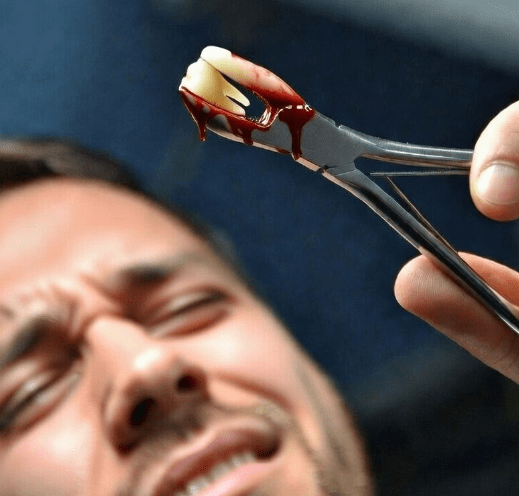
Image – Grok AI
From BBC Cumbria today:
‘Patients have tried DIY dentistry because they are so desperate’ – It is becoming increasingly difficult for some people to access routine NHS dental care. But what happens when the pain become unbearable? Health bosses in one region believe they have the answer. https://www.bbc.co.uk/news/articles/c9qp2xx3e37o
You can be sure BBC Scotland would have a story like this, if they could. Why can’t they?
Waiting to even get on a the books of an NHS dentist in England
From Scottish dentistry student numbers increase, published 22 January 2026 11:35
The number of Scottish students starting Bachelor of Dental Surgery (BDS) courses has increased by 7% – the highest increase in a decade.
The boost in student numbers fulfils a Scottish Government pledge to deliver an expanded pipeline of new dentists joining the workforce from 2029. The increase, which came in 2025-26, will be further supported by the Draft Budget for 2026-27 which outlines record funding of over £526.5 million for the sector.
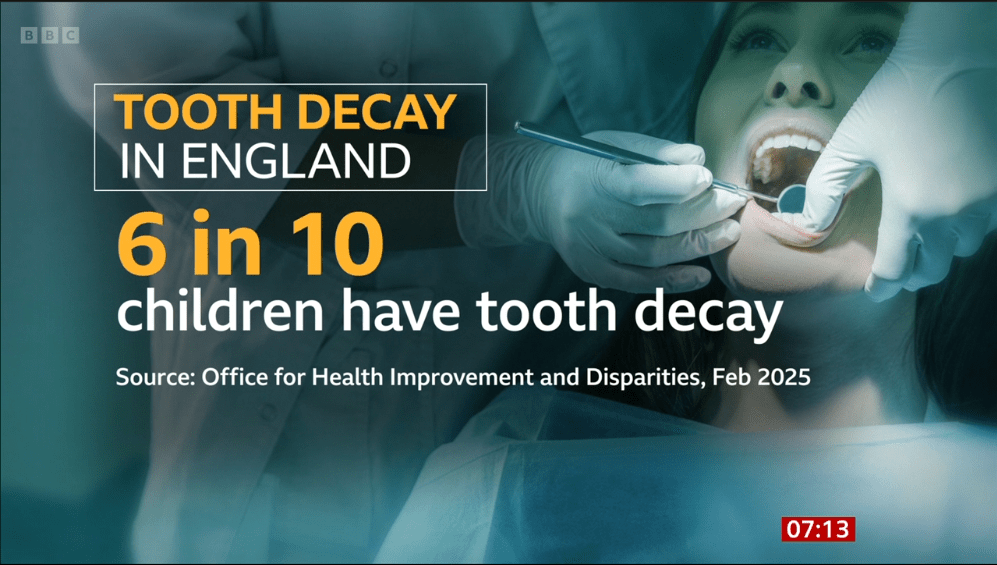
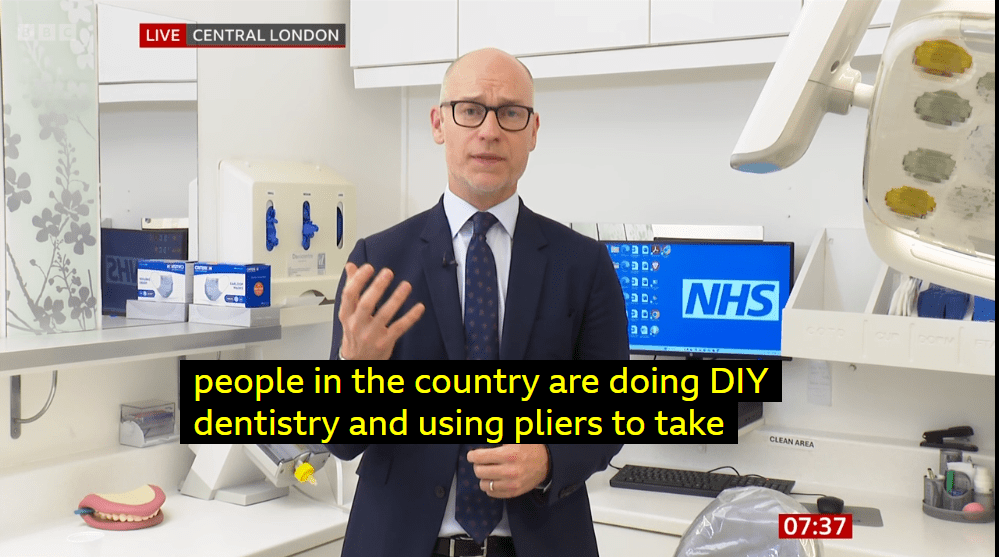
BBC Breakfast had extended and intensive coverage on the dentistry crisis in England, with the above images of queues around the block to even get on a dentist’s waiting list, and a minister admitting that folk are using pliers on themselves, 18 months after his government came to power.
BBC Scotland is not covering this topic.
Here’s why:
Shocking contrast as nearly twice as many Scots have access to an NHS dentist as those in England
The above table from Public Health Scotland today, reveals a very high level of access to free NHS dental treatment in Scotland – 90% of children and 97% of adults with 100% access for some age groups.
When I searched for equivalent data for England, what I found shocked me. From the ONS in September 2024:
Overall, 52.1% of adults reported having an NHS dentist, 34.2% have a private dentist, 13.5% did not have a dentist and 0.2% used a dental hospital.
Females were more likely (54.1%) than males (50.0%) to have an NHS dentist, while males were more likely (16.0%) than females (11.1%) to not have a dentist.
Imagine this was the other way round? BBC Scotland would have us sick to the back etc….
Why we don’t need nuclear energy for radiopharmaceuticals
Image Grok AI
From Rare Earth Exchanges, yesterday:
The revolution in targeted cancer therapy is being held back by a surprising bottleneck: a global shortage of atomic-sized bullets.
Radiopharmaceuticals—drugs that deliver radioactive isotopes directly to cancer cells—have become one of oncology’s most promising frontiers. Treatments like Lutetium-177 PSMA-617 (Pluvicto®) for prostate cancer have proven that these “theranostic” agents can extend life with remarkable precision. Yet, for every patient who receives treatment, dozens more wait, their hopes stalled not by a lack of scientific know-how, but by a severe supply crunch of the rare earth radioisotopes that power these drugs.
The traditional supply chain, reliant on a handful of aging nuclear research reactors, is brittle and centralized. This creates a critical vulnerability for the entire life sciences sector. In 2026, however, a powerful solution is moving from the lab to the clinic: decentralized, accelerator-driven isotope production. This technological shift isn’t just solving a logistics problem; it’s enabling a new generation of more effective therapies and reshaping the medical landscape.
So, here is clear evidence that justifying nuclear reactor expansion to meet this important need is no longer evidence-based. Is the Labour government up-to-date on this or are they, unavoidably backed and aped by their Scottish branch, parroting the old rationale?
In Wales, Plaid Cymru have been pushing for decentralized, accelerator-driven isotope production and a project there called ARTHUR) but Labour have been disinterested in their drive for more nuclear power across the UK:
From: Baroness Merron (Labour, Parliamentary Under-Secretary of State at the Department of Health and Social Care): In a written response (November 2025) to questions about Project ARTHUR:
The government has not made a specific assessment of Project ARTHUR.
In a further January 2026 written answer on domestic radioisotope production:
The Government does not have any current plans to produce a strategy or to consult on the potential for further domestic medical radioisotope manufacture.
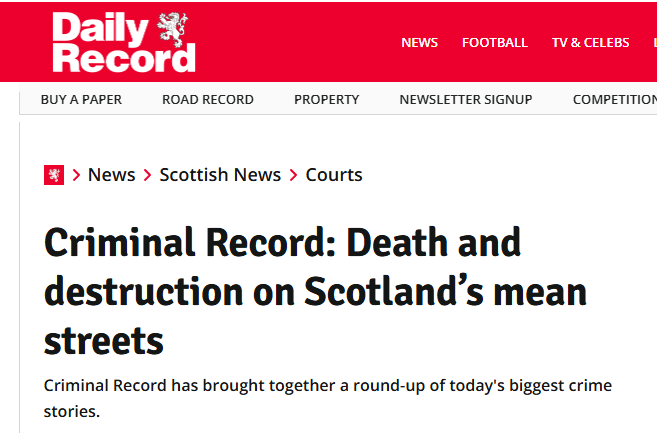
Why the Daily Record’s ‘Scotland’s mean streets’ is a dirty big lie
Finally, today, the above disgusting, scare-mongering, misrepresentation of life in Scotland today is quickly rejected:
Denmark, one of the safest places in the World, has more murders than Scotland
Scotland’s media continue to utterly ignore the murder rate in Scotland falling to the lowest level ever in recorded history and 20% lower than in England and Wales.
Between 2023-24 and 2024-25, recorded crimes of Murder and culpable homicide decreased by 24% from 58 to 44 crimes [8.1 per million]. There was a 27% decrease over the 10 year period between 2015-16 and 2024-25, from 60 to 44 crimes.1
The homicide rate in England and Wales for the year ending March 2025 was 8.8 per one million people, based on 535 homicide offences recorded by the police.2
That 0.7 per million looks small as a decimal number but it represents 51 more murders in England & Wales.
How does this compare with other European countries?
Denmark’s population is 5.97 million, 9.7% greater than Scotland’s 5.44 million.
In 2024/2025, there were 44 murders in Scotland and 48 in Denmark3, 9.1% more than in Scotland.
The murder rate in Denmark, 0.804 cases per million, is lower than in Scotland, 0.808 cases per million, but not statistically significantly different.
A dramatic fall in murder by knives in Scotland overall AND by young people, rubbishing the media reports here
From Knife crime statistics: FOI release published in October 2024 asking:
The number of knife crime offences [homicides], broken down by offence, age of suspect, and ethnic appearance of suspect, for each year for the last ten years (broken down by year), up to the most recent data.
The recent trends are clear:
a four year falling trend from 40 cases in 2019/2020 to 37, 26 and 25 in following years;
a three year falling trend among 16-24 year-olds, from 13 in 2020/2021 to 8 and 6 in the following years;
zero cases among minors for the last three years after 1 case in each of the previous two;
a reliable, statistically significant fall in the 5 year-average, from 35.8 five to ten years ago to 33.4 in the last five years.
One thought on “Reposted with no paywall – Why the ‘hospital deaths’ won’t result in criminal charges, why Scots don’t do DIY dentistry, why we don’t need nuclear energy for radiopharmaceuticals and why the Daily Record’s ‘Scotland’s mean streets’ is a dirty big lie”
I would like some clarity about the subscription too. I understood it to be a token “one off” to sort the sheep from the goats., pending the setting up of a real subscription service.
However, if it’s a £1 per article then I will have to cancel. There are usually at least 5 articles per day so that would cost £150 per month!







 Talking-up Scotland
I would like some clarity about the subscription too. I understood it to be a token “one off” to sort the sheep from the goats., pending the setting up of a real subscription service.
However, if it’s a £1 per article then I will have to cancel. There are usually at least 5 articles per day so that would cost £150 per month!
LikeLiked by 1 person