

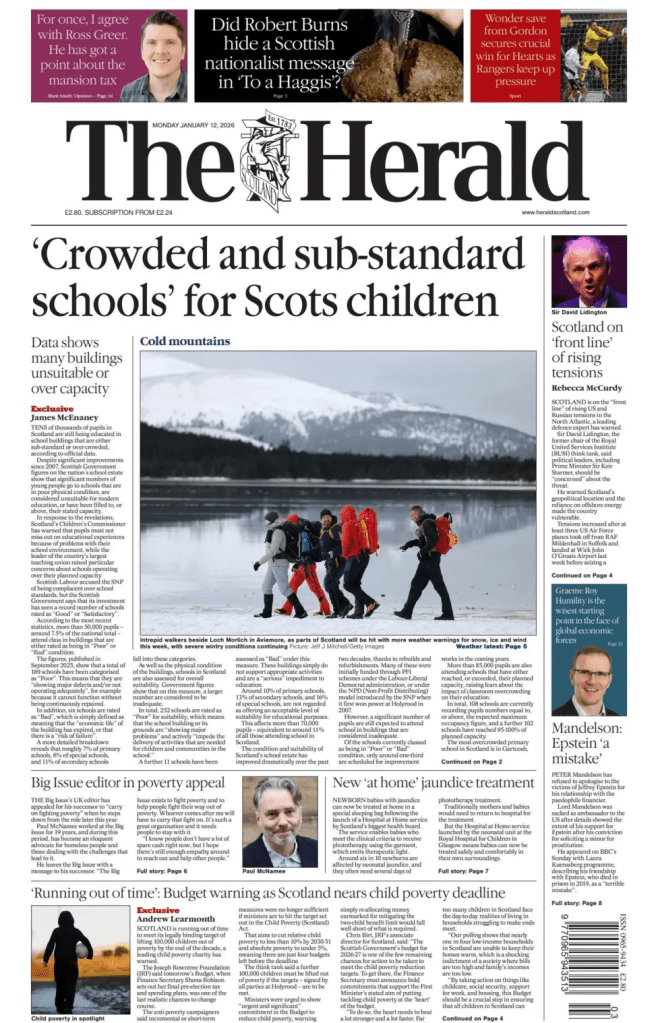
The Herald today, above, joining the daily anti-SNP drip from the 95% Unionist media in Scotland, with the above evidence-free reporting and, of course, ignoring the key role of local councils in maintaining school buildings.
Here’s the evidence on school buildings:
By stewartb
This provides statistics for context and perspective. It follows a BBC Scotland article on the corporation’s News website on 12 October headlined: ‘Child safety fears as ‘repaired’ ceiling falls at neglected school’.
Now don’t get me wrong, no one should have a piece of wood or plasterboard fall on or near their head, anywhere. And especially no one wants children to be at risk from such an incident in a school. It’s a legitimate BBC local news story to highlight alleged flawed repair and maintenance of Milngavie Primary School by East Dunbartonshire Council officials.
But that is not where the BBC Scotland news story takes readers.
By also referring to national statistics, BBC Scotland seeks to use this one incident as a ‘salient exemplar’, as the basis for a strongly implied, negative generalisation about Scotland’s schools. It selects statistics from a recent review (see reference below) of the condition of Scotland’s state-funded school estate. But being BBC Scotland, it does so without context or perspective. So here once again TuS takes on the role of information provider – of context and perspective provider – to offer the public service that BBC Scotland steadfastly refuses to perform!
Source https://www.gov.scot/publications/school-estate-statistics-2024/documents/
Context
It would be a legitimate story for BBC Scotland’s local news to highlight parental demand of their local council for a major refurbishment or a replacement of an aged primary school. After all, across Scotland, local councils and the Scottish Government have been replacing or upgrading much of Scotland’s school estate since the SNP first came to power in Holyrood.
This is from the Scottish Government on 10 September this year: ’During the 2023-24 year 41 school builds or substantial refurbishment projects were completed. This brings the total number of school builds or substantial refurbishment projects completed since 2007-08 to 1,139. Only builds or refurbishments costing at least half a million pounds for primary and at least one million pounds for secondary and special schools are reported here.’
To put the number 1,139 in context, the Scottish Government in this review reports that in 2024 there are 2,457 state schools in Scotland.
Better school buildings created for many teachers and young people across Scotland; many people directly employed in school construction projects plus the resulting beneficial economic impact of the employment and supply chain multiplier; community benefits delivered locally due to clauses in procurement contracts – all despite the financial challenges imposed by Westminster austerity and the Scottish Government’s severely constrained borrowing powers.
BBC Scotland and the perspective void
The BBC Scotland article tells readers this: ‘A recent review of Scotland’s school estate found that 8.3% of schools were in a poor or bad condition – which is equal to 204 schools.’ So 91.7% are good or satisfactory – so not perfect but is that not a positive?
For the benefit of BBC Scotland’s users and others: a recent review of Scotland’s school estate (the very same review that BBC Scotland journalists must have read!) reminds us that in 2007 – before the SNP came to power – 37.3% of schools were in a poor or bad condition – which equated to 993 schools! Now the figure is 8.3%!
The table below summarises further salient statistics from the same condition review of the school estate that are ignored by BBC Scotland:
| 2007 | 2019 | 2024 | ||
| Schools by condition: | Good condition | 371 schools (13.9%) of all schools) | 709 (28.5%) | 644. (26.2%) |
| Satisfactory | 1,298 (48.8%) | 1,491 (59.9%) | 1,609 (65.5%) | |
| Poor | 855 (32.1%) | 284 (11.4%) | 198 (8.1%) | |
| Bad | 138 (5.2%) | 4 (0.2%) | 6 (0.2%) | |
| % pupils in schools by condition | Poor condition | 32.9% | 10.1% | 4.4% |
| Bad | 4.7% | 0.2% | 0.6% |
Is the trend towards improvement over time here ‘perfect’, well no: is improvement over time very substantial, emphatically yes! Has the period since the SNP gained power been a time of financial plenty in UK public spending? Has it been a period of substantial UK investment to improve public infrastructure, including in education in England and therefore as a consequential spillover, in the rest of the UK? From the financial crash c. 2008 followed by Tory austerity, followed by Brexit, followed by a global pandemic as well as persistently anaemic UK growth and more recently, high UK inflation – hardly a time of plenty. And yet …..!
Statistics to be treated with care!
The BBC Scotland article goes on: ‘The number of pupils in schools with a bad condition rating has risen for the third consecutive year – from 1,736 in 2023, to 4,292 this year. And 51,905 pupils are taught in buildings with a poor condition rating.’
Firstly on the ‘three consecutive year’ claim: in 2022 the number of pupils in ‘bad’ condition schools was 1,688 and therefore the BBC Scotland report of an increase over three years is factually correct. BBC Scotland also notes that 51,905 pupils were in ‘poor’ condition schools in 2024 but fails to report that in 2023 the equivalent number was 58,116.
And recall the table above: pupils in ‘bad’ condition schools dropped from 4.7% in 2007 to 0.6% in 2024; in ‘poor’ schools, the percentage dropped from 32.1% in 2007 to 8.1% in 2024. Credit where credit is due – to Scotland’s local authorities and the Scottish Government. Addressing successfully a former British Labour Party government’s inheritance?
But why is there an uptick in the number of pupils in schools in a ‘bad’ condition in 2024? Focused on reporting statistics, the Scottish Government report offers no explanation. In terms of number of schools rated as ‘bad’ in 2024, the total is six (0.2% of all schools). The number in 2023 was just three schools rated as ‘bad’. The difference due to these additional schools equates to an additional 2,556 pupils experiencing a ‘bad’ condition school – an average school roll of 852 pupils.
The last time there were more than 6 ‘bad’ condition schools was in 2016 – there were 8 at that time. The number of pupils in those 8 schools was reported to be 3,604 – an average roll of 450. So whilst schools in ‘bad’ condition are to be deplored and need to be ‘fixed, the impact on the absolute pupil number statistic for schools assessed as in ‘bad’ condition in any single year depends hugely (obviously) on the size of the school involved: year on year statistics may therefore be ‘lumpy’ as sometimes the school falling for the first time into the ‘bad’ condition category may be a small rural primary or a large urban secondary.
Let’s hope the Scottish Government’s finances can soon be sufficient to eradicate all ‘bad’/‘poor’ condition schools, and also have sufficient funds in future to refurbish or replace schools in advance of reaching these conditions.
There is clearly ongoing positive intent. From a Scottish Government press release on 10 September 2024 entitled ‘Record number of pupils in “good or satisfactory” schools’, the Cabinet Secretary is quoted: “The Scottish Government is continuing its investment in the school estate through the £2 billion Learning Estate Investment Programme. As set out in our Programme for Government, construction will begin on a further eight school building projects over the next year. This means that by the end of 2027-28, Scotland will have seen 47 modern, state-of-the-art school buildings open, thanks to our investment.”
Note on Milngavie Primary School
East Dunbartonshire Council officials have already undertaken and have planned substantial remedial work on the Milngavie school building – for the work programme see https://eastdunbarton.moderngov.co.uk/ieListDocuments.aspx?CId=152&MId=1070&Ver=4 Appendix 2C.
Discover more from Talking-up Scotland
Subscribe to get the latest posts sent to your email.
 Talking-up Scotland
What prompted The Herald to devote its front page to this story about the state of Scotland’s school estate today, 12 January 2026? After all, from reading the front page by enlarging the image above, the article seems based solely on a Scottish Government report published as far back as 16 September 2025: 12 January, 2026 a quiet day for news?
And The Herald has already published an article on this report. From 16 September 2025, this headline: ‘34% of Highland schools in disrepair, estate survey reveals.‘
One wonders what or who – internally or externally – is influencing The Herald to re-hash ‘old news’ for its front page lead today?
LikeLiked by 2 people
An astonishing commissar wart?
LikeLike
I note at the end of The Herald’s front page article on Scotland’s school estate, there is a reference to Scotland’s ‘most overcrowded’ primary school, at Gartcosh, North Lanarkshire. The Scottish Government’s September 2025 reports the latest pupil roll, at September 2024. It reports a roll of 265, 141.0% of a capacity of 188. I don’t pay to read ‘inside’ The Herald, so I wonder if it eventually told its readers the rest of the story set out below. Anyone know?
Information for parents presently on the school’s website includes this on ‘capacity’: ‘The school has a permanent planning capacity of 188 pupils and a working capacity of 182 pupils. In addition to this, the school has access to 120
temporary spaces. These are not included in the capacity calculations because of their temporary nature.’ Together, this provides total actual capacity for 302 pupils.
The Scottish Government report from September 2025 explains: ‘The school capacity reported in these statistics is based on physical teaching spaces in a school which are designated for full time class teaching. Temporary accommodation, for example modular external teaching spaces or the designated use of a general purpose space as a class base for a particular school session, may not be included in the capacity calculations if they are not part of the authorities longer term planning. (my emphasis)
Was the following heeded by The Herald? ‘The physical capacity of school buildings is just one factor that determines the overall capacity of the school. Therefore, the capacity information from the school estates collection should not be used in isolation to determine whether a school has capacity to accommodate more pupils.’
Did The Herald report this? Gartcosh Primary school’s website presently states in the headteacher’s letter to parents: ‘This year will be a very special year for the school with the move to a brand new building, Gartcosh Community Hub. A venture that we are all very excited to be part of.
‘Our new build will bring new opportunities both within the primary school and with the addition of a nursery and a Language and Communication Unit.’
From the Project Scotland website ( July 10, 2024): ‘The new building will be built on the existing Gartcosh Primary School site, significantly increasing its capacity from 188 to 434 students, and will include new additional support needs (ASN) provision, early years provision, and community facilities. It will also provide a nursery and a language and communications skills centre.’
Craighill Primary, Highland is ranked second highest in terms of exceeding capacity, at 134%. From the Ross-shire Journal (October 3, 2025): ‘Tain Royal Campus opening delayed until February 2026’.
‘A TRAILBLAZING superschool campus serving a vast swathe of Easter Ross has been hit by further delays and won’t now welcome pupils until February 2026.
‘The Tain project, originally due to complete last December and open early this year, is due to replace a number of buildings categorised in ‘poor’ condition in a recent Scottish Government school estate report.’
This new campus will accommodate pupils from Tain Royal Academy, Knockbreck Primary and Craighill Primary.
Third highest ranked primary on over capacity is Christ The King Primary, North Lanarkshire. From the Daily Record ( July 5, 2023): ‘Pupils at two North Lanarkshire primary schools learning in bright new spaces following investment – Close to £800,000 has been spent at Christ the King and St Barbara’s primary.’
This concerns the installation of two new additional modular classrooms presumably to ease overcapacity concerns. But are they temporary and therefore not eligible for inclusion in the Scottish Government’s school capacity statistics? ‘Parent councils, elected members, and school staff at both schools have all welcomed the news about the investments in their schools.’
North Lanarkshire Council has opted to invest in building new primary schools elsewhere in its area: ‘Three new community hubs will be built after North Lanarkshire Council confirmed investment plans during budget – The new hubs, which will include state-of-the-art primary schools, will be built in Glenboig, Ravenscraig and Cumbernauld’s Abronhill.’ (Daily Record February 21, 2025).
By the way, the fourth most over capacity primary school in the Scottish Government report viz. Croy Primary, Highland is to be replaced with a new school.
From the Inverness Courier(March 28, 2025): ‘Highland councillors back new school for Tornagrain by 2027’. It reports: ‘Councillors have given the green light for new a primary school in Tornagrain – its first for the planned new town.
‘Under current proposals, previously backed by Highland Council’s education committee and now agreed by a meeting of the full council, this could see a school open its doors by 2027. It has been granted after fears were raised nearby Croy Primary could face an “unmanageable level of overcrowding” as Tornagrain continues to grow. Currently the school will open in phases, with the first stage bringing eight classrooms.’
The Press & Journal back on October 9, 2024 reported that Highland Council was putting in two new (temporary?) modular classrooms at Croy Primary School. Highland Council stated that the development is needed “to support the current school roll”. The article notes that according to the most recent figures, Croy Primary is six pupils over its 100 pupil capacity.
One has only to scratch very little below the surface to expose an attempt at gaslighting by The Herald and by those that may be influencing its decision on 12 January 2026 to rehash news based on a Scottish Government report issued back in September 2025.
LikeLiked by 1 person
Labour introduced PFI. Contracts many not being honoured. Getting bailed out with public money. After £Billions went to shareholders.
LikeLike
That’s very well explained: 62% to 95% of schools in good condition under SNP vs. Labour. And the BBC/Herald ignoring the data to favor Sarwar.
LikeLike