

Professor John Robertson OBA
Today, the Herald’s Martin Williams has:
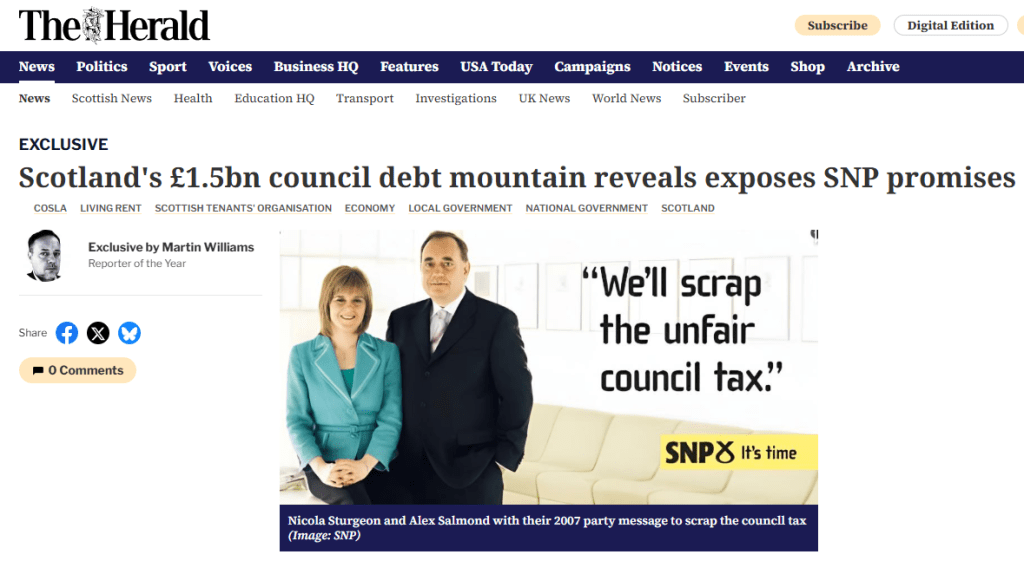
Exclusive – Scotland’s £1.5bn council debt mountain reveals (sic) exposes SNP promises
Wow! more than a billion. That’d be like £18bn in a country with around 12 times the population, say the UK.
From GOV.UK’s Live tables on local government finance on 18 December 2025, the outstanding local authority borrowing of the UK’s local councils, was £147bn.1
So, debt under the Cons and the New Cons is now 8 times higher than in Scotland under the SNP?
Martin does seem to be doing everything so I guess he has no time for research or proof reading.
Sources:
Discover more from Talking-up Scotland
Subscribe to get the latest posts sent to your email.
 Talking-up Scotland
Happy New year everyone!
Just think, even our councillors are better at managing budgets than they are ‘elsewhere!’
John
LikeLiked by 2 people
You need to be doing YouTube shorts John.
everyone needs to be presented with the truth, rather than than politically skewed BS the unionist papers print.
John Lawson
LikeLiked by 1 person
At 74 I have a face for radio
LikeLike
Hi John,Speaking about money and debt have you seen this one below
Michelle Mone to keep £15,000-a-week London mansion rent amid PPE case
This is much more than my basic state pension and this twisted Lab Government lets her keep it
By the way at 88 my face is not too bad
Keep up the good work.
LikeLiked by 1 person
Another ”exclusive” by a dying newspaper !
If it were really an Exclusive story due to hard work and persistence by a crusading journalist determined to expose real corruption in Government then this would have been worthy of respect .
However , the truth is very different . Another ”story” from the biased unionist media gleaned from the ‘exhausting’ work of a Freedom of Information Request with the obvious intent of trying to undermine the Scottish Government .
As John exposes above , this story is missing context . The position of Council debt in England is many , many times worse . If The Herald journalist (sic ) really wanted a ”story” then he should have contrasted the situation in Scotland with that south of the border and asked …Why is it so bad in England ?
But , of course , that was not the point of this propaganda piece !
LikeLiked by 2 people
I see The Herald is recycling the unmet ‘scrap unfair Council Tax‘ promise. Nothing could be easier than scrapping it – could it?
Dear ChatGPT: ‘why, despite promises, has council tax not been scrapped in Scotland?
Response (unedited except for my added emphasis): ‘Scotland has not scrapped council tax despite repeated promises (particularly from the SNP) for several key, fairly practical reasons — not simply because politicians changed their minds on a whim. Here’s the core of the issue:
🧾 1. Initial 2007 Promise Fell Apart Quickly
When the SNP first came to power at Holyrood in 2007, their manifesto pledged to scrap council tax and replace it with a local income tax based on ability to pay. However: That plan failed to secure support from other political parties (Labour and Conservatives) in the Scottish Parliament. Finance Minister John Swinney said the government couldn’t afford a switch — in part because of a £500 million cut in Scotland’s block grant from Westminster — making the reform financially unwise at the time.
Source: The Ferret
So the most ambitious pledge was simply dropped early on.
⚖️ 2. Council Tax Is a Key Funding Stream for Local Services
Council tax still provides significant revenue for local authorities. Roughly £2.7 billion is raised from it compared to nearly £12 billion in total council funding — meaning it’s not trivial. Eliminating it without a replacement would leave councils with big holes in their budgets. Reformers agree that the system is outdated and unfair, but no alternative has yet won political agreement.
Source: Tax Justice Scotland
💰 3. Political and Practical Obstacles to Reform
Even though there’s broad consensus among experts that the current council tax system is unfair (bands based on 1991 property values, not modern values), actual reform proposals keep getting blocked or sidelined:
Green MSP proposals to overhaul or revalue council tax were voted down by SNP, Labour and Conservatives.
Source: Scottish Greens
A proper revaluation (based on current values) is politically sensitive because it would push some households into higher bands and would be seen as a tax rise, even if it’s a fairness measure.
Source: Reddit
So while everyone agrees “something should change,” the details of what replaces council tax have proven extremely contentious.
📉 4. Freezes Rather Than Abolition
Rather than scrapping the tax, recent Scottish governments have tended to freeze or cap council tax bills to ease the cost-of-living pressures — but they haven’t abolished it outright. These freezes still depend on negotiations with councils and funding from the Scottish Government; councils have warned a freeze without full funding can strain local budgets.
Source: The Independent
🗳️ 5. Manifesto vs. Political Reality
Subsequent SNP manifestos have downgraded promises from outright abolition to “reform” or “freeze” measures — and even those have fallen short. One fact check noted the original 2007 pledge was indeed to scrap council tax, but it was abandoned after failing to find support (and likely due to cost) and later commitments have mostly been incremental or vague.
Source: The Ferret
📌 Summary
Council tax hasn’t been scrapped in Scotland because:
– The original abolition plan failed politically and financially.
– Council tax still funds essential local services, with no agreed replacement.
– Meaningful reform (like revaluation or a new tax) hasn’t secured cross-party consensus.
– Freezes have been used to ease bills, but that’s not abolition.
– Political promises have become less bold over time as challenges emerged.
In short, it’s not that politicians suddenly decided to keep council tax for fun — rather, cost, political opposition, technical complexity and the lack of a viable alternative have all stalled outright abolition.‘
I’d add this, from the COSLA website October 27, 2025: ‘Today, a consultation ‘The Future of Council Tax in Scotland’ was launched. The consultation seeks views on how Scotland’s council tax system could be made fairer and more up to date. It explores illustrative models such as revaluing properties, adjusting tax bands and introducing protections to help households manage any changes to their bills.’
‘Commenting on the consultation, Councillor Katie Hagmann, COSLA Resources Spokesperson, said: “Local government has long called for a fairer and more proportionate Council Tax system – one that reflects the needs of our communities and supports our local services. Reform is long overdue. This important work marks the beginning of a process to build consensus around a better system of local taxation.’
The implication here is that Scotland’s local authorities have been calling for REFORM of Council Tax, not its abolition, and even wanting (just) reform, finding consensus will be far from straightforward!
Much weight since 2007 has been placed – you may think rightly or wrongly – on the importance of reaching consensus over Council Tax reform and it still is. The impact of absence of consensus over the introduction of the Tory Poll Tax in Scotland is well remembered and surely, to be avoided. The question is how much ‘good faith’ is there amongst pro-Union politicians and others: how much incentive do they have to reach consensus specifically with an SNP government over Council Tax reform or its abolition?
LikeLiked by 1 person
The Herald has forgotten, or hopes we have, that the SG tried to replace the Council Tax with a local Income Tax or similar during its first term in office. The SG was a minority Gov at that time so of course the Unionist parties voted it down.
The Council Tax contributes around 20% of Local Council’s income the remaining 80% or so comes from SG. Even if the Council Tax is replaced is it not likely that ratio would remain more or less the same?.
LikeLiked by 2 people
On the face of it, local government finance in England is also ‘problematic’ but seems to attract less ‘heat’ from opposition politicians in Westminster and their media allies.
As the responsible government of Scotland in Union lacks the powers of the responsible government of England in Union, it’s worth for context gaining some further insights into local government finance in England.
Source: Brien, P. (July 24, 2025) Local government finances. House of Commons Library Research Briefing Number 08431. (https://researchbriefings.files.parliament.uk/documents/CBP-8431/CBP-8431.pdf )
‘… although core spending power in England has risen in cash terms since 2015/16, this rise has not yet made up for the large cuts in core spending power that took place in the first half of the 2010s. As of 2025/26, core spending power in England was about 9.0% below its 2010/11 level in real terms. Despite further increases in the 2025 Spending Review, by 2028/29 core spending power will still be about 3% below its 2010/11 level.’ (my emphasis)
‘Despite extra spending, people are finding it increasingly difficult to access local authority services – for example, the number of requests for publicly funded adult social care has risen by 15% between 2015/16 and 2023/24, but the number of people actually accessing this support has increased by only 2%.’
The HoCL notes that for England as a whole, ‘local government settlement funding’ – un-ringfenced funding made up of Revenue Support Grant and redistributed business rates – has become a much less significant element of core spending power since 2015/16, while social care grants and council tax requirement have become much more significant.
And some remarkable stats: ‘As of 2023/24, total local authority spending on services in England was about 23% lower in real terms than it had been in 2010/11, despite an increase during the covid-19 pandemic.’
The present Westminster government is introducing reforms to local government financing, not to Council Tax but to the allocation of central government funding. From the Institute for Fiscal Studies (December 17): ‘Government confirms big redistribution of funding to more urban and more deprived councils in England’.
Context: ‘The government has today published the provisional Local Government Finance Settlement, setting out funding allocations for English councils for the next three years from 2026-27 to 2028-29. This is a particularly important settlement for councils, as the government is implementing major reforms to how local government is funded, with changes set to be phased in over these three years.’
Some ‘interesting’ facts – imagine the media outcry if this was happening in Scotland!
(1) ‘.. assumed increases in council tax revenues – which reflect both increases in tax rates, and growth in the underlying council tax base due to new housing development – are set to account for around three-quarters of the overall increase in councils’ core funding.’
(2) ‘Many of the details of the reforms – such as how to assess councils’ need to spend, and how far to account for council tax revenue-raising capacity – embody subjective, political judgements about how councils should be funded.’
(3) ‘.. almost half of councils (43%) will see their funding fall in real-terms over the next three years.’
From the Local Government Association’s website: ‘County Councils Network finance spokesperson, Cllr Steven Broadbent, said many of its member authorities ‘will see their Government grant cut’.
‘He warned that ‘county taxpayers, the length and breadth of this country, will foot the bill for these reforms’, adding that an estimated nine in 10 of its member councils will need to increase council tax by more than the 5% cap to benefit from the Government’s ‘much-vaunted increase in total core spending power.’
LikeLiked by 1 person
A sizeable number of people see/saw the the 2007 “promise” as electioneering.
A better idea would have been a commitment to a through review but with no promises to abolish due to many unknowns. Honesty from politicians seems to be no closer (why were bugging allegations made, and if true, what will come of that, and the ongoing Peter Murrell case?)
As 2026 is an election year for Scotland, comments have already started circulating on what will be contained in The Scottish Budget.
Again, support from other Holyrood parties must be obtained to enable its passing.
Again, whether you trust them or not, according to opinion polls, The SNP will not have enough seats for a majority.
If they are the largest party again after the election, they will again look to relying on other parties to see through legislation etc… But who will they turn to?
LikeLike
Apologies for even more words from me but (i) it’s a quiet day here, and (ii) candidly, the sort of media output highlighted in the main blog post riles!
If Scotland was an independent nation-state I would think it perfectly reasonable – indeed necessary – to hold its parties and system of government to account in part through making public policy (input, process, output and outcome) comparisons with other broadly similar nation-states. However, so long as Scotland remains in Union, it is wholly appropriate – indeed necessary – to make such comparisons with other parts of the UK. It’s relevant to draw comparisons with those parts whose responsible national government has limited (devolved) powers. However, it is ESPECIALLY ‘interesting’ and relevant to compare Scotland (and NI and Wales) with England, the only UK nation whose responsible government is ALL powerful. Such comparisons are legitimate ways to benchmark one’s own government’s effectiveness, efficiency and economy in terms of public policy track record.
Source: Wales Online (September 10, 2025) Welsh council’s debt sees steep rise in just one year – figures show that debt at Merthyr Tydfil Council rose by £27.68m or 21.2% from 2023/2024 to 2024/2025 (https://www.walesonline.co.uk/news/local-news/welsh-councils-debt-sees-steep-32450536 )
‘The analysis of figures from the Ministry of Housing, Communities and Local Government (MHCLG) show UK councils owe a combined £122.2bn to lenders, equivalent to £1,791 per resident, as of April 2025.‘ And: ‘They also show that is up 7% from a total of £114.5bn, the equivalent of £1,677 per resident, a year ago.’
‘The total borrowing figure for Wales at the end of 24/25 was £6.43bn with the debt per person in Wales being £2,034.
Didn’t The Herald claim the equivalent aggregated debt figure for Scotland’s local authorities was (just) £1.5bn?
The Wales Online piece adds: ‘A total of 16 of the 22 Welsh local authorities saw an increase in debt from 2023/24 to 2024/25.’ And: The councils that saw the biggest increases in debt over this period were Torfaen (26.8%), Newport (22.34%) and Merthyr Tydfil (21.2%). In terms of other Welsh councils, Cardiff (Wales’ largest council) had the highest level of debt which went up by 1.39% to over £980m.’
£1.5bn debt for all of Scotland’s councils: nearly £1bn debt just for Cardiff!
Source: BBC News website (August 26, 2025) ‘Schools, care homes and sports clubs sold off to pay spiralling council debt’.
‘Communities across the UK are paying for spiralling levels of council borrowing with a fire sale of publicly owned facilities, a BBC study has found.
‘Schools, care homes, a boxing gym and even an Olympic legacy equestrian centre are among hundreds of buildings being sold as struggling councils seek to reduce a debt pile totalling £122bn. Chief executive of the Local Government Information Unit (LGIU), Dr Jonathan Carr-West, said “public value” would continue to be eroded until the government came up with a long-term solution to council debt.’
Of English councils with the largest amount of debt per head of population,
Woking’s £2.16bn worth of debt is equivalent to more than £20,000 per person – double that of the next highest council. The average for England’s councils according to the BBC is £1,688 per head of population.
In mid 2024 Scotland’s population was estimated to be 5,546,900. If local government debt in Scotland is – according to The Herald – £1.5bn then the average debt equates to £270.40 per person. Merits no acknowledgement – at the very least – from The Herald?
Just imagine the potential electoral impact – and the Scottish electorate’s confidence in government from Holyrood – if The Herald and almost all the rest of the mainstream media in Scotland opted, as a matter of decent journalistic practice, to provide context and perspective rather than consistently avoiding doing so, presumably in the service of political parties and other interest groups that oppose self-determination for Scotland.
LikeLiked by 2 people