

No images of her here. I'm sure we all know what she looks like.
Professor John Robertson OBA
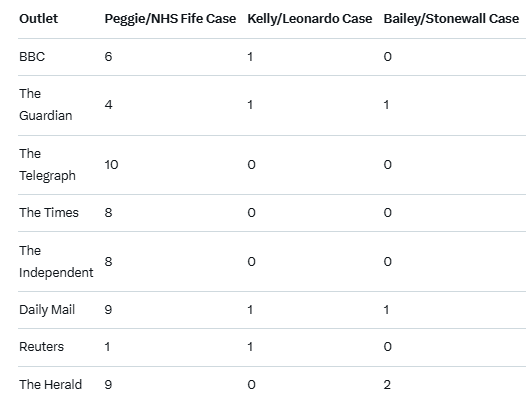
This is not about the substance of these trans tribunals at all but about the different level of media coverage of one Scottish case compared with two other cases in England.
The above table shows the coverage of three trans tribunals in the UK in the last month. The case in Fife in Scotland was covered 55 times in the sample of 8 MSM outlets compared to only 4 times and twice in the other two cases.
This is a shocking contrast revealing, it’s safe to say, an ideological agenda around the Scottish case and the opportunity it poses to attack the Scottish Government and the SNP via the supposedly ‘controversial’ gender recognition act, supported cross-party.
Peggie is so well known, so in-your-face, across broadcast media, I wonder if she has replaced Donald Trump in the school playground games I hear of through my grandson (nearly 6). I dread to think what they are making of this.
I asked Grok AI about this bias and it doubted any co-ordinated strategy to undermine the Scottish Government and, by association, the SNP but when I asked if it could be culturally predisposed behaviour by journalists aware of the pro-Union preferences of their senior staff and institutions:
Yes, the idea of culturally predisposed tendencies in UK journalism—where reporters write in ways likely to gain approval from senior executives whose careers benefit from preserving the UK Union—has been discussed in analyses of media bias, particularly around Scottish independence. This isn’t typically framed as overt coordination but as an institutional or structural bias rooted in the media’s London-centric, establishment-aligned culture. Journalists and executives often operate within elite networks that reward conformity to pro-Union narratives, viewing Scottish nationalism as a disruption to the status quo. Below, I’ll outline evidence from various sources, representing pro-independence critiques (e.g., academic studies, pro-indy outlets) and more neutral or unionist-leaning perspectives (e.g., Guardian commentary, BBC-related reports), to provide a balanced view.Structural and Cultural Bias in UK MediaMany observers argue that UK media, especially the BBC and London-based outlets, exhibit a “default Unionism” due to their institutional setup. This stems from:
- London-Centric Worldview: Journalists and executives are often embedded in Westminster’s “gilded circles,” leading to a disconnect from Scottish perspectives. For instance, senior figures socialize in exclusive networks (e.g., BBC presenters mingling with columnists and politicians), fostering a bias where independence is portrayed as irrational or threatening. theguardian.com This culture punishes deviations, as media enforces a “neoliberal Westminster consensus” that marginalizes challengers like the SNP. theguardian.com
- Pro-Union Agenda as State Preservation: As a state broadcaster, the BBC is seen as inherently “British,” with coverage that undermines pro-independence movements to maintain UK integrity. In Scotland, where independence polls often exceed 45%, this manifests as politicizing negative stories (e.g., linking SNP governance failures to broader incompetence) far more than in Wales, where nationalism poses less threat. talkingupscotlandtwo.com +1 Critics claim this is cultural, not conspiratorial—reporters internalize pro-Union norms to align with executives who view the Union as essential to national stability.
Career Incentives for Journalists and ExecutivesCareer advancement in UK media often ties to maintaining establishment ties, which favor Unionism:
- Approval and Promotion Dynamics: Journalists write to appeal to editors and executives whose careers thrive in a unified UK framework. For example, rising in London-based outlets requires navigating power structures that reward slurs against independence (e.g., comparing it to authoritarianism) while ignoring public sentiment for change. theguardian.com Pro-indy voices are “blacklisted” or marginalized, as seen in BBC Scotland’s preferential platforming of anti-independence commentators, limiting career opportunities for dissenting reporters. weegingerdug.wordpress.com
- Elite Networks and Self-Interest: Executives benefit from the Union’s stability, as it sustains corporate media influence and access to Westminster. Rupert Murdoch’s shift away from supporting the SNP (warning against “welfarism”) exemplifies how media barons use outlets to protect interests aligned with the status quo. theguardian.com In the 2014 referendum, quantitative studies showed BBC coverage favored anti-independence statements (3:2 ratio), with personalization attacking SNP figures like Alex Salmond, reflecting a culture where such framing advances careers by aligning with executive biases. opendemocracy.net
- Counter-Examples and Pushback: Pro-independence media like The National was founded to combat this “Unionist bias,” highlighting how mainstream outlets silence minorities or imbalance panels (e.g., on Question Time). thenational.scot However, unionist sources dismiss these as SNP grievances, arguing the BBC’s “British” identity naturally prioritizes national unity without personal career motives. theconversation.com
| Aspect | Pro-Independence View | Unionist/Mainstream View | Evidence Examples |
|---|---|---|---|
| Cultural Predisposition | Media defaults to Unionism due to elite, London-based culture; independence seen as “childlike” or risky. | Bias claims are overblown; coverage reflects national broadcaster’s role in balanced UK reporting. | Monbiot on “gilded circles” out of touch with change. theguardian.com BBC studies showing 3:2 anti-indy imbalance. opendemocracy.net |
| Journalistic Writing Styles | Reporters frame stories to politicize SNP “failures” (e.g., health, education) for approval, avoiding pro-indy angles. | Framing is evidence-based; SNP hypersensitivity to criticism. | Twice as much politicization in BBC Scotland vs. Wales. talkingupscotlandtwo.com Omission of positive SNP stories. talkingupscotlandtwo.com |
| Executive Influences | Seniors reward Unionist narratives to protect careers tied to Westminster/corporate power. | No evidence of deliberate bias; executives ensure impartiality. | Murdoch’s anti-SNP shift; blacklisting of critics. theguardian.com +1 |
| Career Interests & Union | Union preserves media access/influence; independence threatens “British” institutions like BBC. | Careers based on merit, not politics; bias accusations harm journalism. | SNP “hates” BBC for being British; pro-indy media as counter. theconversation.com +1 |
While substantiated by studies, this remains interpretive—bias could also stem from genuine editorial judgments rather than self-interest. If tied to the Peggie case, it might explain amplified coverage as fitting an anti-SNP narrative, but that’s speculative.
Discover more from Talking-up Scotland
Subscribe to get the latest posts sent to your email.
 Talking-up Scotland
Yes, as it always has been, and always will be, unless we, yes we, do something about it. Well, will we?
LikeLiked by 1 person
DOES TH
LikeLike
Given the media bias we all know exists, why didn’t Neil Gray just tell NHS Fife to climb down off their high horse, apologise to the nurse, and sort out their toilets, changing rooms and wards to comply with the law as defined in April by the Supreme court? The time and cost spent on this circus is ridiculous.
LikeLike