

Professor John Robertson OBA
From Primary 1 Body Mass Index (BMI) statistics Scotland School year 2024 to 2025, published yesterday, the above and:
In school year 2024/25, 74% of Primary 1 children measured had a healthy weight, 24% were at risk of overweight or obesity and 1% were at risk of underweight.
In England, in the same period only 63.2% had a healthy weight. 1.6% were at risk of being underweight thus 35.2% were at risk of being overweight or obesity:
Roughly then 50% more children at risk of being overweight or obese in England than in Scotland?
Why?
What is the SNP Government doing to reduce obesity? You don’t know? You’re not really that interested? Oh, maybe that Prof Robertson will know? Let’s see:
Research from the London School of Hygiene and Tropical Medicine, reported in the Independent on 26th May 2018 suggested:
‘Under current trends it is predicted that 11 per cent of the population in Wales will be morbidly obese in 2035, roughly 340,000 adults, while Scotland is likely to plateau at about 5 per cent and England will rise to about 8 per cent.’
The researchers offer a surprisingly clear, confident and simple explanation, for the significantly slower growth in Scotland – Scottish Government policy initiatives and resource allocation:
‘The government put a massive push on developing a route map for how we can actually combat this. They put together resources from the NHS that were proving to be effective. They did put a lot of work into it.’https://www.independent.co.uk/news/health/morbid-obesity-double-britain-poverty-education-employment-study-a8369731.html
I appreciate that the trend graph relates to combined male and female obesity, but the table below shows that for other than two groups, the prevalence of obesity in Scottish women is expected to be significantly lower than that in England or Wales and notably much lower for the 15-24-year-olds most likely to have experienced, in schools and colleges, the ‘Scottish Government policy initiatives and resource allocation.’
Table: Predicted % prevalence of obesity
https://www.eveningexpress.co.uk/news/five-million-british-people-will-be-morbidly-obese-by-2035-study-shows-2/
Also, published in November 2018, but ignored again by the Nomedia, later research findings supported the London School findings:
From Growing Up in Scotland: Overweight and Obesity at Age 10:
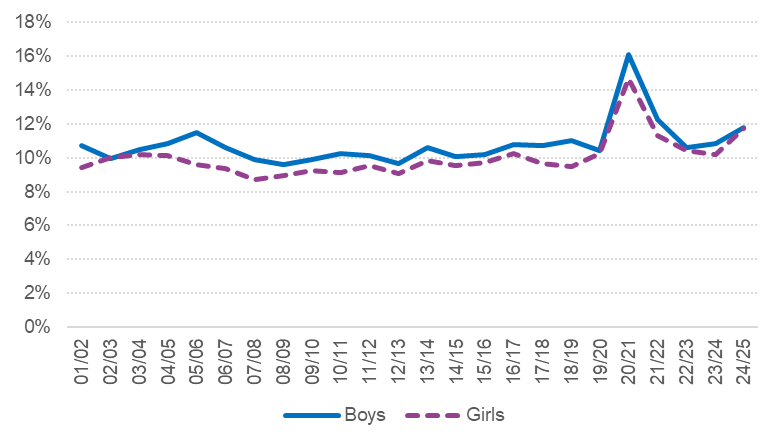
‘Historic data from the survey shows that the prevalence of overweight [in Scotland] including obesity remained relatively stable between 1998 and 2016, fluctuating between 28% and 33%. However, in recent years levels of obesity have shown a steady decline dropping from 17% in 2014. This is largely due to a decline in obesity amongst boys which have dropped from 20% in 2012 to 12% in 2017 [40%].’ (14)
‘The results are broadly comparable with similar UK research. For example, analysis of data from the Millennium Cohort Study showed that the proportion of healthy, overweight and obese 5-year olds becoming or remaining obese by age 11 were 6%, 32% and 68% respectively (Mead et al, 2016). Comparative figures from analysis of administrative data from the National Child Measurement Programme (NCMP)13 in England were 8%, 43% and 77% (Copley et al, 2017).’ (25)
So, compared to England, 25% fewer healthy 5-year-olds becoming obese by 11 in Scotland. Similarly, 25% fewer overweight 5-year-olds becoming obese and 12% fewer obese 5-year-olds remaining obese.
While the London School research directly attributes credit to Scottish Government policy initiatives, this modestly associates them. See:
‘Food available in and around schools has also been a focus of policy aimed at improving children’s diets. Legislation5 requiring local authorities to ensure schools provide food and drink of an appropriate nutritional standard has been in place since 2007 with accompanying guidance’ (17)
‘Progress towards achieving the goal of a more active population has been made through a range of activities in recent years including the implementation of the National Walking Strategy (Scottish Government, 2014c), the Cycling Action Plan (Scottish Government, 2017b), the Active Schools programme8, Community Sports Hubs9 and the Legacy 2014 Physical Activity Fund10. Of particular relevance for children and young people is the Scottish Government’s commitment to expanding the Daily Mile11 to ensure that Scotland becomes the first ‘Daily Mile nation’ with roll out to nurseries, schools, colleges, universities and workplaces. Recent research results suggest the Daily Mile is effective at increasing levels of moderate to vigorous physical activity (MVPA), reducing sedentary time, increasing physical fitness and improving body composition.’ (17/18) https://www.gov.scot/publications/growing-up-scotland-overweight-obesity-age-10/
Discover more from Talking-up Scotland
Subscribe to get the latest posts sent to your email.
 Talking-up Scotland
Not directly on this topic, but related to it:
After I retired I volunteered to help a group which tidied up walking and cycling routes in and around Glasgow – cutting back encroaching vegetation, clearing litter and rubbish.
A number of these routes passed close to secondary schools and in these areas, littering was persistent. It comprised, entirely items related to fast foods : crisp packets, soft drinks and water cans and bottles, polystyrene packaging for hamburgers, disposable forks, wrapping papers. The ‘meal deal’ promotions contain around nine disposable items. The trail of litter could be followed directly from the school gate to the nearby food shops.
The majority of students remained on the campus for lunch and either ate tschool dinner or a packed lunch from home. So littering is caused by a minority. There are, usually, litter bins on the route between the schools and the food shops and these are used. However, because of the bulk of polystyrene packaging and plastic bottles, the bins fill up very quickly – mostly with air! Despite trying to put rubbish in the bins, it falls out and is scattered by wind and gulls.
Since it is the fast food shops which generate this litter, I think the owners should contribute to the cost of keeping the area clean. They could provide less packaging and crushable packaging, they could provide more bins along the routes to schools, they could either tidy up at the end of the lunch break or pay someone to do it. And, they could also provide more nutritious options.
LikeLiked by 1 person