

Professor John Robertson OBA
In the Guardian yesterday, the above and:
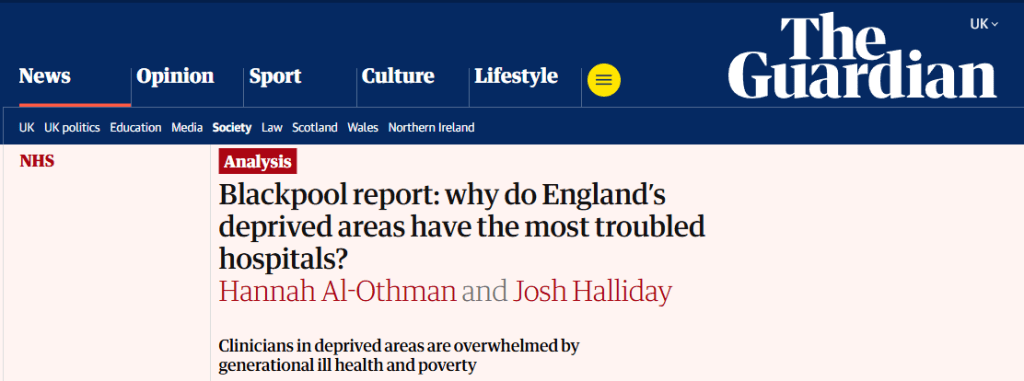
Blackpool report: why do England’s deprived areas have the most troubled hospitals? The findings of the report into Blackpool Victoria hospital are as shocking as they are damning: a culture of bullying, racial discrimination and harassment that has contributed to a staff exodus with a direct impact on patients. The treatment of chronic disease, including Parkinson’s, were just some of the areas blighted by what appears to be a toxic culture.
But the Royal College of Physicians report, leaked to the Guardian, exposes much broader challenges for the NHS – and particularly for hospitals in the most deprived corners of Britain.
Clinicians in places such as Blackpool are overwhelmed by generational ill health and entrenched poverty, a crisis that is deepening in many parts of the country. Their ability to respond is often hampered by their struggle to attract the best staff. https://www.theguardian.com/society/2025/dec/03/leaked-blackpool-report-why-do-deprived-areas-in-england-have-most-troubled-hospitals
Which hospitals are in Scotland’s most deprived areas? The ones in Greater Glasgow & Clyde, in Inverclyde and in Ayrshire and Arran. Are any of them troubled? Using standardised mortality we see that they are all within the same acceptable range.
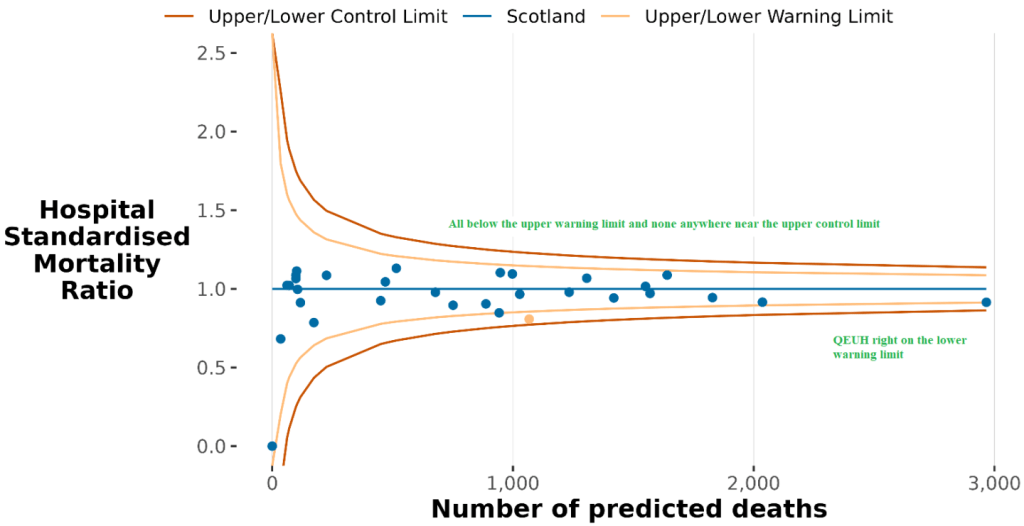
From Hospital Standardised Mortality Ratios April 2024 to March 2025 published today, the above graph reveals that all of Scotland’s hospitals have mortality ratios within the normal range confirming the complete absence of any postcode lottery here.
Of particular interest, the large Queen Elizabeth University Hospital, extreme right, often unjustly criticised in media and serving one of the most disadvantaged populations in Scotland, has a below average mortality ratio of 3.7, below the Scottish average.
In England, we see more evidence of a two-tier system here with a cluster of hospitals in affluent areas revealing as many as 700 fewer deaths than predicted and others in the north, with the same number, in excess of even predictions made in the full knowledge of the local poverty-levels. In England, it makes a huge difference to your chances if you attend in Chelsea as opposed to Blackpool. https://digital.nhs.uk/data-and-information/publications/statistical/shmi/2025-07
Discover more from Talking-up Scotland
Subscribe to get the latest posts sent to your email.
 Talking-up Scotland
Could part of the reason for the differences in hospital effectiveness between Scotland and England be due to the smaller degree of social segregation?
I am not arguing that there is not social segregation in Scotland, but that areas of different affluence are not as widely separated.
The population of Scotland is concentrated in the central belt and up the east coast. This means that in and around Glasgow, for example, we have parts of Drumchapel and Maryhill very close to the more affluent Bearsden and Milngavie; Pollok and Arden are physically close to East Renfrewshire. There are similar adjacencies in the other cities and larger towns.
These areas are served by the same hospitals. The south and west sides of the Glasgow area are served by the QEUH, the north and east by Glasgow Royal Infirmary. All human life is represented in these hospitals. Although there are some private hospitals, they are usually close to the larger facilities and staff who work in both the NHS and in private clinics.
There are, of course, differences in mortality between adjacent areas of high and low affluence, but the hospitals to which the residents of both attend are unlikely to be significant factors in the differences in mortality.
LikeLike
That got me interested. I did a quick AI question – ‘Is there less geographical social segregation in Scotland than in England evidenced by the lack of NHS hospitals which are significantly dysfunctional in disadvantaged areas’
Answer:
Geographical social segregation refers to the uneven spatial distribution of socioeconomic groups, often measured by residential clustering of income levels, ethnic minorities, or deprivation in neighbourhoods and schools. Evidence from multiple studies suggests that Scotland exhibits more geographical social segregation than England in key areas like neighbourhoods and schools, contrary to the premise of your query. This is driven by factors such as Scotland’s stricter catchment-area school policies, which tie education more closely to local deprivation levels, and higher concentrations of social housing in deprived urban areas.
but
NHS Scotland and NHS England both face systemic pressures, including post-COVID backlogs and workforce shortages, but Scotland has fewer instances of “significantly dysfunctional” hospitals in deprived areas. This stems from its integrated, non-competitive structure (no NHS Trusts; instead, 14 regional health boards with needs-based funding), which prevents localized “failure” more effectively than England’s market-oriented model.
John
LikeLike