

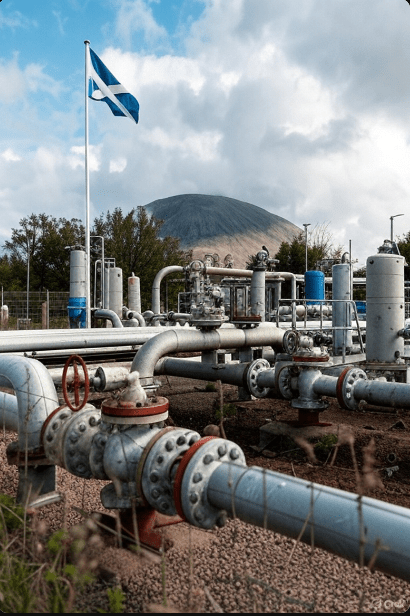
In the Guardian today:
Report detailing risk to UK gas security was not one to bury on budget day – In short, Neso found there is an “emerging” risk of Britain running out of gas if an important piece of kit were to be out of action at a bad moment. It modelled five “pathways” for gas demand out to 2030 and 2035 and tested against a prolonged spell of very cold weather. Here is the key sentence: “In the unlikely event of the loss of the single largest piece of gas infrastructure, gas supply falls short of demand for all pathways in 2030-31.”
What does gas supply falling short of demand mean? Emergency measures would first involve telling factories and power plants to stop using gas. In extreme scenarios, households could be affected as well – there wouldn’t be enough gas for everyone with a gas boiler to heat their homes during cold weather. The latter, you’d think, could be a government-toppling event.
Would an independent Scotland face the same problem?
You know the answer. Does AI?
Key Figures for 2023
| Metric | Value | Notes |
|---|---|---|
| Production | ~240 TWh (est.) | Equivalent to 20.6 mtoe. Represents ~62% of UK total gas production (387 TWh). Down ~3-5% from 2022 due to natural field decline. Includes all gas from Scottish waters; ~95% exported to the UK grid via St. Fergus terminal. |
| Consumption | 42.7 TWh | Final end-use only (down 2% from 43.6 TWh in 2022). Accounts for 66% of Scotland’s total final energy consumption (64.5 TWh), mainly for heating (91% of heat demand). |
Trends and Context
- Production Surplus: Scotland produces 5-6 times more gas than it consumes annually, making it a net exporter. In 2017 (latest detailed injection data), ~329 TWh entered the UK grid at St. Fergus, with only ~18% (59 TWh) used domestically—though actual final consumption is lower after accounting for grid losses and non-Scottish demand.
- 2024 Estimates: Production is projected at 228 TWh (est.), reflecting a 5% decline. Consumption data for 2024 is not yet finalized but expected to remain stable or slightly lower (42 TWh) amid mild weather and efficiency gains.
- Units Conversion Note: To arrive at TWh from mtoe, multiply by 11.63 (standard energy equivalence for natural gas). For example, 2019 production of 23.2 mtoe = (23.2 × 11.63) ≈ 270 TWh. Recent estimates adjust for updated field data.
- Economic Impact: Gas production contributed ~£3-4 billion in sales value in 2023 (fluctuating with prices), supporting ~196,000 jobs. However, the sector faces transition pressures toward net-zero, with focus on carbon capture and hydrogen blending.
For raw data tables (e.g., supply/use balances in GWh), refer to the Scottish Government’s Oil and Gas Production Statistics (updated September 2025), which include field-level breakdowns consistent with UK totals.
Sources:
https://www.gov.scot/publications/oil-and-gas-production-statistics/
https://x.com/i/grok?conversation=1995793090544652759
Discover more from Talking-up Scotland
Subscribe to get the latest posts sent to your email.
 Talking-up Scotland
Simply another ( of many ) examples of WHY the UK Government ( of whatever hue ) cannot , repeat cannot , allow Scotland to become independent .
It would be a fatal blow to England’s economy !
LikeLike
Scary thing is which tactics will they use and how far would they go to keep Scotland shackled, quite far I suspect.
LikeLiked by 2 people
Is the export value of Scottish gas reflected in GERS? I think a percent of gas is attributed to Scotland but that wouldn’t reflect the value. I don’t understand how GERS is calculated – apos.
LikeLiked by 1 person
Is it not made up numbers by the EngGov and advertised across the BritNat media in Scotland platforms as the truth and nothing but the truth. It’s lies.
LikeLiked by 1 person
I don’t remember whether oil and gas is allocated to Scotland on a percentage of population basis or North Sea sector basis (skewed though that was in 1999 by Tony Blair and Donald Dewar).
But that wouldn’t reflect the value of the oil and gas Scotland “exports” through the pipelines and grid. In a normal country that would be income because we would be selling it to another country at an agreed rate.
LikeLiked by 1 person
If we ever get to the point where Scotland is negotiating its departure from the UK, we need to demand reparations for gas and oil supplied to the UK economy without charge.
LikeLike
In the UK, personal taxation is linked to place of residence not place of work. All those working in the commercial exploitation of the in-demand natural resources indigenous to Scotland and its offshore pay their income tax to HMRC not to Revenue Scotland if they are NOT resident in Scotland. They could reside in England or Norway: from a Scotland perspective it’s all the same, HMRC gains the tax revenue. (There will be cross-border arrangements with e.g. Norway and other countries to avoid an individual being subjected to full double taxation as there would be between an independent Scotland and an independent England etc.)
What is the scale of this ‘foregone’ tax take whilst Scotland is in Union? Is this financial contribution to the UK exchequer acknowledged in GERS?
And then as non-resident workers take their earnings, net of income tax, home to another part of the UK, the UK outside Scotland gains benefit a second time, from the consequent economic multiplier on the back of working to exploit Scotland’s indigenous natural assets.
The ‘foregone’ multiplier is inevitable with an multinational workforce but when associated also with a ‘foregone’ tax take due to a fiscal regime in which Scotland’s electorate and government have very limited agency, would it not be good – for completeness – to know the scale of what is going? Anyone got a clue?
LikeLiked by 4 people
Can we conclude that Scotland is relatively secure in natural gas reserves relative to need; Scotland is relatively secure in oil reserves relative to need; Scotland is secure in capacity to generate electricity by wind energy – probably in absolute terms and certainly very much more so than England/rUK? And then there are the indigenous assets of tidal power, pump storage hydro etc. also available.
Upon independence, all these natural assets remain in place and if demand for them continues – which it will (cf. England’s needs) – investment (public and private as necessary) to sustain their exploitation will continue.
And overnight, output from these natural assets will become (true not notional) Scottish exports, ones that require meters to record and charge for, not impacted by border post scaremongering. Overnight, pricing of energy to address household and industrial needs and wants in Scotland becomes a decision for Scotland’s parliament and government.
Within the UK, whose national economic circumstance will change most when Scotland becomes independent – and which most negatively? Yet I noted an international credit rating agency comment in the context of Scottish bond issuance only on potential downgrading of ONE country’s credit rating should Scotland achieve independence. It focused only on the smaller country, on Scotland, that is the one set to gain ownership and agency over its relatively very much great abundance of energy assets than its larger neighbour.
LikeLiked by 3 people
STOP GIVIG SCOTLANDS OILS AND OTHER FUELS
to Egland
LikeLike