

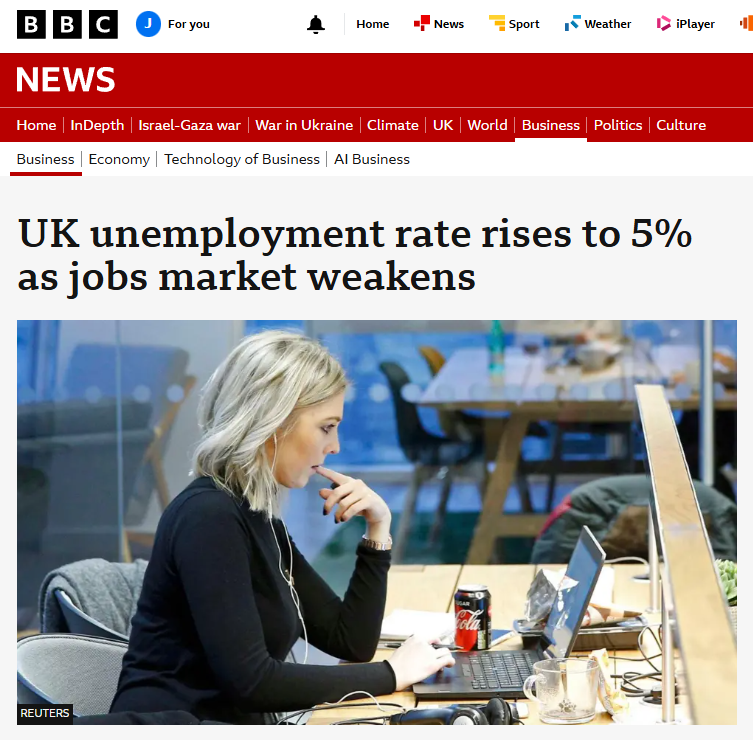
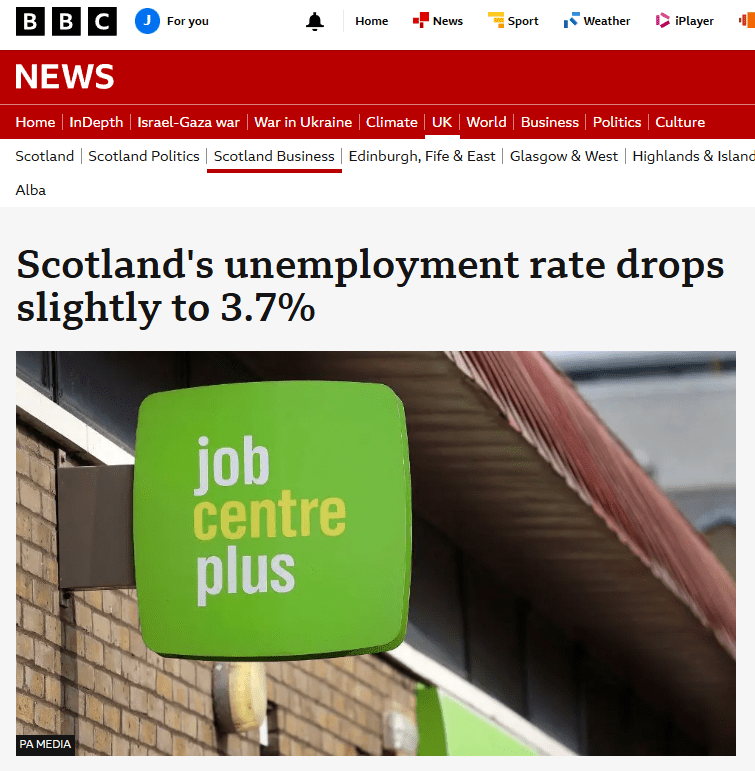
Professor John Robertson OBA
These two headlines today and the full text, reveal the agenda in editorial decision-making, in BBC Scotland reporting, to conceal good news about Scotland, after 18 years of SNP rule.
Imagine the figures were the other way round, they would have been compared, like the drug deaths, and the worse figure linked to government mismanagement with a quote from an opposition politician.
Obliged to report the change of 0.1%, from 3.8% to 3.7%, they refer to that as ‘slight’ knowing most will accept that only 0.1% does seem small and concealing the fact that it refers to more than 1 000 people, out of the 101 000 out of work.
More significant, the 5% figure for the UK is 35% higher than the 3.7% figure for Scotland, meaning that more than 30 000 in Scotland are in work because they are in Scotland. Who gets the credit? I know, it’s complex, but if it was the other way round, you know who’d be blamed.
Why is unemployment so much lower in Scotland than in the UK as a whole?
As I said at the outset, it is complex and an AI answer offers 5 main factors which you can read at the link below, but it does include at number 3:
Devolved employability and skills policies: Scottish Government initiatives, such as £90m+ in employability services for 2025–26 (targeting disabilities and long-term health conditions), have supported labour market entry and retention. These contrast with UK-wide challenges, where inactivity remains higher in some regions.1, 2
Sources:
- https://www.insider.co.uk/news/unemployment-rate-scotland-fell-slightly-35570882
- https://x.com/i/grok?conversation=1988180142561038748
Discover more from Talking-up Scotland
Subscribe to get the latest posts sent to your email.


Scotland’s unemployment rate falls while the UK rises ! Since Labour came to power the UK rate has jumped from 4.1% to 5% .
Does Anas Sarwar know this ? Yesterday he was busy talking down Scotland ( same as any other day ! ) and blaming our Tax Levels for ”driving away people ”.
Will he now highlight the effects that Labour is having on unemployment and TALK UP Scotland’s response ?
Thought not
LikeLiked by 2 people
No chance mj. And the same goes for any politician from an England based party. Their job is to denigrate any achievement by the present Scottish Government, because they realise, although never say publicly, if we become Independent, England would become even more of a basket case than it is at present.
LikeLiked by 1 person
Some more ‘dry’ statistics on employment matters, the sort that gets MSM news coverage if unfavourable to Scotland and its present government.
Median weekly pay for full-time employees across the UK has fallen between 2008 and 2025, after adjusting for CPI inflation – dropping from £788 to £767. This is the finding in a new briefing document published by the House of Commons Library (HoCL).
Source: HoCL (November 6) Average earnings by age and region – Research Briefing (https://commonslibrary.parliament.uk/research-briefings/cbp-8456/ ).
The equivalent statistic just for Scotland reveals a rise in median weekly pay from £762 in 2008 to £766 in 2025.
At April 2025, medium weekly pay by UK region and nation of residence was highest by some margin in London (£903). Scotland ranked fourth (£776) after the South East and East of England regions. Wales (£719) ranked ninth of 12 areas
Economic metrics can be highly variable over time. A snapshot for 2025 is of interest but limited value. However, the HoCL briefing enables the analysis of trend in earnings over time, stretching back to 2022. It is possible to examine time series data for each region/nation separately. It is also possible to use the HoCL spreadsheet to calculate ratios of individual regions/nations relative to each other or relative to the overall UK median value, and to track these over time.
Using data from the HoCL, the changing nature of three ratios is noteworthy: (i) the ratio of the median weekly wage in Scotland relative to the UK value; (ii) the ratio of the median weekly wage in Scotland relative to the value for Wales; and (iii) the ratio of the median weekly wage in Wales relative to the UK value. The HoCL data adjusted for CPI inflation are used in each case. (Why include Wales? Shouldn’t we always look to explore evidence of how devolved powers, allegedly, are used so much more successfuily by British Labour Party politicians in government?)
By calculation, data in the HoCL’s spreadsheet show that:
– between 2002 and 2006, the median weekly wage in Scotland varied between 93% and 97% of the UK value.
This changed in the 2010s:
– between 2007 and 2025, the median weekly wage in Scotland has varied between 96% and 103% of the UK value – the 96% figures relate only to two years, 2007 and 2009
– since 2014, the median weekly wage in Scotland has been equal to 100% of the UK figure or higher, with the exception of 2019 and 2020 when it was 99% of the UK median value.
Comparing the median weekly wage rates in Scotland and Wales over the same periods:
– between 2002 and 2006, the median weekly wage in Scotland varied between 102% and 106% of the Wales value
– between 2007 and 2025, the median weekly wage in Scotland varied between 106% and 109% of the Wales value
– since 2009, the median value of the weekly wage in Scotland has diverged more from that of Wales, in Scotland’s favour.
And how does the media wage rates for Wales vary relative to the UK?
– between 2002 and 2006, the median weekly wage in Wales varied between 90% and 92% of the UK value
– between 2007 and 2025, the median weekly wage in Wales has varied between 89% and 94% of the UK value.
On November 10, the charity Living Wage Scotland stated on its website: ‘We’re proud to be celebrating the milestone of 4000 accredited Living Wage employers in Scotland, which represents 25% of the 16,000 employers across the UK who have joined the Living Wage movement.’
A senior executive of Living Wage accredited, Capital City Partnership is also quoted: ‘Employers in Scotland are also leading the way on Living Hours – an accreditation designed to ensure security of hours and contracts alongside a real Living Wage. There are currently 117 Living Hours employers in Scotland – representing 43% of the UK total. Living Hours employers in Scotland include SSE, Dear Green Coffee and the Scottish Government.’
LikeLiked by 2 people