

Professor John Robertson OBA
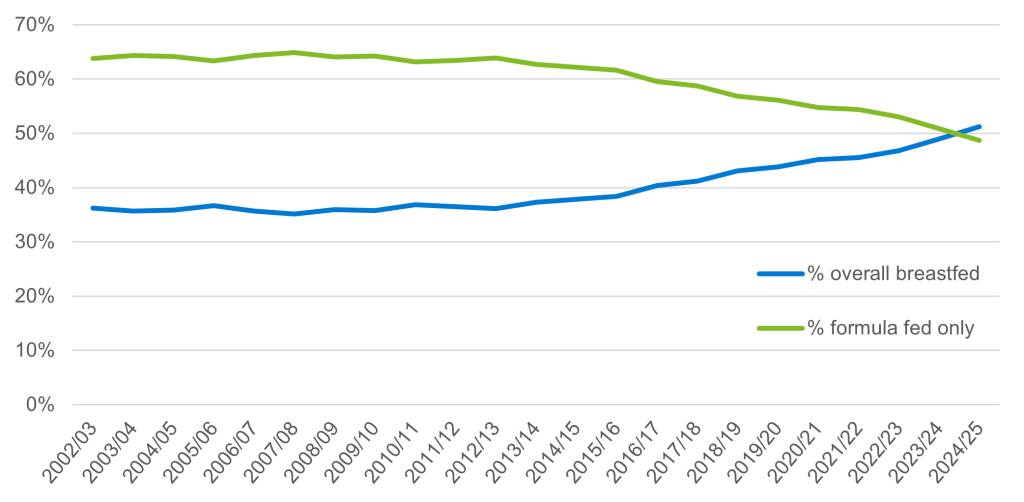
From Infant feeding statistics Financial year 2024 to 2025, published today, the above momentous graph and:
Supporting breastfeeding is an important public health activity, with strong evidence that breastfeeding protects the health of children and mothers. The information is collected at Health Visitor reviews of children at 10-14 days (First Visit), 6-8 weeks, and 13-15 months of age.
Main points
There have been notable increases in breastfeeding – 69% of babies reviewed in Scotland in 2024/25 were breastfed for at least some time after their birth, compared with 63% in 2016/17.
In 2024/25, and for the first time since these data began in 2002/03, at the 6-8 week review more babies were being breastfed (34% exclusively breastfed, 17% mixed breast and formula fed) than were being formula fed only (49%).
The fuller version of the document is unambiguous about the benefits:
Breastfeeding provides the best nutrition for babies and young children and supports children’s health both in the short and longer term(1,2). There is strong evidence that breastfeeding reduces children’s risk of gut, chest, and ear infections and leads to a small but significant improvement in brain development and IQ(3,4). Growing evidence suggests that breastfeeding also protects against Sudden Infant Death Syndrome (‘cot death’), promotes healthy weight in childhood and into adulthood, and reduces the risk of Type 1 and Type 2 diabetes and childhood leukaemia(3,5).
Breastfeeding also benefits mothers’ health, with strong evidence that it reduces the risk of breast and ovarian cancer, and some evidence that it may also promote maternal healthy weight and reduce the risk of Type 2 diabetes(3,6,7). The benefits of breastfeeding for both baby and mother are seen across the world, including in high income countries such as Scotland(8-12). Increasing sustained, exclusive breastfeeding of babies has the potential to improve health and reduce health inequalities(20).
chrome-extension://efaidnbmnnnibpcajpcglclefindmkaj/https://www.publichealthscotland.scot/media/35987/2025-11-11-infant-feeding-statistics-report-final.pdf
What has the Scottish Government done to achieve this?
The Scottish Government has one of the most progressive and well-funded breastfeeding-promotion programmes in the UK. Here are the main initiatives and policies as of November 2025:1. National Breastfeeding Policy & Strategy
- The Maternal and Infant Nutrition Framework (updated 2023) and the Breastfeeding (Scotland) Act 2024 set ambitious targets:
- 50% of babies receiving any breast milk at 6 months by 2030 (current rate ~38%).
- Maintain the highest exclusive-breastfeeding rate at 6–8 weeks in the UK (~42% vs England ~24%).
- Legally protects the right to breastfeed in public and requires all NHS boards to have a funded breastfeeding strategy.
2. Financial Incentives
- Scottish very generous Scottish Baby Box (universal since 2017) includes breast pads, a breast pump voucher, and maternity bras.
- Best Start Grant Pregnancy and Baby Payment (£754 first child, £377 subsequent) explicitly lists breastfeeding equipment as allowable expenditure.
- Breastfeeding Support Payment pilot (Glasgow, Dundee, and Highlands, 2024–2026): £25/week for low-income mothers who breastfeed exclusively to 12 weeks, then £12.50/week to 26 weeks. Early data (Sept 2025) shows +18% exclusive breastfeeding at 3 months in pilot areas.
3. Universal NHS Services
- Every maternity unit has UNICEF Baby Friendly Initiative (BFI) Gold accreditation – Scotland is the only UK nation with 100% coverage (achieved 2023).
- NHS Inform Breastfeeding Friendly Scotland scheme: 8,400+ premises (cafés, shops, museums, buses) display the “Breastfeeding Welcome” sticker and train staff. Local councils can fine businesses that ask mothers to leave.
- Free peer-support networks funded in every health board (e.g. NCT/Breastfeeding Network contracts worth £4.2 million/year).
4. Workplace & Education
- Breastfeeding-friendly workplace accreditation for employers (Scottish Government itself achieved Gold status 2025).
- Statutory right to paid breastfeeding breaks extended to 2 years (vs 1 year in rest of UK).
- All secondary schools must teach infant feeding in PSE curriculum (S3 module mandatory since 2022).
5. Marketing & Media
- Annual £1.8 million national media campaign (“Breastfeeding: it’s worth it”) running on STV, social media, and buses.
- Formula milk advertising banned in NHS properties and on Scottish Government digital channels (stronger than UK-wide voluntary code).
6. Research & Data
- Scotland funds the Longitudinal Breastfeeding Study (University of Dundee/Scottish Government, 2021–2028), tracking 15,000 mother–baby pairs.
- Public Health Scotland publishes quarterly breastfeeding stats within 8 weeks (fastest in UK).
Recent 2025 developments
- Budget 2025–26 (announced March 2025) increased ring-fenced funding to £28.4 million (+12%).
- Breastfeeding (Workplaces) Regulations 2025 require all employers with >50 staff to provide a private, hygienic pumping space and fridge storage by April 2026.
In short, Scotland combines legal protections, cash incentives, universal health-service quality, workplace rights, and aggressive social marketing—making it consistently ranked #1 in the UK for breastfeeding initiation (78%) and duration by UNICEF and WHO.Sources: Scottish Government, Public Health Scotland quarterly stats (Q2 2025), UNICEF BFI UK report 2025, Hansard (Scottish Parliament) 2024–2025. https://x.com/i/grok?conversation=1988241272188858770
Discover more from Talking-up Scotland
Subscribe to get the latest posts sent to your email.

