

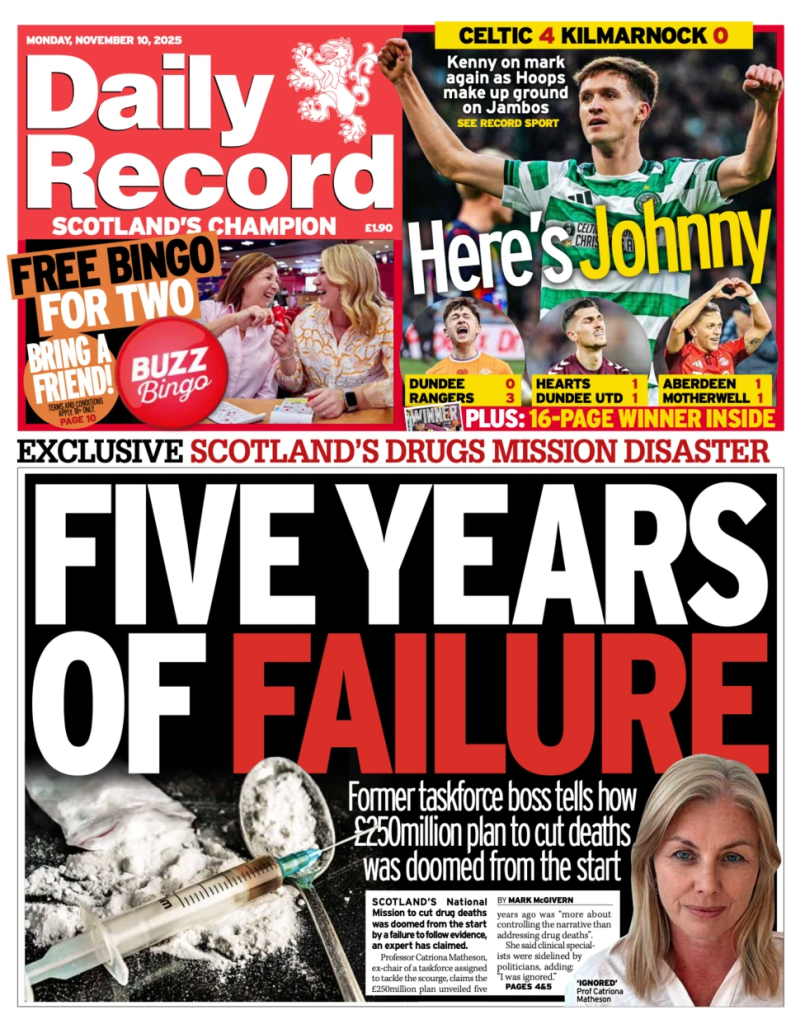
Professor John Robertson OBA
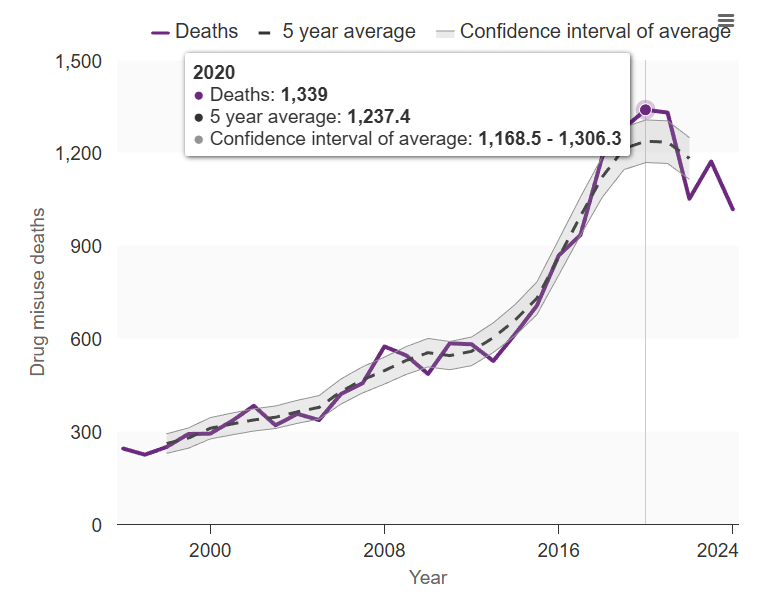
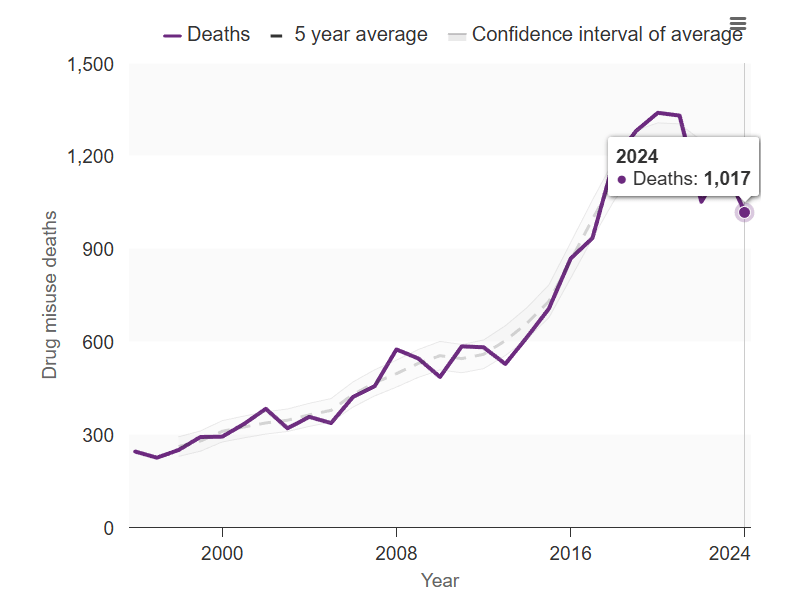
This is simply untrue. The drug deaths trend in Scotland has been downward for these last five years, from 1 339 in 2020 to 1 017. A 24.2% fall, by a quarter in only 5 years after more than 20 years of increasing, is very significant and suggests a successful strategy by government, which I’ll return to.
Here is the evidence in two graphs, for 2020 and 2025 from Drug-related deaths in Scotland, 2024, published on 2 September 2025: https://www.nrscotland.gov.uk/publications/drug-related-deaths-in-scotland-2024/
The full NRS report contains further evidence that this is a confirmed downward trend and notably reason for optimism regarding younger abusers. For example:
The age profile of drug misuse deaths has become older over time. The average age of drug misuse deaths has increased from 32 years in 2000 to 45 years in 2024.
Becoming addicted during the years of Tory and Labour governments, deaths among older abusers (35-54), due to cumulative effects of long-term drug abuse on their bodies make up 73% of the deaths.
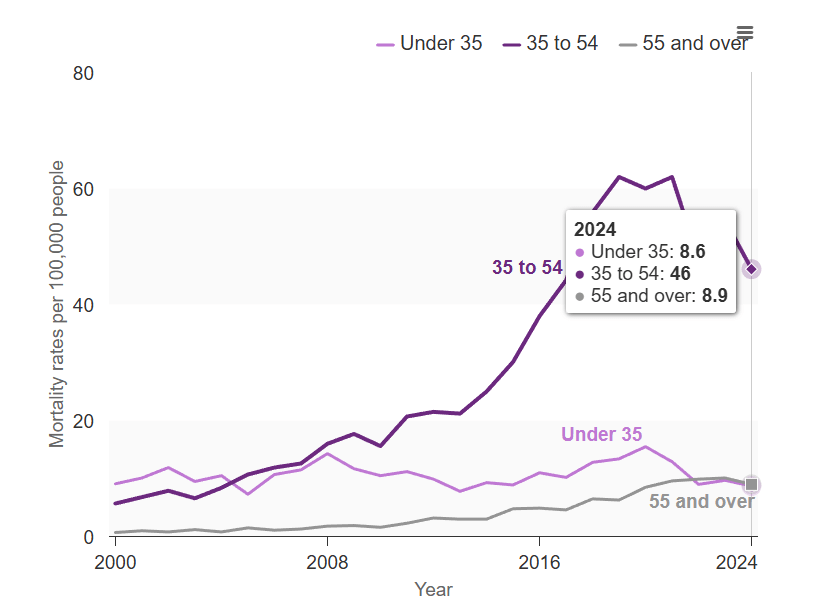
Sadly, very few make it to even 55 years of age and this is reflected in small number of over 54 year-olds in the figures.
Most encouraging is the failure of the under 35’s to surge and to fall to less than 10% of the total.
What explains this trend?
First, for years now 95-98% of drug abusers referred to NHS Scotland begin treatment within three weeks, more than half in only one week and nearly every part of Scotland hits or betters the 90% target:.
Second, drug-related hospital admissions plummet for third year in a row after Scottish Government’s ‘world-first’ opioid overdose reversal Naloxone initiative
https://www.sfad.org.uk/naloxone
Why is it not better?
First, Westminster refuses for years to allow safe injection rooms in Scotland despite early evidence:
The largest review ever undertaken, of 349 research studies, from across the globe though mostly in Europe, carried out by the Centre for Criminology at the University in South Wales in 2017, found that ‘safe’ or ‘supervised’ injection rooms significantly reduced drug-related harms, dramatically cut mortality and offered a range of benefits for the wider population, in terms of reduced crime, nuisance in public spaces, violence and trafficking.
chrome-extension://efaidnbmnnnibpcajpcglclefindmkaj/https://discovery.ucl.ac.uk/id/eprint/10106973/1/180320atisn12038doc2_0.pdf
Second, a BBC documentary links increase in drug-related hospital stays after three years of falling to surge in activity by County Lines drug gangs from England
https://www.bbc.co.uk/iplayer/episode/m001kzhq
Discover more from Talking-up Scotland
Subscribe to get the latest posts sent to your email.
 Talking-up Scotland
That DR headline is false. Fake News as You-Know-Who would say. Talking of which, that other purveyor of lies, the BBC, is having to report on itself again but this time in glaring headlines.
How the mighty have fallen.
How we laughed.
LikeLiked by 1 person
The problem with this statement, “Westminster refuses for years to allow safe injection rooms in Scotland” is that Scotland now HAS such a facility and Westminster had to CHANGE NOTHING to facilitate it.
Don’t you find it worrying that even someone as well-versed in theminutiae of Scottish governance as you are has overlooked that fact? All Westminster did was to say it wouldn’t intervene to prevent its operation, choosing not to try and use whatever powers it may have argued it had to do that.
At the time of the Glasgow drug policy summits in February 2020, a UK Government Minister, Kit Malthouse, stated that the Scottish Parliament and Government already had “all the powers they need” to operate a safe injection facility.
The fact is that for years it wasn’t Westminster that blocked the setting up of such a facility in Scotland. Whether out of opposition to the principle or political cowardice it was some person or some institution right here in Scotland that blocked it. And we should all know who that was!
LikeLike
Hi Anon, I’d prefer to respond to someone brave enough to come out.
The Scottish Government has long supported the establishment of supervised drug consumption facilities (also known as safe injection rooms) as part of its public health approach to tackling Scotland’s drug death crisis, which has seen record-high overdose rates. The concept gained urgency after a 2015 HIV outbreak among injecting drug users in Glasgow, leading to a 2016 health needs assessment recommending a pilot facility. However, drug classification and the Misuse of Drugs Act 1971 are reserved matters under the UK devolution settlement, meaning Westminster holds ultimate authority over legal amendments needed for such facilities.Westminster’s Conservative governments repeatedly opposed these plans, citing concerns over appearing “soft on drugs” and potential increases in drug supply from English gangs. This resistance effectively blocked early proposals:
As a result, a 2016 Glasgow pilot proposal stalled, with the Lord Advocate initially ruling that users could not be granted immunity from prosecution without UK legal changes.
Did Westminster “Block” the Plans?
This case highlights tensions in UK devolution, with the facility now serving as a potential model for evidence-based harm reduction. Early reports indicate it has supervised hundreds of injections with no overdoses on-site, though long-term evaluations are ongoing.
LikeLiked by 2 people
IIRC it was Dorothy Bain who announced in Holyrood that she would not press prosecution for taking illegal drugs in a safe consumption room. Class A drugs do remain illegal . Westminster has reserved the right to control drugs policy.
Lord Advocate defends Glasgow drug consumption room | The National
It may be that the previous Lord Advocate took a different view. Scottish ministers would have to obey the law.
LikeLike
And the BBC propaganda machine hire will still not show the facts of County Lines drug gangs or property Cuckooing.
Sent from Outlook for Androidhttps://aka.ms/AAb9ysg
LikeLiked by 1 person
So, did you know, I didn’t, of the possibility of that ‘workaround?’
LikeLike